

Every enforceable HOA snow removal contract needs six non-negotiable elements: a mapped scope of service, a numeric snow trigger, a defined response window, written de-icing standards, insurance naming the association as additional insured, and a documentation requirement with a pricing cap. Before signing anything, request a certificate of insurance, a sample service log, and a full attorney review of the draft. Skip any one of those steps and the board is negotiating blind.
TL;DR:
- Contracts should include detailed mapped service areas, clear trigger depths, and defined response times to prevent disputes and ensure coverage for all common areas.
- The trigger depth is usually set at 2 inches, with specific language needed to clarify whether multiple snowfall events are considered one or several billing periods.
- A hybrid pricing structure with a seasonal cap and overage rate balanced the risk of heavy snowfall and is recommended over per-push or flat fees alone.
- Insurance must list the HOA as an additional insured and exclude indemnification clauses that shift negligence onto the association.
- Proper documentation, including timestamped logs and calibration records, is essential for evidence during claims or liability investigations.
Table of Contents
- What Belongs in Your HOA Snow Removal Contract Checklist
- How Trigger Depth and Response Time Actually Work
- Choosing a Pricing Structure That Doesn’t Bankrupt Your Reserve Fund
- Insurance and Indemnification: What Actually Protects Your Association
- Documentation and Service Logs: Your Evidence If Something Goes Wrong
- Setting Performance Standards Your Contractor Can Actually Be Held To
- Environmental and De-icing Rules Worth Writing Into the Contract
- Termination, Force Majeure, and Renewal Terms Worth Negotiating
- Red Flags That Should Stop You From Signing
- A Board Member’s Honest Take on Getting This Right
- Get a Sample Contract and Site Walk From Denver Snow Removal
- Where to Verify Contract Standards Before You Sign
- Sources
- FAQ
What Belongs in Your HOA Snow Removal Contract Checklist
A snow removal agreement for HOAs should read less like a vendor quote and more like a risk allocation document, because that’s what it actually is. Work through these clauses in order, and don’t sign until each one has language specific to your property.
- Scope of service: Attach an exhibit map identifying every common area, sidewalk segment, parking row, clubhouse entrance, and mailbox kiosk covered. List exclusions (private driveways, balconies, individually owned patios) just as explicitly.
- Trigger depth: Set a clear numeric threshold, most commonly 2 inches for commercial-grade agreements, and define what counts as one storm event.
- Response windows: Separate primary routes (main drives, building entrances) from secondary areas (guest parking, side walkways), with different time commitments for each.
- De-icing standards: Specify materials, application rates, anti-icing pre-treatment timing, and storage requirements.
- Insurance and bonding: Set minimum liability limits, require additional insured status, and confirm workers’ compensation and commercial auto coverage.
- Indemnification: Push for contractor indemnity tied to contractor negligence, not a blanket clause that exposes the association.
- Pricing structure: Name it explicitly (per push, seasonal, hybrid) and cap seasonal exposure with a defined overage rate.
- Documentation: Require event logs, calibrated application records, and GPS or photo timestamps for every visit.
- Subcontracting and equipment: Disclose whether subcontractors will be used and confirm equipment capacity matches your property’s size.
The Community Associations Institute recommends contracts explicitly define service areas, trigger depths, response times, and ice-management protocols precisely because vague language is where most disputes originate.
How Trigger Depth and Response Time Actually Work
The trigger depth is the number that starts the clock. Most commercial and HOA contracts set it at 2 inches, a baseline the industry treats as the point where plowing becomes necessary rather than optional, according to Landscapey’s analysis of snow contract pricing. Below that threshold, contractors typically aren’t obligated to respond, which matters when you’re pricing per push.
Multi-day storms create the real ambiguity. Your contract should define whether continuous snowfall over 18 or 24 hours counts as one event or several, since that single definition can double or triple your invoice under a per-push structure.
- Priority routes (main entrances, fire lanes): 1 to 2-hour response window after trigger depth is reached
- Standard routes (guest parking, interior walkways): 2 to 4 hour response window
- Continuous snowfall: define a re-trigger interval (commonly every 2 to 4 inches of additional accumulation) rather than leaving it open-ended
Pro Tip: Ask the contractor for language like: “A single snow event is defined as one continuous snowfall period, or snowfall separated by less than six hours, regardless of total duration.” That single sentence prevents your board from getting billed for five invoices during one three-day storm.
Choosing a Pricing Structure That Doesn’t Bankrupt Your Reserve Fund
Pricing structure determines who eats the cost when a season runs heavy. Per-push billing puts weather risk on the association, since every plowable event generates a new invoice with no ceiling. Seasonal flat-fee contracts shift that risk to the contractor, who is betting the season stays average or light. A hybrid structure, seasonal with a defined event cap and per-push overage beyond it, tends to balance that risk more fairly for both sides, a structure recommended in Landscapey’s breakdown of per-push versus seasonal pricing.
- Pull one to two seasons of per-push invoice history if you’re switching structures, so your board negotiates from actual event counts rather than guesswork.
- Calculate a break-even cap: divide your target seasonal budget by the average per-push cost to find how many events the flat fee should reasonably cover.
- Write the overage rate into the contract itself, not a verbal understanding, specifying the exact per-push price once the cap is exceeded.
- Require itemized invoices showing date, depth recorded, and area serviced for every billed event, even under a seasonal contract.
Insurance and Indemnification: What Actually Protects Your Association
Insurance gaps are where HOA boards get hurt worst after a slip-and-fall claim. The Community Associations Institute advises that a compliant snow contract name the association as additional insured on the contractor’s commercial general liability policy, not just carry a generic liability limit.
- Require commercial general liability, workers’ compensation, and commercial auto coverage as separate line items, not bundled assumptions.
- Confirm the certificate of insurance lists your HOA by legal name as an additional insured, delivered before the contractor sets foot on the property.
- Avoid indemnification language that requires your association to cover claims arising from the contractor’s own negligence. Push for contractor-side indemnity instead, and have counsel confirm enforceability in your state.
- Set a renewal reminder tied to the policy’s expiration date, since a lapsed COI mid-season leaves the association uninsured without anyone noticing.
CAI resources on snow removal policy risk point to hiring uninsured contractors, including well-meaning neighbors with a plow attachment, as one of the most common liability exposures boards create without realizing it.
Documentation and Service Logs: Your Evidence If Something Goes Wrong
Service logs aren’t paperwork for its own sake. They’re the evidence your association needs if a resident falls and claims negligence. CAI’s maintenance guidance ties documented preventive maintenance and recordkeeping directly to demonstrating reasonable care.
- Require timestamped arrival and departure logs for every service visit, with recorded snow depth at the time of dispatch.
- Ask for calibration records on spreaders and de-icing equipment, following the operator training model used in the City of Edina’s snow and ice management contract.
- Set a retention period of 3 to 5 years for all logs, tied directly to your invoice records.
Pro Tip: Ask upfront whether logs include GPS-stamped photos. A contractor already using that system will show you a sample without hesitation.
Setting Performance Standards Your Contractor Can Actually Be Held To
A snow removal agreement without measurable performance standards is a handshake with extra paperwork. Quantify what “cleared” means.
- Commit to a specific hour count for primary route clearance after the storm officially ends, not after it starts.
- Define remedies for missed windows, service credits, mandatory make-good visits, or a documented cure period before termination becomes an option.
- Require notice if subcontractors are used on your routes, and disclose how many other properties that crew services during the same storm.
- Include a warranty clause covering damage to plantings, curbs, irrigation heads, and concrete from plow blades or de-icing chemicals, with a repair timeline attached.
Environmental and De-icing Rules Worth Writing Into the Contract
De-icing decisions affect your landscaping budget and your liability exposure at the same time. The City of Edina’s model contract builds a “Best Practices” section directly into its template, requiring operator training and calibrated application to limit chloride runoff and salt damage.
- Specify approved de-icing products and maximum application rates per square foot.
- Require documented storage and containment standards for bulk salt or liquid brine.
- Assign responsibility for concrete spalling or plant damage caused by over-application.
- Ask for a materials log noting product type and quantity used after every event.
Termination, Force Majeure, and Renewal Terms Worth Negotiating
Most disputes that end up with a board calling counsel trace back to a contract with no clear exit path. Build these terms in from the start.
- Set cause and no-cause termination notice at 30 to 60 days, spelled out in writing rather than left to a phone call.
- Define force majeure narrowly, covering genuine weather extremes and equipment failure beyond routine storms, not ordinary snowfall the contractor simply failed to staff for.
- Require 60 to 90 days’ renewal notice with any price escalation stated as a percentage, not left open.
- Include an amendment procedure for adding services mid-season, like snow hauling or roof clearing, without renegotiating the entire agreement.
Red Flags That Should Stop You From Signing
- Vague scope language, no trigger depth, or refusal to produce a certificate of insurance before the season starts.
- Blanket indemnification clauses that shift the contractor’s own negligence onto your association.
- No documentation requirement anywhere in the draft, meaning no way to verify service after the fact.
- A vendor unwilling to accept a reasonable cure period or disclose subcontractor use.
- Any request that your board sign a vendor-drafted “proof of performance” waiver limiting future claims. That’s a legal document dressed up as routine paperwork.
A Board Member’s Honest Take on Getting This Right
Most boards treat the snow contract as a seasonal formality, something to renew every August without much thought. That’s backward. It’s one of the few vendor agreements tied directly to slip-and-fall liability, and a poorly worded scope clause can cost more in one lawsuit than five years of seasonal fees combined.
Before signing anything, schedule a physical site walk with the contractor, ask for a sample COI in writing, and if you’re switching from per-push to seasonal, pull at least one full season of invoice history first. Then send the draft to counsel. Many experienced snow removal companies have spent decades handling HOA and commercial contracts across metro areas, and the boards that negotiate hardest up front are consistently the ones who never call with a claims problem later.
— Jesse
Get a Sample Contract and Site Walk From Denver Snow Removal
Some snow removal vendors provide HOA boards with documented service logs including timestamps, calibrated application records, and certificates of insurance naming the association as additional insured before contracts are signed. Instead of guessing at trigger depths or response windows from a generic template, you get a free site walk of your property’s actual common areas and a sample contract you can hand straight to your attorney for review.
With over 44 years of experience serving Denver Metro properties, the team knows what a mapped exhibit for a multi-building HOA needs to cover, from clubhouse entrances to mailbox kiosks, and how to price a seasonal snow removal contract with a realistic event cap instead of an open-ended per-push exposure. If your board is comparing structures, the parking lot and HOA service page walks through typical response standards and documentation practices in more detail. Call to request your free estimate and sample contract language before your next board meeting.
Where to Verify Contract Standards Before You Sign
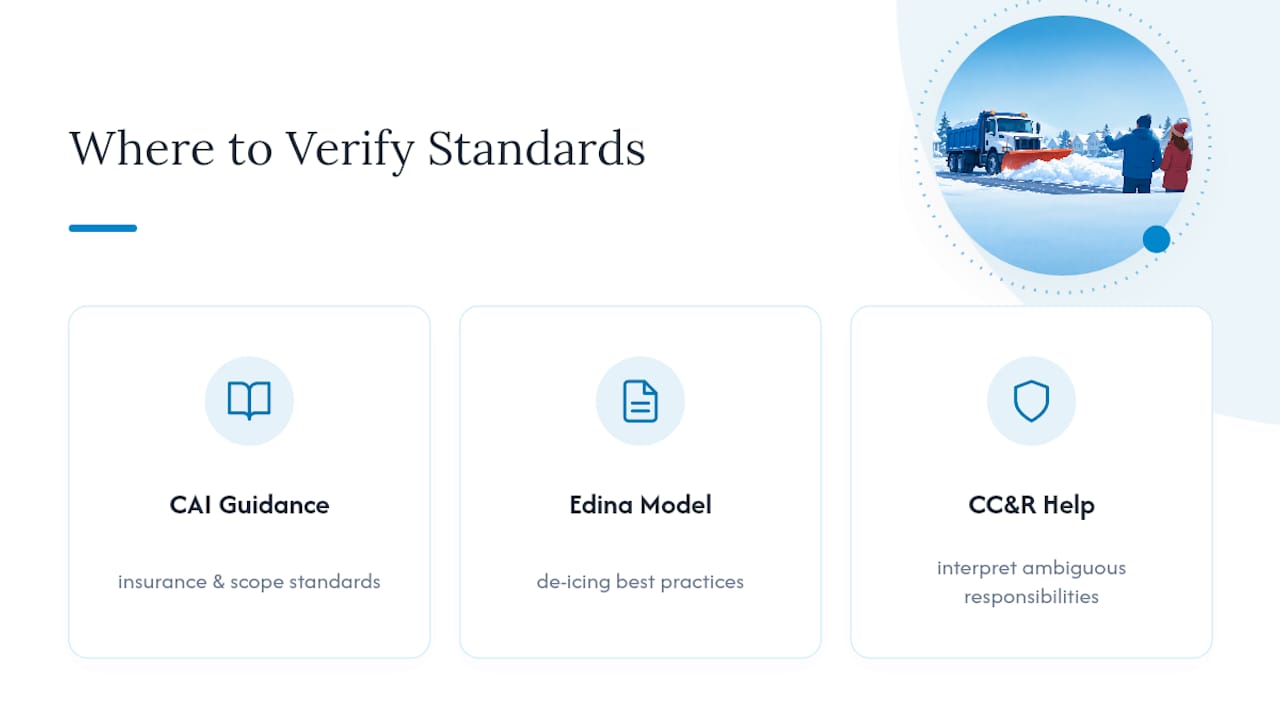
For drafting language your attorney can redline efficiently, lean on the Community Associations Institute’s snow removal guidance for insurance and scope standards, the City of Edina’s model snow and ice contract for de-icing best practices, and CC&R interpretation resources like HOA Letter AI’s guide to referencing governing documents when scope disputes touch on ambiguous responsibilities.
Sources
- HOA tips for handling snow removal — Community Associations Institute
- Model snow & ice management contract — City of Edina
- Best practices and maintenance standards — CAI resources
- Snow Removal Contract: Per Push vs Seasonal, Priced Out — Landscapey blog
FAQ
Are HOAs Responsible for Snow Removal?
Responsibility depends entirely on the association’s CC&Rs and declaration, which typically assign common-area snow clearing to the HOA while leaving private driveways to owners. Boards should confirm this in their governing documents before assuming scope, since ambiguity here is where most liability disputes start.
What Should Be Included in a Snow Removal Contract?
At minimum, the agreement needs a mapped scope of service, a numeric trigger depth (commonly 2 inches), defined response windows, de-icing material standards, insurance with additional insured status, and a documentation requirement with a pricing cap. The Community Associations Institute recommends all of these appear explicitly in writing rather than as verbal understandings.
How Much Is a Typical Snow Removal Contract?
Costs vary widely by property size, trigger depth, and structure, since per-push, seasonal, and hybrid agreements each allocate weather risk differently. Denver Snow Removal’s residential clearing starts from $41.25 per visit for driveway and walkway service, while commercial and HOA seasonal contracts are quoted after a site walk since scope and route counts differ so much property to property.
Are HOA Snow Removal Contracts Legally Binding?
Yes, once signed, a snow removal agreement is a legally binding contract that can be enforced in court, which is exactly why vague clauses create real exposure. Any indemnification, insurance, or scope language should go through attorney review before the board signs, since these terms directly affect liability if a resident is injured.