
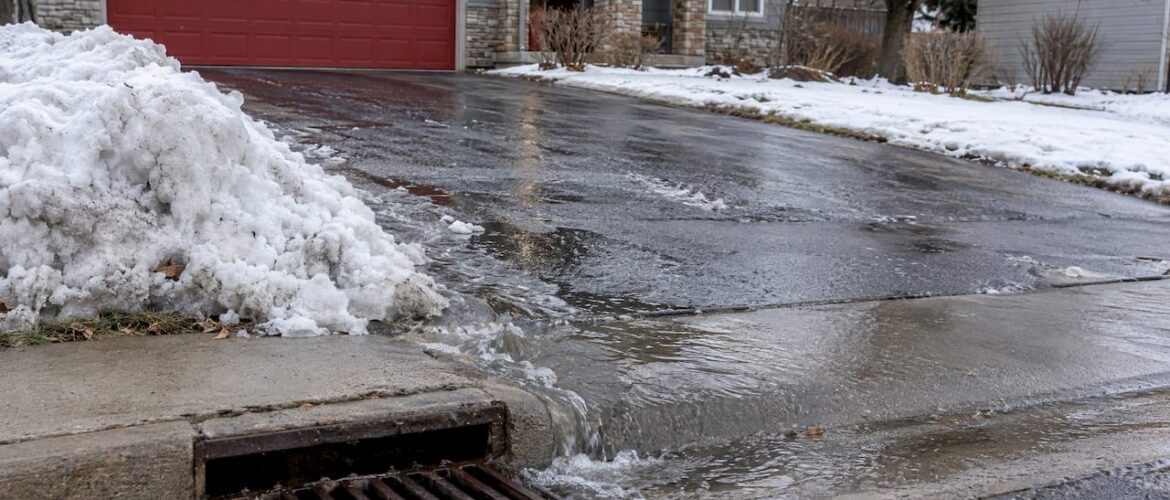
Meltwater needs somewhere to go, and when it can’t reach a drain it pools, soaks toward your foundation or refreezes into ice on walkways and parking stalls. The fix is mostly about three things: keep drains and downspouts open, put snow where its meltwater drains away from where people walk and park, and treat lots and walkways before the evening refreeze. This guide covers each, for homes, HOAs and commercial lots in the Denver area.
TL;DR
- Frozen or blocked drains, frozen ground and daily freeze-thaw cycles are why meltwater pools and turns to ice.
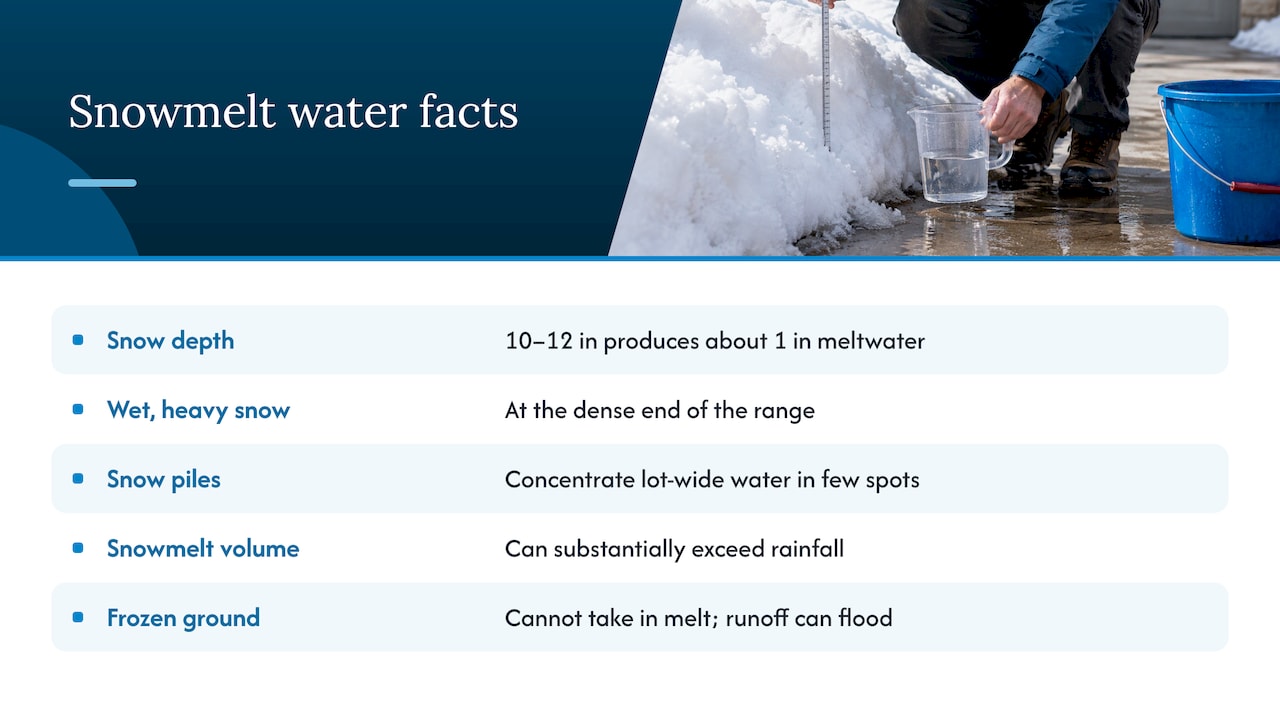
- About 10 to 12 inches of snow makes roughly one inch of water, so a big pile is a lot of water to place.
- Never pile snow on storm drains, and clear downspouts and inlets before a thaw.
- On parking lots, push snow downhill and away from entrances, and keep meltwater from crossing walking areas.
- If standing water or ice keeps returning at the same spot, it’s time for a professional assessment of the site.
Table of Contents
- Why melting snow causes drainage problems
- How much water is in a pile of snow?
- Before the thaw: a homeowner’s drainage checklist
- Parking lot drainage after snow
- Stopping meltwater from refreezing
- After a flood or heavy runoff event
- Fixes that go beyond snow management
- Denver-specific points for property owners
- Our perspective
- Let us handle the snow and the meltwater plan
- FAQ
- Sources
Why melting snow causes drainage problems
Snow is stored water. It builds for weeks, then releases during a warm spell. The Minnesota Stormwater Manual describes the core problem as a volume of water that builds for months and then releases suddenly, either in spring or during short warm periods all winter.
Several things make that release hard to handle on a property:
- Drains that are still frozen. Storm drains and catch basins can be partly frozen or only beginning to open, which causes temporary pooling in low-lying areas until drainage fully opens and temperatures settle.
- Gutters and culverts that freeze. Freeze-thaw cycles through winter and spring mean that gutters, catch basins and culverts can freeze and block water from draining off streets.
- Frozen ground. When soil freezes, its surface is sealed over and it absorbs less liquid water, which means more surface runoff. Lawns that would soak up a light rain can act more like pavement.
- Refreezing. Snow melts in the afternoon sun and the runoff freezes again overnight, often exactly where it crosses a sidewalk or pools at a lot entrance.
Denver gets plenty of sunny days after a storm, which makes the daily melt-and-refreeze pattern the one to plan around. Water that was harmless at 2 p.m. is a slip hazard at 6 a.m.
How much water is in a pile of snow?
A rough rule from the University of Minnesota Water Resources Center is that 10 to 12 inches of snow produces about one inch of meltwater, depending on how light or heavy the snow is. Wet, heavy snow sits at the dense end of that range.
That is useful for planning. A foot of snow across a 5,000 square foot lot is not a trivial amount of water, and plowing concentrates it. Push the snow from the whole lot into a few piles and you have put that entire volume in a handful of spots. Where those piles sit decides where the water goes.
The volume matters beyond your property line too. The Minnesota Stormwater Manual notes that the total volume of a snowmelt can be substantially more than rainfall, even though it comes out over a longer period. And if several storms stack up and melt all at once, the result can be a major runoff event and flooding, because frozen ground can’t take it in.
Once the ground thaws and saturates, there is another effect: soil that normally absorbs water can become effectively impervious, so all additional melt runs off.
Before the thaw: a homeowner’s drainage checklist
Most home meltwater trouble is preventable in about 20 minutes, ideally before the first warm day after a storm.
- Clear snow from around downspouts. The Pittsburgh Water and Sewer Authority advises clearing snow around downspouts so roof melt can flow instead of collecting at the foundation, which helps prevent basement flooding.
- Find the nearest storm drain and keep it clear. Penn State tips, summarized by the University of Nebraska-Lincoln, say to make sure nearby storm drains are clear and never pile snow on them. Boulder County’s own procedures say the same: don’t pile snow in front of storm sewer inlets and clear ice from gutters and inlets so snowmelt can flow in.
- Choose your pile locations. Put snow where it will soak in when it melts. The same Pittsburgh guidance suggests relatively flat areas that don’t typically pond during rainstorms. In practice that means lawn areas away from the foundation, window wells and the driveway apron, not the low corner where the yard already collects water.
- Check where your roof water lands. Downspouts that discharge onto a walkway or driveway will put ice exactly where you step. Well-fitted seamless metal gutters and downspout extensions that carry water away from paths and the foundation help limit water accumulation during a thaw.
- Use deicer sparingly. More salt does not melt more snow. Sweep up what remains after the ice melts, per the Nebraska guidance. Boulder County likewise calls for only the recommended amount of deicer on lots, driveways and sidewalks.
Our own homeowner photo of snow placed on a lawn away from a drain shows the idea in a single frame: the snow goes on the grass, and the drain stays visible and open.
Driveway berms and cul-de-sacs
When a city plow passes, it leaves a ridge of heavy snow across the end of your driveway. That berm is also a dam. Meltwater can back up behind it, spill across the apron and freeze. If you live on a cul-de-sac, the piles are bigger and last longer. Our guide to cul-de-sac snow removal and driveway berms explains how to deal with them, and our driveway windrow removal service clears the plow berm so water has a path to the street gutter rather than into your garage door track.
Gravel and landscaped areas
Meltwater running across gravel can carry material with it, and plowing too low scrapes it away in the first place. See our notes on protecting a gravel driveway during snow removal, which cover keeping a blade clearance of 0.5 inches.
Parking lot drainage after snow
Lots are harder than driveways. They are large, they are paved, and meltwater from a plowed pile can cross a long stretch of pavement to reach a drain. Every one of those feet is a place for ice to form.
Where to put the snow
The Connecticut Transportation Institute’s guide for parking lots and sidewalks recommends plowing and blowing snow to the downhill sides of lots and walkways so meltwater doesn’t flow back over areas where people park and walk. It also advises clearing catch basin drains and leak-offs, and checking that roof gutters don’t discharge onto pedestrian paths.
The Minnesota Stormwater Manual adds three rules for storage areas:
- Don’t store snow on top of drain inlets or in stormwater treatment facilities.
- Make sure meltwater from the pile won’t drain onto sidewalks, roads or other places where it could freeze during thaw-freeze cycles.
- For snow likely to carry pollutants, such as commercial lots and roads, store it on an impervious surface that drains to a stormwater treatment facility.
That last point is worth noting: snowpack accumulates soluble pollutants near its base, so the early part of a melt releases a disproportionate share. Pile placement is a drainage decision and a runoff-quality decision.
Grading and catch basins
Some ponding is built into the pavement. The Lake Simcoe Region Conservation Authority’s parking lot guidelines say that slopes under 2% raise the risk of depressions that pool water and form ice, and recommend 2% to 4% to minimize them. They also recommend laying out catch basins so meltwater travels only a short distance before leaving the surface. Good grading also reduces the need to re-apply salt.
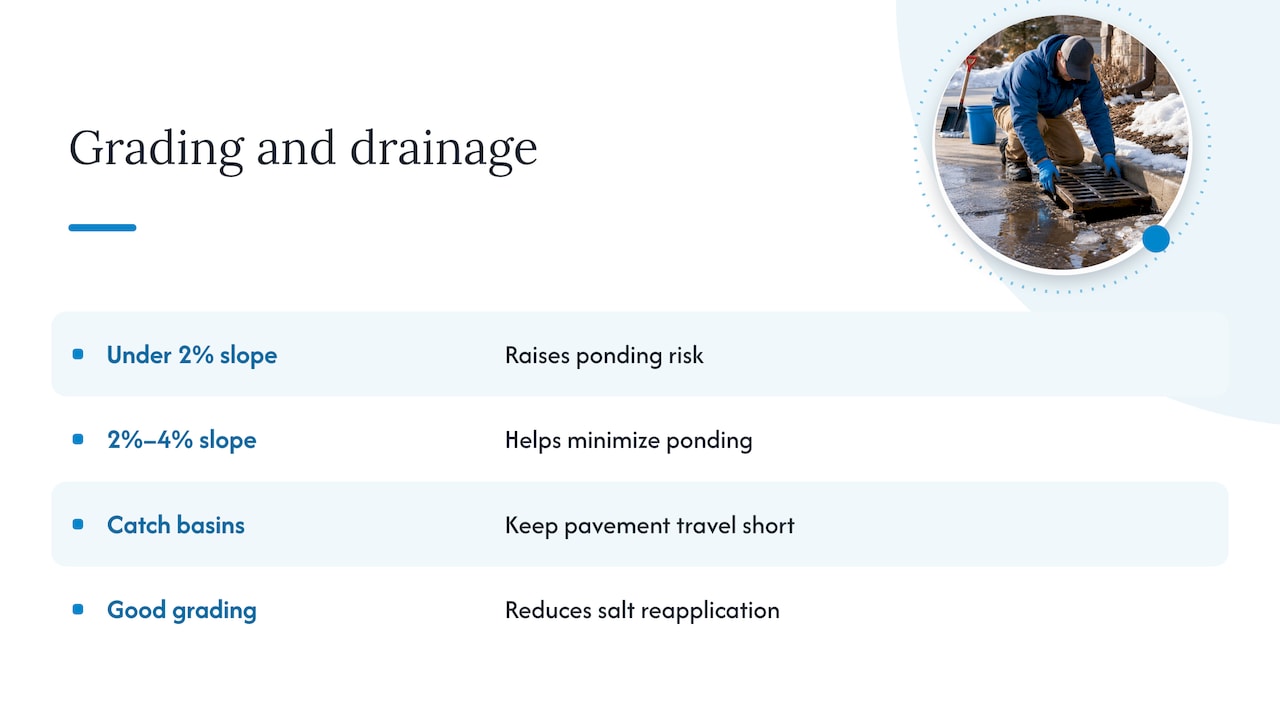
Those are Ontario guidelines, but the physics is the same in Denver. You can’t re-grade a lot between storms, but you can notice where a lot ponds and plan around it. A sloped lot brings its own plowing and ice-control questions, which we cover in sloped parking lot snow removal.
A simple lot walk-through
After a storm, before the first big melt, walk the lot with a manager’s eye:
| What to check | Why it matters | What to do |
|---|---|---|
| Catch basins and inlets | A blocked inlet turns a lot into a pond | Clear snow and ice off the grate; ask your plow crew to keep piles off them |
| Pile locations | Meltwater runs from piles to the lowest point | Keep piles downhill of parking and walkways, not uphill of entrances |
| Entrances and crosswalks | Runoff crossing a walking path refreezes overnight | Pretreat or de-ice these spots before dusk |
| Roof downspouts and drip lines | Roof melt lands on walkways | Redirect or extend downspouts; re-check after each thaw |
| Low spots and depressions | Water pools and freezes in the same places each time | Log them with photos; raise them with the property owner or an engineer |
If a lot is large or you manage several, hauling the snow off site is often the cleanest drainage answer, because the water never arrives on your pavement at all. See our pages on snow hauling and disposal in winter contracts and snow stacking and relocation for large volumes.
Stopping meltwater from refreezing
Drainage and de-icing work as a pair. Water that can’t be drained has to be kept from freezing where people walk. Three practices make the difference:
- Anti-icing before the storm or before the evening refreeze. Applying treatment ahead of time keeps ice from bonding to pavement, which makes later clearing easier.
- De-icing the spots where water crosses a path. Entrances, ramps, the bottom of downspouts and the low end of a slope are the usual trouble spots.
- Right-sized application. Over-salting doesn’t speed melting, and it leaves residue to sweep up. Our guides on commercial de-icing in Denver and parking lot salting, safety and liability go into timing and documentation.
Underground garages have their own version of this problem: melt drips off vehicles, ramps carry water down, and floor drains can ice up. Our page on underground parking garage snow and ice control covers it.
After a flood or heavy runoff event
If meltwater has already gotten into a garage, shed or yard, the cleanup comes first: wet debris, damaged items and silt need to be cleared out so water can move and nothing sits and rots. A guide on flood debris removal, what to do first lays out the order of operations for a homeowner.
Fixes that go beyond snow management
Sometimes careful pile placement and clear drains aren’t enough. If water pools in the same place every thaw, enters a basement or erodes soil, the cause is usually the site itself: low grade, a downspout dumping next to the foundation, or a drain that is undersized for the area it serves. Regrading, surface drains, French drains and dry wells are the usual categories of fix, and each suits a different problem. Which one fits depends on soil, slope and where the water can legally and safely go, so that is a question for a drainage or civil contractor who can assess the property. We plow and haul snow; we don’t build drainage systems, and we’d rather tell you that than guess.
What we can do is give a drainage contractor useful information. Take photos of where water pools and refreezes after a thaw, note how long it takes to drain, and mention where the snow was piled. That record often shows whether a problem is a pile-placement issue, which we can fix on the next visit, or a grading issue, which needs a different specialist.
Denver-specific points for property owners
A few local facts are worth knowing:
- Storm drainage and snowmelt are one system, and you pay for it. The City and County of Denver’s wastewater FAQ states that storm drainage charges cover collection and disposal of rain water and snow melt, that storm drainage and sanitary sewers are two independent systems, and that the charge is based on a property’s ratio of impervious surface to total parcel area. The more pavement, the more meltwater your property sends to the storm system. Don’t send meltwater or melting piles toward a sanitary sewer cleanout.
- Building work needs a drainage plan. Denver requires a detailed storm drainage plan before a building permit is issued for a building or structure, unless a written variance is approved, according to a summary of Denver’s stormwater rules. If you are adding pavement, a patio, an addition or a regraded yard, confirm requirements with the city first.
- Storm inlets are public infrastructure. Piling snow over one can flood a street and your neighbor’s driveway. Keep piles off them, as the Boulder County procedures also direct.
Snowmelt flooding is a recognized hazard in colder parts of the country: the National Weather Service notes that it happens most years in the northern United States, mostly minor and localized, with frozen ground, heavy snow cover, rain during the melt and rapid melting among the causes. In Denver, the common version is smaller but still costly: a flooded window well, an iced entrance, a pooled low corner of a lot.
Our perspective
Meltwater problems are rarely about the melt. They are about where the snow was put three days earlier.
In our 44 years plowing across the Denver metro area, the most repeated mistake we see is piling snow in the most convenient place instead of the most sensible one: against a downspout, over a drain, uphill of an entrance. The plow did its job, and the thaw then undid it.
That’s why we plan a site before the first storm. We look at where water will run, where it will refreeze and where the piles can sit without feeding it back onto walkways. Commercial-grade equipment that can clear a lot in one pass helps, because fewer passes mean more control over where the snow ends up. When a lot is too tight to stack safely, we haul the snow away.
We also document our visits, so if a slip-and-fall question comes up, a property owner has a record of when the lot was plowed and treated. And because we dispatch around the clock, a refreeze at 2 a.m. doesn’t have to wait until morning.
Jesse
Let us handle the snow and the meltwater plan
We provide snow plowing and removal for homes, HOAs, apartment communities, offices, retail centers and industrial properties in Denver, including anti-icing pre-treatment, ice management and de-icing, sidewalk clearing and snow hauling. Seasonal contracts run September through May, and we offer free estimates and same-day service for new and existing clients. Residential driveway and walkway clearing starts from $41.25 per visit.
For lots and driveways, see our parking lot snow removal and de-icing services, or request an estimate for your property at denversnowremovals.com.
FAQ
Is snow melt bad for your driveway?
Meltwater itself is not the issue; repeated freezing and thawing is. Water that seeps into cracks and refreezes can widen them, and heavy salt use can leave residue that you should sweep up. Keeping water moving off the surface and applying only the recommended amount of deicer is the safest approach.
How much water does 10 inches of snow melt down to?
A rough estimate from the University of Minnesota Water Resources Center is that 10 to 12 inches of snow yields about one inch of water. So 10 inches of snow is usually somewhat under one inch, depending on whether the snow is light and fluffy or wet and heavy.
Where should I put snow so it drains properly?
Put it on relatively flat ground that doesn’t usually pond, away from the foundation, storm drains, window wells and walkways. On a lot, push it downhill so meltwater doesn’t run back over parking and walking areas, as the Connecticut guide recommends.
Why does meltwater pool and then freeze at my entrance?
Usually a low spot, a blocked inlet or a pile sitting uphill sends water to the entrance during the day, and temperatures drop at night. Clear the nearest drain, move the pile if you can, and pretreat the spot before dusk. If it happens at the same place every thaw, have the grade assessed by a drainage professional.
Sources
- Understanding cold climate impacts on runoff management, Minnesota Stormwater Manual
- Snowmelt Management, City of Grande Prairie
- Drainage and Stormwater, Town of Morinville
- Snowmelt and rain, where does it drain? University of Minnesota Water Resources Center
- Melting Snow is Stormwater Run Off, UNL Water
- Stormwater tip: snow and ice removal, Pittsburgh Water and Sewer Authority
- Municipal Operations stormwater standard operating procedures, Boulder County
- A Guide for Parking Lots and Sidewalks, Connecticut Transportation Institute
- Guidance for storing transported snow and onsite snow storage, Minnesota Stormwater Manual
- Parking Lot Design Guidelines to Promote Salt Reduction, Appendix A, LSRCA
- Wastewater Questions and Answers, City and County of Denver
- Stormwater Management in Denver, CO, CityRuleLookup
- Snowmelt Flooding factsheet, National Weather Service
- Seamless metal and copper gutters
- Flood debris removal: what to do first