
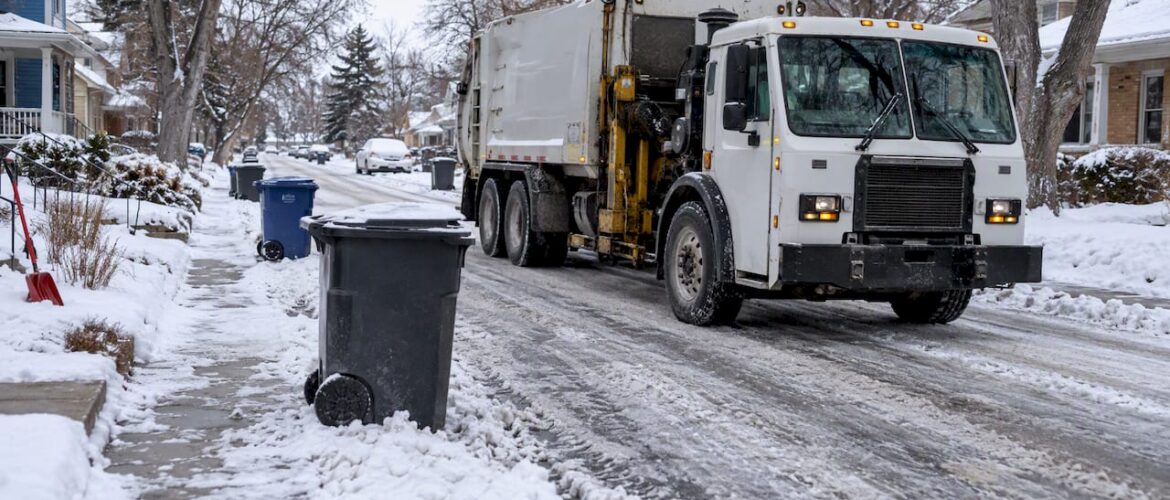
When snow hits Denver, curbside trash and recycling pickup may be delayed, and a cart buried in a plow berm may be skipped even on a day when trucks do run. The city’s own schedule page says inclement weather may cause service delays, so the practical answer is to check your status, leave carts out until they are emptied, and keep a clear, reachable spot at the curb. This guide walks through each step, explains why crews sometimes pass a street by, and shows where a professional snow service fits in.
TL;DR
- Denver’s rules allow trash collection to be skipped where severe weather exists, and late pickups are made as quickly as reasonably possible, so a delay is normal after a big storm.
- Carts need to be at the curb by 6 a.m. on collection day, no earlier than 7 p.m. the night before, with 2 feet of clear space on all sides.
- If your pickup is missed because of snow, leave the cart at the curb unless your hauler or city says otherwise, and use the official app or phone line to check status.
- The plow berm at the end of your driveway is the most common reason a cart gets blocked. Clearing it, or hiring someone to, solves the problem.
Table of Contents
- Why snow disrupts curbside pickup
- How to check whether your pickup is running
- Setting out your cart in winter
- The plow berm problem
- What to do when pickup is missed
- Perspective: what we see from the plow side
- Dumpsters, HOAs and shared properties
- Safety: for you and for the crew
- When to call a professional
- A simple plan for the next storm
- FAQ
- Sources
Why snow disrupts curbside pickup
A collection truck is heavy, wide and slow to stop. A street that looks fine to your SUV may not be fine for a loaded truck on packed ice.
Denver’s 2025 trash rules say that collection may not be provided where severe weather conditions exist, and that delayed collection is made in the most reasonably expedient manner, as determined by the Manager of the Department of Transportation and Infrastructure or an authorized representative. In other words, the rule is built around safety and practicability, not a fixed promise of same-day service.
The hauler side says the same. Waste Connections’ Denver winter guidance explains that snow, ice, freezing rain and extreme cold can make routes inaccessible, and that drivers may decline service to protect people and property even when a road appears drivable to a passenger car. A driver who skips your block is usually making a safety call about a grade, a narrow street, or a parked car that has become part of a snow wall.
Three things typically cause a missed pickup after a storm:
- The street. Unplowed or icy residential streets, steep blocks, and alleys the truck cannot enter safely.
- The cart’s position. A cart set behind a plow berm, in a snowbank, or too close to a car or pole cannot be lifted by the truck’s arm.
- The schedule. Crews run behind after a storm and work through a backlog, so your day may simply slide.
How to check whether your pickup is running
Do not guess based on whether your street has been plowed. Check the source.
In the city and county of Denver, you can sign up for notifications on the free Trash and Recycling app to get collection reminders. The same page warns that bad weather may cause delays.
If Waste Connections serves your address, the company says customers should check inclement-weather updates on its Denver website, mobile app and telephone greeting.
In nearby cities, the approach varies. Longmont’s official schedule page notes that rare extreme weather, including snow, ice or wind, can affect trash, recycling and compost collection, and residents can sign up for service alerts through the online calendar. If you live in a suburb, look for your own city’s alert system or your HOA’s hauler instructions rather than assuming Denver’s rules apply.
Some cities go further than Denver. Washington, D.C. publishes a Collection Status Map where you enter an address and see separate trash and recycling days and route status, updated through the service day. It separates delayed routes, still expected that day, from carried-over routes collected the next day. Denver does not necessarily offer that level of detail, which is one more reason to sign up for the alerts you do have.
Trash and recycling may not move together
Denver’s rules say that trash and compost are collected weekly, while recycling is collected every other week. After a storm, that matters. A delayed trash day may be made up quickly, while a missed recycling day could mean waiting for the next cycle. Before you decide what to do with a full recycling cart, check the status for that specific service rather than assuming it follows the trash truck.
Setting out your cart in winter
The standard rules do not relax just because it snowed. If anything, they matter more, because snow is what usually breaks them.
Denver’s cart guidelines require carts to be out by 6 a.m. on collection day, but no earlier than 7 p.m. the night before, with 2 feet of clearance on all sides and no overhead obstructions. The same page lists what blocks automated pickup: cars, fences, poles, overflow material, large items, other carts, garage overhangs and gutters.
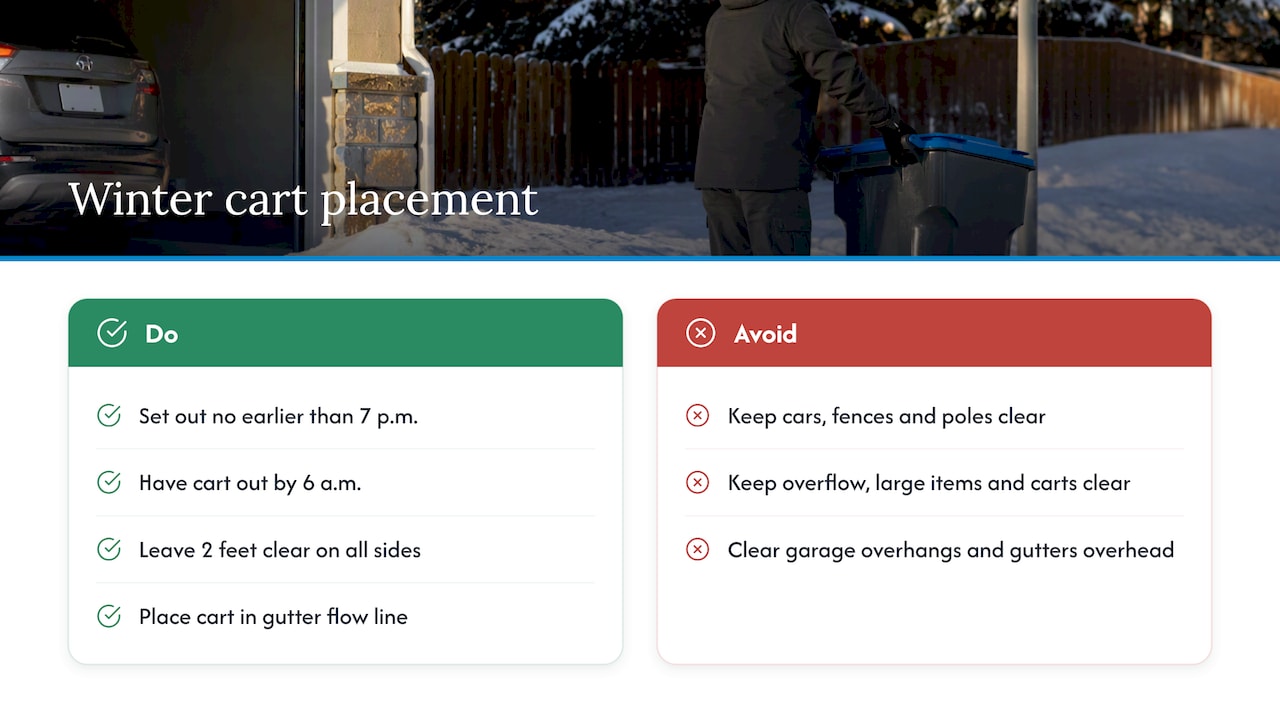
The city’s rules also call for automated-collection carts to be placed in the flow line of the gutter at the start of collection hours and stored on your property on noncollection days. That is exactly where plows push their snow.
A winter set-out checklist
| Step | What to do | Why it matters |
|---|---|---|
| Check the forecast the night before | Look at your app or hauler alert before dragging carts out | Avoids leaving carts in a storm if service is suspended |
| Clear the spot | Shovel a flat pad at the curb or gutter line | The truck’s arm needs level, open ground |
| Keep 2 feet on all sides | Leave space between carts, cars, mailboxes and snowbanks | Denver lists these as pickup blockers |
| Look up | Check for icicles, branches, or garage overhangs above the cart | Overhead obstructions can stop automated pickup |
| Keep lids closed | Do not stack bags on top or overfill | Denver says overfilled, stuffed or too heavy carts cannot be emptied |
| Clear a path | Shovel from your door or garage to the cart | Lets you set out and retrieve carts safely |
One cold-weather tip: wet trash can freeze to the cart walls, and a frozen load may not dump. Keeping the cart in a garage until the evening before and avoiding pouring liquids into it are simple ways to reduce that risk.
What other cities require
Some cities put the snow-clearing duty in writing. Minneapolis requires residents to clear snow around carts before the next pickup and, after a snowfall of 2 inches or more, within 24 hours. It also specifies a path at least 3 feet wide from the cart to the alley or curb, and tells residents to clear snow left by plows so carts can move freely. Those are Minneapolis rules, not Denver rules, but they describe a good standard to aim for anywhere you live.
The plow berm problem
If you live on a street the city plows, the blade pushes a ridge of heavy, compacted snow along the curb. It often lands right where your cart belongs and across the bottom of your driveway.
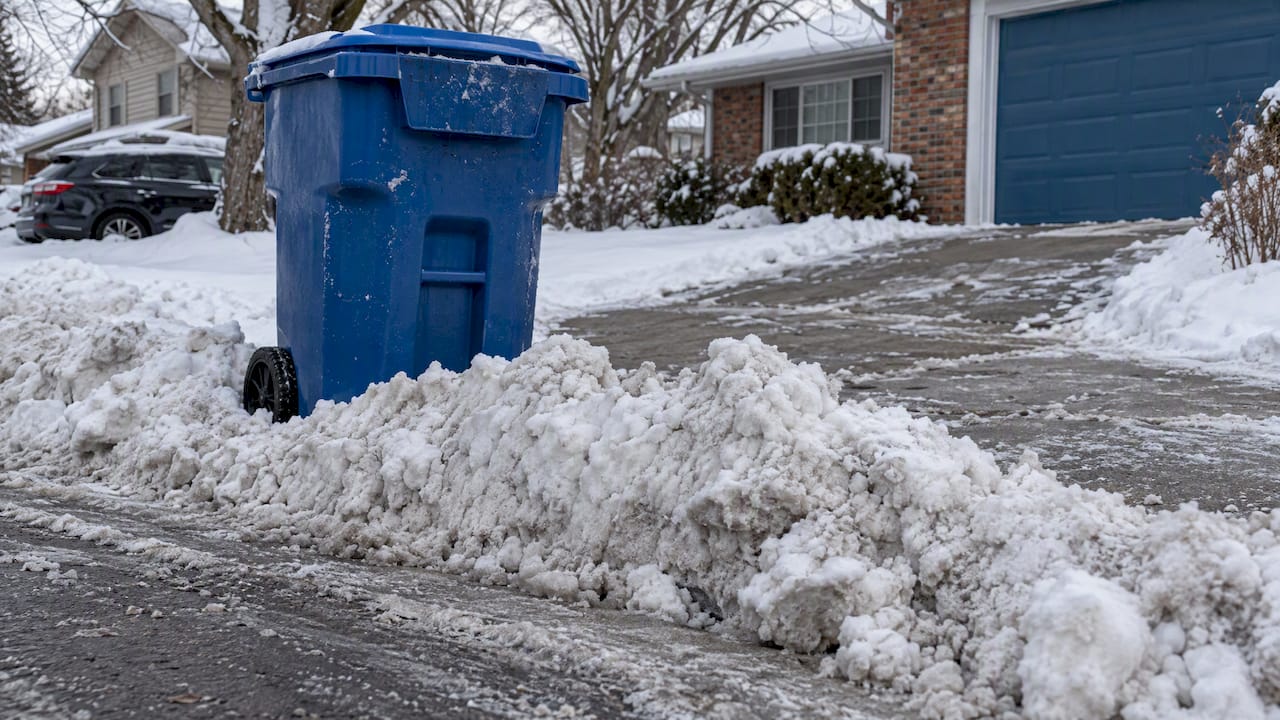
That ridge is the most common reason a Denver cart is passed over on a day the truck is running. It is also the reason residents carry carts across an icy street, or leave them in the lane, which creates its own hazard for plows and neighbors.
Your options:
- Shovel a gap by hand. Cut a pad at least wide enough for a cart plus 2 feet on each side. Plow-packed snow can be dense and icy, so lift in small amounts and take breaks.
- Place the cart on your side of the berm only if it stays reachable and out of the roadway. Check your city’s rule first, since Denver’s cart guidance points to the gutter line.
- Hire out the berm. A skid steer clears a windrow quickly and cleanly. We cover the method in our guide to driveway windrow removal in Denver.
If you share a driveway or a private street, the ridge is easier to deal with proactively than after the pickup is missed.
What to do when pickup is missed
The first rule is not to panic. Hauling backlogs after a storm are normal.
- Check status. Open the Denver app, the hauler’s app, or your city’s alert page to see whether your route was delayed, suspended or carried over.
- Leave the cart out, unless told otherwise. Montgomery County, Maryland, tells residents that when collection is suspended for snow, they should leave items at the curb until service occurs. D.C. likewise tells residents to leave carts out unless a specific event message says otherwise. Denver’s rules say carts should be stored on your property on noncollection days, so if you are unsure how long to wait, check your own provider’s message and the city guidance first.
- Fix what you can. If the cart was blocked, open the space and make sure nothing sits within 2 feet.
- Report it if the route ran and your cart was skipped. Longmont, for example, tells residents with a missed collection (other than for a listed scheduling or set-out reason) to contact Waste Services. In Denver, use the city’s channels or your hauler’s customer line.
- Do not overload the cart for the next round. Denver says overfilled, stuffed or too heavy carts cannot be emptied. If you have extra from a missed week, hold it in the garage rather than piling it on top.
Perspective: what we see from the plow side
We have been clearing snow in the Denver area for more than 44 years, and cart trouble after a storm is one of the most predictable problems we see. The pattern is nearly always the same. The plow comes, the berm builds, the cart disappears behind it, and the truck moves on.
Our view is that this is a timing issue as much as a snow issue. Clearing the curb before the trash truck arrives only works if the snow is gone early enough, and that depends on who is on call. That is why our dispatch runs 24/7 and why we document each visit. When a property manager or homeowner asks what was done and when, there is a record.
For homes, our advice is to treat the curb pad the same as the walkway: it is part of the cleared path. For HOAs and apartment communities, it is worth spelling out in the contract where carts or dumpster enclosures sit, and who clears the approach. A dumpster pad blocked by snow causes the same problem at a larger scale, and it is easy to add when the plan is written.
If you take one thing from this, make it that a clear, level spot is cheaper than a missed pickup.
— Jesse
Dumpsters, HOAs and shared properties
Individual carts are only part of the picture. Condo communities, apartment complexes and commercial buildings usually have shared enclosures, dumpster pads and alleys, and snow management there involves more people.
Key points for HOA boards and property managers:
- Who clears the approach? If trucks cannot reach the enclosure, they may not empty it. Write the responsibility into the snow contract.
- Where does the plowed snow go? Piles that grow against a dumpster pad cut off access for the rest of the season. Hauling is sometimes the only fix, which we explain in our look at when plowing is not enough.
- What about ice? Meltwater refreezes overnight around enclosures and cart pads. Pre-treatment before a storm and ice melt after it reduce slip hazards for residents and for collection crews. Our sidewalk ice control page explains how anti-icing works.
- Who is responsible for walks? Denver has rules for clearing sidewalks, and we summarize them in our guide to business and residential snow-clearing deadlines. If the walk from a building to the curb is part of your property, it should be on the same schedule as the lot.
If you manage multiple properties, our commercial snow management guide covers how to structure a seasonal contract so that details like these are not left out.
Safety: for you and for the crew
Collection workers are on foot and on slick roads in the same conditions you are. A few habits help everyone:
- Do not leave carts in the traffic lane or against a berm where a plow could clip them.
- Keep a walking path to your cart clear of ice. If you slip carrying a full cart, that is a preventable injury.
- Do not shovel snow back into the street. It makes the problem worse for the next plow pass and may violate local rules.
- Use ice melt on the pad where you stand to move the cart, and keep it away from pets and plants if you can.
For a property owner, there is a liability side as well. A cart pad or walkway that is not cleared or treated is a place where someone can fall. Documented service visits help show that reasonable care was taken.
When to call a professional
Most households can manage a cart pad with a shovel. It becomes a job for a crew when:
- The plow berm is deep, frozen or wide.
- You have a long driveway, a steep apron, or multiple carts.
- You cannot safely shovel because of health, age, or travel.
- You manage an HOA, apartment community or business with shared waste areas.
- A storm hits repeatedly and snow piles keep rebuilding.
Denver Snow Removal handles driveways, walkways, parking lots, sidewalks, de-icing and snow hauling for homes, HOAs and commercial properties across the Denver Metro area. Our published starting price for residential driveway and walkway clearing is $41.25 per visit, on a one-off basis. Estimates are free, and seasonal plans run from September to May. When you ask for an estimate, mention where your carts or dumpsters sit so the crew can include that spot.
You can see our residential and parking lot services on our driveway and parking lot snow removal page, or reach the full list of services from our homepage. If you want help choosing between a one-time visit and a plan, our residential sidewalk clearing guide is a good place to start.
A simple plan for the next storm
- Sign up for the Denver app or your hauler’s alerts before the season starts.
- Decide where your carts will sit and keep that spot in mind when you shovel.
- After the plow passes, clear the berm first, then the pad, then the walkway.
- Check status on the morning of collection, not the night before only.
- If service is delayed, leave carts accessible, closed and unfrozen, and wait for the confirmed pickup.
- If it keeps happening, line up help before the next storm, not during it.
FAQ
Does Denver cancel trash pickup when it snows?
Not automatically. Denver’s rules allow collection to be withheld where severe weather conditions exist, and delayed collection is made as expediently as reasonable. Check the Trash and Recycling app or your hauler’s alerts on the morning of your pickup day for your specific status.
Should I leave my cart at the curb if pickup is delayed?
Usually yes, if your city or hauler says collection will happen soon, and some places such as D.C. and Montgomery County tell residents to leave carts out. Denver’s rules also say carts should be stored on your property on noncollection days, so follow the instructions in your own alert. Keep the lid closed and the space around it clear.
How much space does a cart need in the snow?
Denver requires 2 feet of clearance on all sides of a cart and no overhead obstructions. Cars, fences, poles, snowbanks and other carts can all prevent automated pickup. Minneapolis, as a comparison, asks for a path at least 3 feet wide from the cart to the alley or curb.
Are trash and recycling collected on the same schedule after a storm?
Not necessarily. Denver collects trash and compost weekly and recycling every other week, so a delay can affect them differently. Look up the status for each service rather than assuming they move together.
Can a snow removal company clear the plow berm in front of my cart spot?
Yes. Clearing the ridge the city plow leaves is a common service, and we use skid steers for it. Ask for the curb area to be included when you request a free estimate.
Sources
- Trash, Recycle, Compost: Collection Schedules and Reminders, City and County of Denver
- Rules and Regulations for Trash, Recycling and Compost, 2025, City and County of Denver
- Cart Set-Out and Service Guidelines, City and County of Denver
- Denver Inclement Weather, Waste Connections
- Collection Schedule, City of Longmont
- Trash and Recycling Collection Status Map, DC Department of Public Works
- Clearing Around Carts, City of Minneapolis
- What does my Montgomery County-provided trash service include, Montgomery County, Maryland