
In nearly every condominium, the association holds responsibility for clearing snow and ice from common areas, not individual unit owners. The next move for any board is simple: pull the governing documents, confirm they name snow removal as an association duty, and put a written policy in place tied to an enforceable service contract. Get those two things right, and the rest of winter becomes a schedule problem instead of a legal one.
TL;DR:
- Clear communication with residents about priority routes and response times can significantly reduce complaints during storms.
- A well-drafted, detailed snow removal contract should specify triggers, response windows, and verification procedures to minimize liability risks.
- Governing documents must clearly assign snow and ice duties to the association or amend them if ambiguities could trigger disputes or legal issues.
- Documentation such as GPS-verified logs, timestamped photos, and crew reports are crucial for defending against slip-and-fall claims.
- An experienced contractor with a proven track record and tailored seasonal contracts can help ensure compliance and effective snow management.
Table of Contents
- How Governing Documents Allocate Snow Removal Duties
- Legal Liability: What Boards Actually Get Sued Over
- Contract Essentials: The SLA Clauses That Actually Protect You
- Operational Priorities During and After a Storm
- Documentation That Actually Holds Up in a Claim
- What a 44-Year Snow Contractor’s Operations Look Like in Practice
- Managing Resident Expectations Before the First Storm Hits
- A Contractor’s-Eye Checklist Before the First Snowfall
- How Denver Snow Removal Supports a Defensible Condo Snow Plan
- Sources
- FAQ
How Governing Documents Allocate Snow Removal Duties
Every condominium’s declaration, CC&Rs, and bylaws spell out what counts as a common area versus a limited common area, and that distinction decides who shovels what. Common areas typically include parking lots, main walkways, and building entrances. Limited common areas, like a single unit’s balcony or a private stoop, sometimes fall to the owner instead. Condominium associations are generally responsible for keeping shared spaces safe and passable, a duty grounded in both governing documents and state property law.
Problems start when the declaration is vague or silent on snow. That silence does not remove liability. It just makes the outcome messier when someone falls, because a court has to guess at intent instead of reading a clear clause.
Boards can close that gap without rewriting the entire declaration:
- Adopt a board rule that explicitly assigns snow and ice duties for each area type.
- Amend the bylaws if the ambiguity is significant enough to invite disputes.
- Document any owner-assigned duties (like a private walkway) in writing, since verbal understandings rarely hold up in a dispute.
- Confirm that any owner-facing duty is actually enforceable under the declaration before relying on it.
An association cannot quietly shift a common-area obligation onto owners just because it is convenient. If the documents assign it to the association, that is where the liability sits too.
Legal Liability: What Boards Actually Get Sued Over
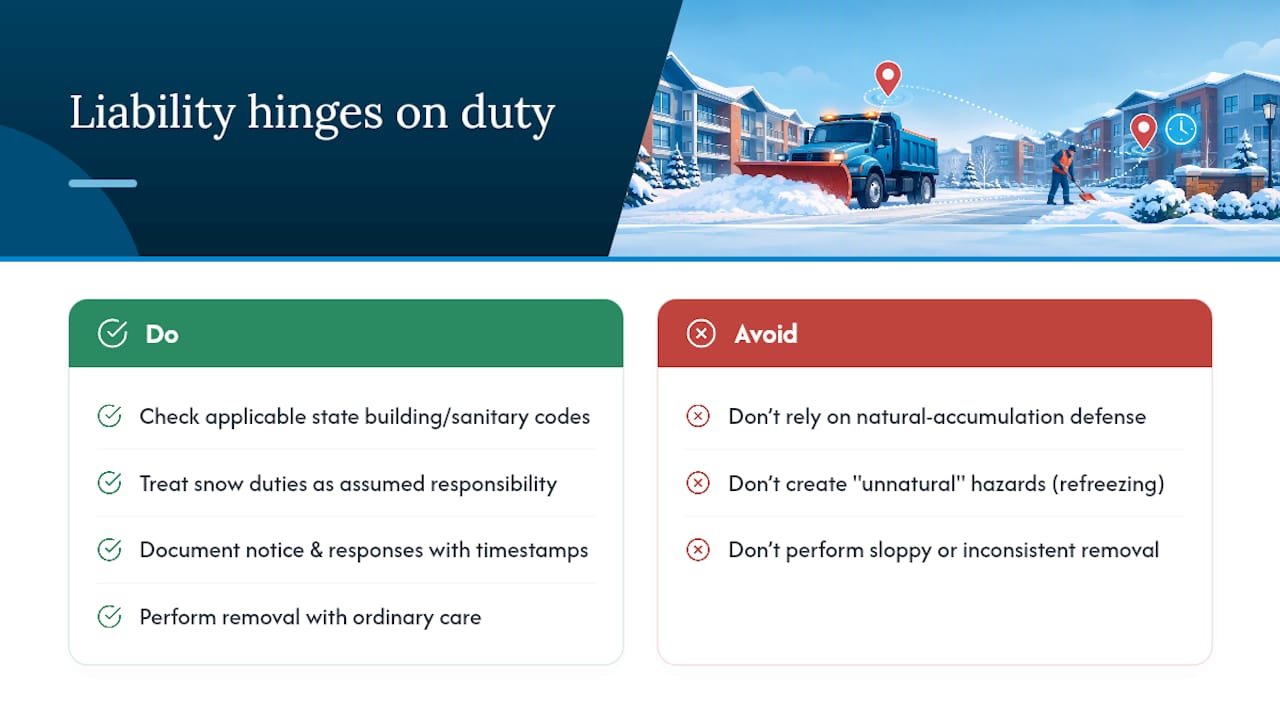
Liability in snow cases rarely comes from a single missed sidewalk. It comes from negligence, from an “assumed duty” the association took on and then performed poorly, or from a state code the board didn’t know applied to it.
Massachusetts offers a clear illustration. Under 105 CMR 410.452, property owners must keep every means of egress, exterior stairways, fire escapes, and walkways free of snow and ice. In a multi-unit property, the association usually inherits that obligation for shared areas. Boards outside Massachusetts should assume a comparable sanitary or building code likely exists in their own state and check it directly rather than guessing.
Illinois courts have held that once an association assumes snow-removal duties, by contract or by consistent practice, it must perform that duty with ordinary care. Removal that creates a new, “unnatural” hazard, like refreezing a pile against a doorway, can expose the association to liability even where a natural accumulation defense might otherwise apply.
That principle shows up across Illinois case law repeatedly: courts look at whether the association owed a duty, whether it had notice of the hazard, and whether its performance was reasonable. Massachusetts has moved in a similar direction. Courts there have narrowed the old “natural accumulation” defense, pushing owners and associations toward the same reasonable-care standard used in general premises liability. The takeaway for boards: once you accept the job, sloppy execution is worse than doing nothing at all in the eyes of a court.
Contract Essentials: The SLA Clauses That Actually Protect You
A generic snow contract is a liability waiting to happen. A defensible one names specific triggers, response times, and proof requirements up front, so nobody argues about what “cleared” means after the fact.
- Site map and scope of work. List every route by name, main entrances, ADA-accessible ramps, fire lanes, and parking areas, with priority order attached.
- Trigger conditions. Specify the snowfall threshold (commonly one to two inches) and separately address ice-only events, which often get skipped in poorly written contracts.
- Response windows and staffing guarantees. Require a maximum start time after a trigger and a named minimum equipment commitment, not just “adequate resources.”
- Snow hauling thresholds. Define when piles must be relocated off-site rather than pushed into a corner of the lot.
- Insurance, indemnification, and verification. Require the vendor to indemnify the association for its own negligence, name the association as additional insured with primary coverage, and provide geo-fenced service logs with timestamps and photos.
Pro Tip: Ask any prospective vendor for a sample of their actual service log, not a description of one. If they can’t show you a timestamped, geo-tagged record from a past storm, they can’t produce one for you either. Boards can find sample clause language in contract guides built for property managers that spell out indemnification and verification terms in plain language.
Operational Priorities During and After a Storm
Clearing order matters as much as clearing speed. A property that plows the parking lot first and leaves the fire exit buried has technically “done snow removal” and still created a liability problem.
- Clear means of egress and ADA-accessible routes first, every time, regardless of how the rest of the schedule looks.
- Move to building entrances and lobbies next, since foot traffic concentrates there.
- Handle vehicle access lanes and secondary walkways after the critical paths are secured.
- Apply de-icing material based on temperature and surface type, and avoid dumping excess salt near storm drains, retention ponds, or landscaping beds.
- Decide on pile placement versus off-site hauling before the season starts, not mid-storm, since some properties simply don’t have room to stack snow without blocking sightlines or drainage.
Sites with medically vulnerable residents, senior living buildings in particular, need tighter thresholds than a standard schedule-based SLA. Continuous or near-continuous clearing of accessible routes fits that population better than a contract that only responds after a set number of inches has fallen.
Documentation That Actually Holds Up in a Claim
A slip-and-fall claim rarely gets decided on who is right. It gets decided on who can prove what happened, and when. Documentation is the piece boards skip most often, and the piece that saves them when a claim lands.
- Require timestamped, GPS-verified service records for every visit, not just a monthly invoice.
- Require photos of cleared conditions, especially for high-traffic entrances.
- Require signed crew reports noting weather conditions and treatment applied.
- Verify the vendor’s certificate of insurance and confirm policy limits before the season starts, not after an incident.
- Run a post-storm audit and log any resident complaints along with the remediation steps taken.
Documented, verifiable service records are widely considered the association’s strongest practical defense against a premises liability claim. Without them, a board is left arguing memory against a plaintiff’s photographs.
What a 44-Year Snow Contractor’s Operations Look Like in Practice
Contract language only matters if a vendor can actually deliver on it. An experienced snow removal contractor has operated in the Denver Metro area for over four decades, and its day-to-day setup maps directly onto the clauses boards should be requiring:
- Dispatch availability around the clock, which satisfies the “response window” clause boards write into contracts but can rarely verify with smaller operators.
- Equipment intended to clear a lot in a single pass, addressing the equipment-redundancy language boards should insist on.
- Documented service visits tied to liability protection for slip-and-fall exposure, which covers the logging piece of a defensible contract.
- Seasonal contracts built around each property’s specific route priorities, rather than a one-size schedule.
Managing Resident Expectations Before the First Storm Hits
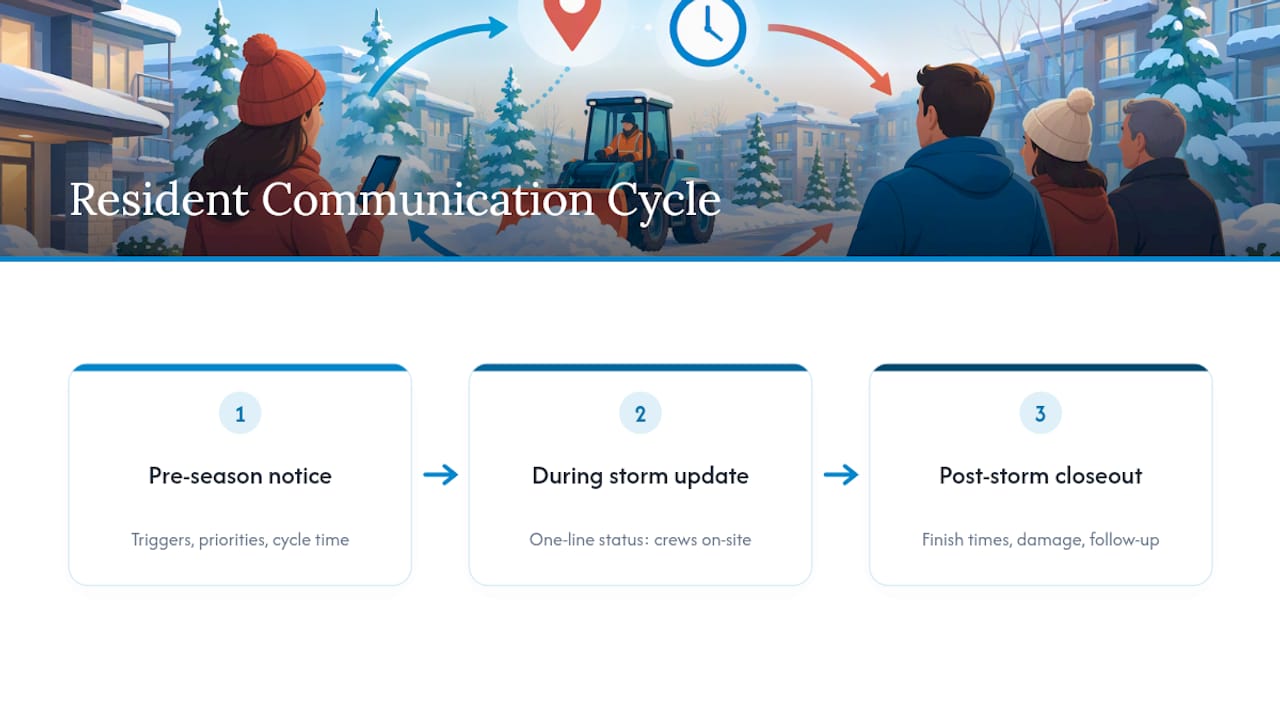
Most resident complaints during a snow event have nothing to do with the actual clearing speed. They come from residents not knowing what to expect, when to expect it, or where to direct a concern. Boards that communicate proactively cut complaint volume dramatically, even in a bad winter.
Send a season-opening notice explaining the trigger threshold for plowing, the order in which areas get cleared, and roughly how long a full clearing cycle takes after a storm ends. Residents who know their entrance is priority three, not priority one, complain far less than residents left guessing.
Set up a single point of contact for snow-related issues, ideally the property manager rather than individual board members fielding calls at odd hours. A clear issue resolution workflow for handling maintenance complaints, adapted for snow-specific concerns, keeps requests from getting lost or duplicated across multiple channels.
During multi-day storms, a short update, even a one-line email or posted notice, saying “crews are on-site, egress routes cleared as of 7 a.m.” does more to reduce anxiety than a perfectly plowed lot residents never hear about. Silence during a storm reads as inaction, even when work is happening.
After the storm, close the loop. Tell residents when secondary areas were finished and note any damage or delay caused by unusual conditions. That follow-up becomes part of your documentation trail if a complaint later turns into a claim.
A Contractor’s-Eye Checklist Before the First Snowfall
Five things separate boards that sail through winter from boards that spend it fielding lawsuits: review your governing documents for gaps, map every priority route by name, lock in a written SLA with verification requirements, confirm the vendor’s insurance and additional-insured status, and run a mock storm call before the season starts. Most failures trace back to vague scope language or a vendor without the equipment to actually hit their promised response time.
— Jesse
How Denver Snow Removal Supports a Defensible Condo Snow Plan
Denver Snow Removal is built for exactly the procurement checklist covered above. Its Seasonal Snow Contracts run September through May and are tailored to each property’s route priorities, rather than a generic schedule bolted onto every building the same way.
For condominium boards, that means sidewalk clearing and de-icing programs, commercial parking lot plowing built around your specific site map, and 24/7 emergency dispatch when a storm arrives outside normal service hours. Documented service visits back every job, giving your board the kind of verification records this article recommends requiring from any vendor. Free estimates come with no obligation, so a board can compare a proposed contract against the clause checklist above before signing anything. If your current provider can’t produce a timestamped log from last winter, that alone is worth a phone call. Request a free estimate or ask for sample SLA language directly through Denver Snow Removal’s site before your next board meeting.
Sources
- Navigating snow removal and policies in condo associations — RealManage
- 105 CMR 410.452 – Safe condition — Cornell Law School (Mass. regs)
- Illinois court opinion (Nos. 1-12-3607) — Illinois Courts
- Massachusetts landlord snow removal law — LegalClarity
FAQ
Is My HOA Responsible for Snow Removal?
In most cases, yes. Governing documents typically assign common-area maintenance, including snow and ice removal, to the association rather than individual owners, a duty reinforced by state property and tort law. Limited common areas like private balconies sometimes fall to the owner instead, so check your declaration for the exact split.
What Is the Average Cost of Residential Snow Removal?
Pricing varies by property size, route complexity, and how often storms hit during the season. Denver Snow Removal lists residential driveway and walkway clearing starting at $41.25 per visit, with seasonal contracts and other commercial services priced through a free estimate.
What Happens After 50 Years of a Condominium?
This depends entirely on the property’s declaration and state condominium law, since some declarations include a defined dissolution or reconstitution date while others do not. There’s no universal rule here, so boards approaching a long-standing anniversary should have counsel review the original declaration for any age-triggered provisions.
In Massachusetts, Are Landlords Responsible for Snow Removal?
Yes. Massachusetts requires means of egress to be kept free of snow and ice under 105 CMR 410.452, and courts have moved away from the old natural accumulation defense toward a reasonable-care standard similar to general premises liability. In condominiums, that obligation for common areas usually shifts to the association rather than sitting with individual unit owners.