
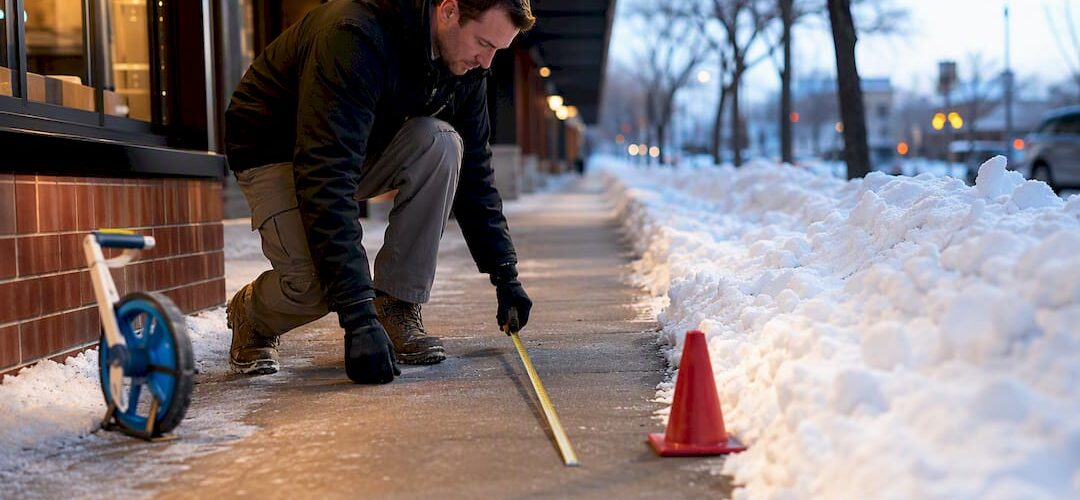
Commercial sidewalk snow standards typically require property owners to clear a passable path, usually 4 to 5 feet wide, within a set window after snowfall stops (commonly 4 to 24 hours), while keeping curb ramps, entrances, and hydrant access clear. Owners who miss the deadline risk fines or a city-ordered cleanup billed back to them. Meeting the deadline still doesn’t fully shield an owner from a slip-and-fall claim if the walkway wasn’t reasonably safe.
TL;DR:
- Property owners must clear a 4 to 5-foot path within specific city-mandated windows, which vary based on storm timing and local rules.
- Most violations happen when owners misjudge the trigger point for starting the deadline, especially if they assume it begins when snow stops falling.
- Clearing high-priority areas like curb ramps, entrances, and hydrant access safeguards ADA compliance and limits liability.
- Municipal codes prohibit pushing snow into roads or transit zones and require on-site stacking away from drainage, fire lanes, and sightlines.
- Proper documentation, including timely photos, service logs, and a detailed contract with defined service levels, is essential to defend against claims and fines.
Table of Contents
- What Are the Municipal Rules and Timelines for Sidewalk Snow Removal?
- How Wide Does a Cleared Sidewalk Path Need to Be?
- Where Can You Legally Put Cleared Snow?
- How Do Cities Enforce Sidewalk Snow Rules?
- Building a Snow Removal Contract That Actually Holds Up
- Meeting Code Doesn’t Mean You’re Off the Hook
- Your Post-Storm Checklist
- What Property Managers Consistently Get Wrong
- How Denversnowremovals Helps You Meet These Standards
- Sources
- FAQ
What Are the Municipal Rules and Timelines for Sidewalk Snow Removal?
Cities measure the compliance clock differently, and that difference trips up more property managers than any other single detail. Some ordinances start counting from the moment snow stops falling. Others count from the end of the full storm system, which matters when a storm drops snow overnight in bursts rather than one continuous fall.
That distinction changes when the clock actually starts, and an owner who assumes the wrong trigger point can rack up a violation before the first shovel even hits pavement.
A few real examples show the range:
- Chicago requires snow removal from sidewalks by 10:00 p.m. for snow that falls during daytime hours, with separate provisions for overnight accumulation.
- Minneapolis gives property owners a short daytime window to clear sidewalks after snow stops.
- Bend, Oregon, sets a daylight-hour window for commercial properties, a longer allowance than many of its residential counterparts.
- New York City enforces citywide rules through NYC311, which spells out clearing obligations, curb cut access, and the city’s authority to clear and bill owners who don’t comply.
Commercial properties often get shorter windows than residential ones, since business access and public foot traffic carry higher stakes. Read your local ordinance’s exact wording. “Snowfall” and “storm event” are not interchangeable terms, and the gap between them is where most first violations happen.
How Wide Does a Cleared Sidewalk Path Need to Be?
Most municipal codes converge on a 4 to 5 foot clear path, wide enough for two wheelchair users to pass each other and consistent with sidewalk width standards baked into ASTM F3627-24, the guide for premises design and snow and ice management.
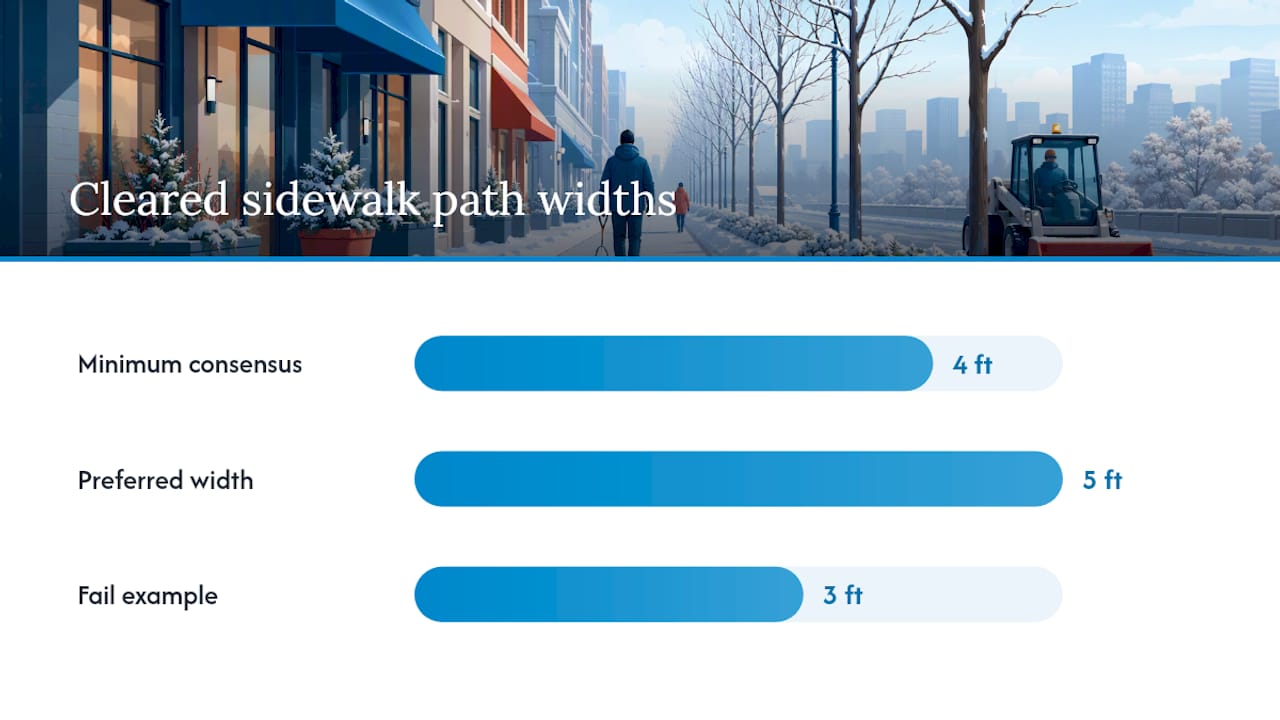
Pro Tip: Measure your widest sidewalk segment before the season starts. A path that’s 5 feet at the entrance but narrows to 3 feet near a planter box or bike rack still fails inspection.
Priority areas get scrutinized first, whether from a city inspector or a customer’s lawyer:
- Curb ramps and crosswalk approaches
- Building entrances and exits
- Fire hydrant access zones
- Transit stops and shelters adjacent to the property
These overlap directly with ADA snow removal requirements, since an accessible route blocked by a snow pile is a compliance failure on two fronts at once, not one.
Where Can You Legally Put Cleared Snow?
Almost every municipal code prohibits pushing sidewalk snow into the street, a bike lane, or a transit zone. Plows need a clear lane to work, and snow dumped back into the roadway becomes an obstruction the next crew has to deal with. Sometimes this creates a refreeze hazard for drivers and cyclists.
On-site stacking is the standard alternative, but stacking has its own limits:
- Pile snow away from drainage paths so meltwater doesn’t refreeze across the cleared walkway.
- Keep piles clear of fire lanes, dumpster access, and parking spaces designated for accessible use.
- Watch pile height near sightlines at driveways and building exits.
When a storm produces more snow than on-site stacking can handle, contact your local public works department about hauling permits before trucking snow off-site on your own.
How Do Cities Enforce Sidewalk Snow Rules?
Enforcement almost always starts with a complaint, typically routed through a city’s 311 system or equivalent code enforcement portal. An inspector documents the violation, issues a notice, and sets a short cure period, often just hours, not days.
If the owner still hasn’t cleared the walkway, most cities move through a predictable sequence:
- The city dispatches its own crew or contractor to clear the sidewalk.
- The cost of that cleanup gets billed directly to the property owner, frequently at a rate higher than hiring a contractor proactively would have cost.
- A separate fine gets assessed on top of the cleanup charge, and repeat violations in the same season tend to escalate.
If you receive a notice, clear the walkway immediately, photograph the completed work with a timestamp, and keep a copy of the notice itself. For anything beyond a routine citation, loop in your insurer or attorney before responding.
Building a Snow Removal Contract That Actually Holds Up
Municipal codes tell you what the sidewalk needs to look like. They don’t tell you how to prove it looked that way on a specific Tuesday at 6:00 a.m. That’s where procurement language does the real work, and it’s the piece most commercial contracts skip entirely.
The ANSI/SIMA procurement standard lays out the core building blocks any commercial snow contract should include:
- A defined Level of Service (LOS): the trigger depth that starts service, response time commitments, and priority zones ranked by risk.
- A written Scope of Work (SOW): exact areas covered, permitted de-icing materials, and where cleared snow gets stacked.
- A site map marking equipment staging areas, drainage paths, and permitted stacking zones, which the standard notes reduces mid-season disputes over where snow was supposed to go.
- Minimum contractor insurance requirements, with your business named as an additional insured.
Pro Tip: Require time-stamped photos and visit logs as a contract deliverable, not a courtesy. If a claim ever surfaces, that log is often the difference between a five-minute conversation with your insurer and a drawn-out dispute. Site-specific hazard assessments, similar to the ones outlined in this health and safety planning guide, also belong in the file before the first snowfall.
Meeting Code Doesn’t Mean You’re Off the Hook
Clearing your sidewalk within the city’s window satisfies the ordinance. It doesn’t automatically satisfy a court. Property owners still carry a separate duty of reasonable care under tort law, and a plaintiff’s attorney will ask what you did, not just whether you technically beat the deadline.
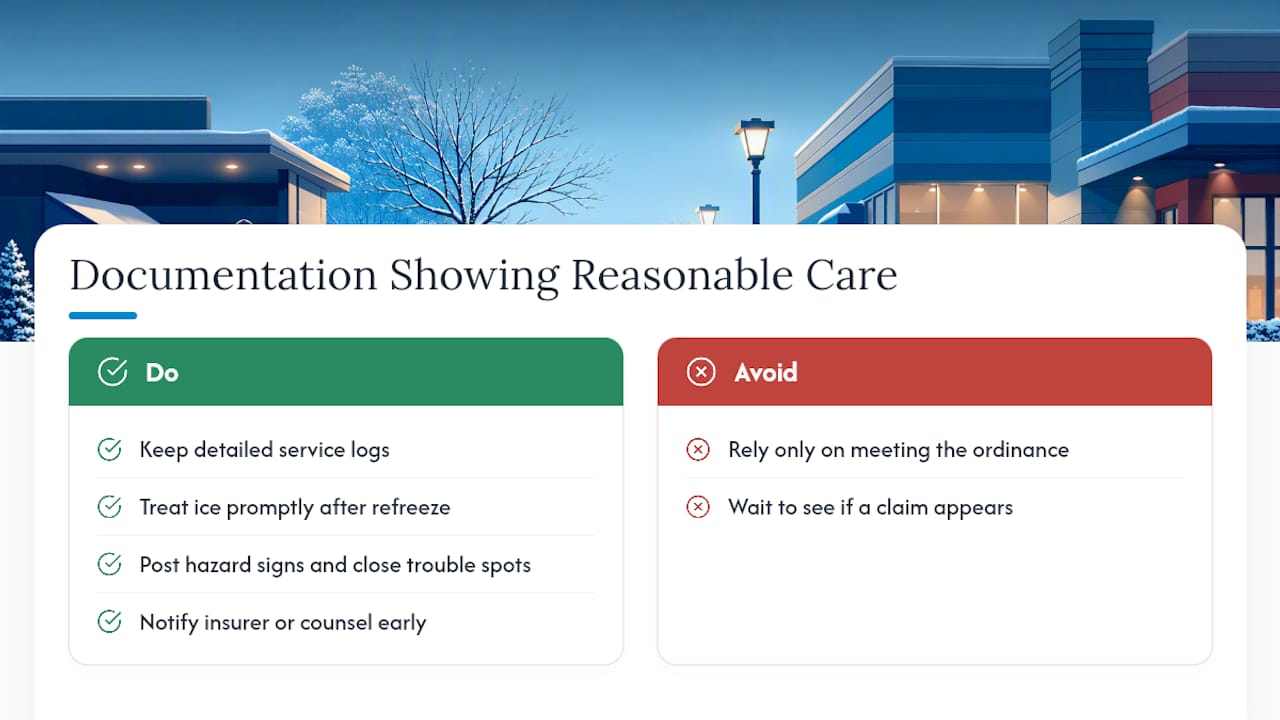
Documentation closes that gap. Service logs, prompt ice treatment after refreeze events, hazard signage, and temporary closures around known trouble spots all build a record that you acted reasonably, not just legally. After any incident, involve your insurer or counsel early rather than waiting to see if a claim materializes.
Your Post-Storm Checklist
Run this sequence every time snow stops falling on your property:
- Clear ingress and egress points first: entrances, exits, and curb ramps, since these carry the highest liability exposure and the tightest enforcement scrutiny.
- Apply deicer to treated areas and flag any remaining slick spots with cones or signage.
- Photograph the completed work with a timestamp, then file it alongside your signed SOW, service logs, invoices, and any municipal notices received that season.
Pro Tip: Set your seasonal contract before October. Waiting until the first storm hits means competing with every other property manager in town for the same limited fleet of contractors. When snow volume outpaces your lot’s stacking capacity, that’s the signal to schedule hauling rather than let piles creep into fire lanes or accessible parking.
What Property Managers Consistently Get Wrong
Three rules hold up across most properties I’ve reviewed: prioritize access points before aesthetics, document every visit like it might end up in a claims file, and write your contract around a Level of Service, not a vague promise to “handle snow.” Owners who skip that last step are usually the ones surprised by a gap in coverage mid-February. A provider offering documented visits and genuine 24/7 dispatch removes most of that guesswork, but only if you actually ask for the paperwork.
— Jesse
How Denversnowremovals Helps You Meet These Standards
A practical alternative to piecing together compliance yourself is to use a provider that offers a written Level of Service and Scope of Work built around your property’s actual priority zones, curb ramps, entrances, and hydrant access.
Denversnowremovals offers sidewalk clearing and de-icing, site mapping, and Seasonal Snow Contracts running September through May, backed by 24/7 emergency dispatch for storms that don’t wait for business hours. Every visit gets documented, giving you the service log you’d want on hand if a compliance question or liability claim ever comes up. Request a free site assessment and a written LOS/SOW through the commercial parking lot and sidewalk service page before the next storm rolls in.
Sources
FAQ
How Much Should Commercial Sidewalk Snow Removal Cost?
Pricing varies by property size, service frequency, and local labor rates, so most commercial providers quote after a site visit rather than a flat rate. Denversnowremovals lists current commercial pricing on its service page rather than a single published figure.
Do You Have to Clear Snow Off Your Sidewalk?
In most municipalities, yes. Local ordinances typically require property owners to clear sidewalks within a set window, often 4 to 24 hours, and cities can fine owners or clear the walkway themselves and bill the cost back.
What Are the OSHA Requirements for Snow Removal?
OSHA doesn’t set a specific sidewalk clearing timeline, but it requires employers to keep walkways free of slip and fall hazards for workers, which extends to equipment and vetting practices covered in guidance like this equipment inspection overview. Municipal sidewalk ordinances remain the primary source for specific clearing deadlines and widths.
Can I Be Sued if I Don’t Shovel My Sidewalk?
Yes. Beyond municipal fines, an uncleared or poorly maintained walkway can expose you to a slip-and-fall lawsuit under premises liability law, since courts look at whether the property was kept in a reasonably safe condition, not just whether the ordinance deadline was met.