
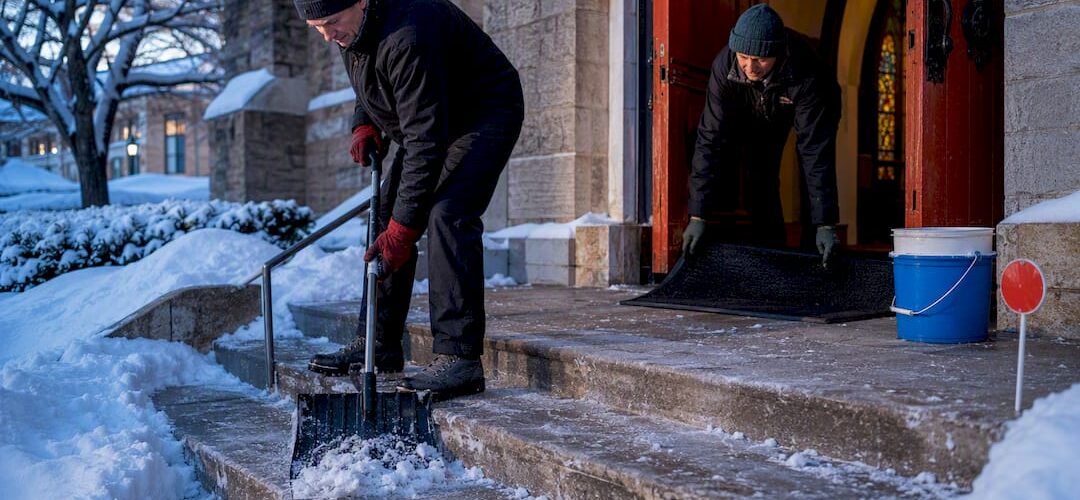
Every church should prioritize clearing entrances, ADA routes, and main parking aisles first, either before services or within 24 hours of a storm. Put a written plan in place every early autumn and name one person responsible for it. Once snowfall regularly becomes significant, or the lot outgrows what staff and volunteers can safely handle, bring in a contractor. Require proof of insurance and keep a maintenance log on every job, no exceptions.
TL;DR:
- Churches should bring in a snow removal contractor once snowfall exceeds two inches or the lot is too large for staff to handle safely, especially in high-frequency snow areas.
- Priority for clearing includes entrances, ADA routes, sidewalks, stairs, and main parking lanes, with completion standards of within 24 hours or before building opening.
- A documented plan with marked obstacles, specified contractor response times, proof of insurance, and a site map helps ensure reliable snow and ice mitigation.
- Costs vary based on lot size, snow frequency, and de-icing needs, with seasonal contracts offering predictable expenses in regions with frequent snow.
- Regular annual review and pre-season planning, including training volunteers and marking hazards, are essential to prevent accidents and property damage during winter.
Table of Contents
- What Does a Church Snow Removal Checklist Look Like?
- When Should a Church Hire a Snow Removal Contractor?
- What Areas Should Get Cleared First and How Fast?
- How Should a Church Plan for Winter Before the First Storm?
- What Should Be in a Church Snow Removal Contract?
- What Safety Rules Apply to Staff, Volunteers, and Roof Work?
- How Much Does Church Snow Removal Typically Cost?
- How Should a Church Document Snow and Ice Removal?
- Why 44 Years of Denver Winters Backs This Guidance
- Protecting Landscaping and Historic Features During Winter Clearing
- How Do You Choose the Right Snow Removal Vendor for a Church?
- What Vendors Get Wrong and Church Facilities Get Right
- Get a Free Estimate for Your Church’s Winter Season
- Sources
- FAQ
What Does a Church Snow Removal Checklist Look Like?
Winter prep for a church doesn’t need to be complicated, but it does need to happen before the first flakes fall. Here’s what belongs on your list right now.
Priority areas to clear, in order:
- Main entrance doors and the ADA-accessible route to them
- Handicap parking spaces and the path connecting them to the building
- Primary walkways and stairs used by the congregation
- Main parking aisles, then the rest of the lot
Basic supplies to keep on hand:
- Rock salt or a pre-mixed ice melt product near every entrance
- A few sturdy shovels and at least one push broom for light dustings
- Traffic cones or caution signs for wet or icy patches
Simple triggers for calling a contractor: if snowfall is forecast above two inches, if your regular crew is unavailable, or if ice has formed overnight, call before the parking lot fills with cars for the first service. When you call, have your address, expected attendance, and priority zones ready to share.
For services themselves, stage a volunteer near the main door with a mat and a bucket of salt for spot treatment, and set out extra walk-off mats in the vestibule to catch melting snow before it becomes a hazard on tile or wood floors.
Pro Tip: Keep a five-gallon bucket of ice melt behind each main entrance door. It sounds simple, but it’s the fastest way to treat a slick spot between scheduled plowing visits.
When Should a Church Hire a Snow Removal Contractor?
Most churches reach a point where in-house effort isn’t enough, and recognizing that point early avoids a scramble. A widely used guideline from risk managers who work with religious institutions is straightforward: bring in a professional once snowfall exceeds two inches or once the property is too large or complex for staff to handle. If your lot serves 100 cars, no volunteer crew with shovels is getting that cleared before an 8 a.m. service.
Liability is the other half of the equation. A volunteer who throws out a back shoveling a 200-foot walkway, or slips while operating a snowblower they’ve never used, becomes the church’s problem in ways a signed contractor relationship simply is not. Consider these factors when deciding:
- Snowfall frequency in your area. Two or three snow events a year might justify a strong in-house plan. Fifteen or more probably calls for a contract.
- Lot size and layout. A gravel lot for 40 cars is a different job than a paved lot with islands, curbing, and multiple entrances.
- Volunteer availability at 5 a.m. Storms don’t wait for convenient hours, and a contractor with equipment staged overnight will beat a phone tree every time.
- Insurance exposure. Contracted crews carry their own coverage; volunteers using church-owned equipment usually don’t.
On pricing structure, per-event billing works for churches in milder climates with occasional snow. A seasonal contract, often billed monthly regardless of storm count, makes more sense where snow is a near-weekly occurrence, because it locks in predictable costs and guaranteed response. A parking lot management guide breaks down how lot size and complexity typically shift that calculation.
What Areas Should Get Cleared First and How Fast?
Clearing order matters as much as clearing speed. A church that plows the whole lot but ignores the front steps has its priorities backward, and a fall on those steps is far more likely to end in a claim than one in an open parking aisle.
- Entrances and ADA routes. These get treated first, every time, because they carry the highest foot traffic and the highest fall risk for people with limited mobility.
- Sidewalks and stairs. Clear and salt these next, paying close attention to any stairs with metal or worn treads where ice bonds fast.
- Main parking aisles. Open the primary lanes so cars can move in and park without getting stuck.
- The rest of the lot. Fill in remaining spaces once the essentials are handled.
- Snow storage and hauling. Push piles to designated corners that won’t block drainage, sightlines, or handicap spaces, and haul offsite if piles grow too large.
Diocesan risk-management guidance sets a clear timing standard: parking lots, walkways, and entrances should be clear by the time the building opens, or within 24 hours after the storm ends. That standard belongs in writing in any contract you sign, not left as an assumption.
Pay special attention to roof-runoff zones and shaded north-facing walkways. These spots refreeze overnight even after a thorough daytime clearing, and they’re responsible for a disproportionate share of black-ice falls. Flag them on any site map you give a contractor.
How Should a Church Plan for Winter Before the First Storm?
Waiting until the first snow warning to think about removal is the single most common mistake churches make, and it’s an easy one to fix. Preparation should start in early autumn, with a written plan reviewed annually before each winter season, not drafted from scratch every October.
Start by assigning a plan owner and a backup, so a single person’s absence doesn’t leave the church without a decision maker mid-storm. Document the plan: who to call, what triggers a call, and who has authority to close the lot if conditions turn dangerous.
Next, build a simple site map. Mark the priority clearing zones from the section above, along with hidden obstacles like sprinkler heads, speed bumps, curb edges, and fire hydrants that a plow blade can catch and damage. Walking the property with your contractor before the first snowfall to review that map together prevents both property damage and missed spots during an actual storm.
On materials, know your options:
- Rock salt is cheap and widely available but loses effectiveness below about 15°F and can damage concrete and plant beds over time.
- Pre-mix products (salt blended with other minerals) work at lower temperatures and are gentler on surfaces, at a higher cost per bag.
- Liquid calcium chloride works fast in extreme cold and is often used for pre-storm anti-icing, but requires sprayer equipment most churches don’t own.
- Sand provides traction on ice but doesn’t melt anything, and it can clog storm drains if overused.
Anti-icing brine applied before a storm and de-icing salt applied after each serve a different purpose, and mixing up the timing wastes material and money. Store bags of salt or pre-mix off the ground in a dry shed, since moisture clumps product fast.
If volunteers will run a snowblower, walk them through the controls before the first storm, not during it, and never assign roof work to anyone without formal training.
Pro Tip: Take photos of your obstacle map and text them to your contractor’s crew lead before the first snowfall. A picture of that sprinkler head buried under six inches of snow is worth more than a verbal warning.
What Should Be in a Church Snow Removal Contract?
A handshake agreement with a plow guy down the street might work fine for three years, right up until it doesn’t. The contract is where a church protects itself, and it needs specifics, not vague promises.
Define the scope in writing: which surfaces are covered (main lot, side lot, all sidewalks, stairs), whether de-icing is included or billed separately, and whether roof snow removal is part of the deal at all. Set a clear trigger, such as “service begins automatically once snowfall reaches two inches,” and a response window, such as “cleared within 24 hours or before the next scheduled service, whichever comes first.”
Insurance is non-negotiable. Contracts should require a certificate of insurance naming the church as an additional insured, with liability limits your insurance agent can help you set appropriately for your property size. Ask for the hold-harmless and indemnification language directly, since that clause is what shifts liability for the contractor’s own actions away from the church.
Beyond insurance, look for:
- A one-year term with a renewal or reevaluation clause, so pricing and performance get revisited annually
- Defined performance metrics tied to the timing standard above
- A dispute resolution process spelled out in advance, not improvised after a bad storm
- A documented pre-storm walkthrough with obstacle marking, discussed in the planning section
| Contract Element | What to Require |
|---|---|
| Scope of work | Named surfaces, de-icing inclusion, roof work status |
| Response trigger | Specific snow depth or time window |
| Insurance | Certificate naming church as additional insured |
| Liability protection | Hold-harmless and indemnification clause |
| Term | One year, with annual review |
| Documentation | Pre-storm walkthrough, obstacle map |
What Safety Rules Apply to Staff, Volunteers, and Roof Work?
Keep volunteer tasks limited to low-risk work: shoveling a short entry walk, spreading salt from a bucket, or spot-treating an icy step. Anyone running a snowblower needs a quick training session first, since these machines cause serious hand injuries every winter when someone reaches into a clogged chute without thinking.
- Never send a volunteer onto the roof, ever, for any reason.
- Require contractors to follow OSHA standards for roof snow and ice removal, since that work involves fall risk and structural load concerns that go well beyond a shovel and a ladder.
- Set out wet-floor signage and extra mats at every entrance during services, and station someone to monitor conditions as the congregation exits.
- Treat roof-runoff zones and shaded walkways proactively rather than reactively, since these spots generate the most black-ice slip-and-fall incidents of any area on a typical property.
The roof rule deserves repeating because it’s the one churches most often get wrong, usually because a well-meaning volunteer with a ladder wants to help after an ice dam forms.
How Much Does Church Snow Removal Typically Cost?
Pricing varies by region, lot size, and how much de-icing is bundled in, so treat any number as a starting point for your own bids rather than a fixed rate. Contractors generally price one of three ways: per push (a flat fee each time they plow), per inch (a scaled rate tied to snowfall depth), or a seasonal contract that covers the whole winter for one predictable fee.
Variables that move the price include lot size, the number of separate walkway segments, whether de-icing material is included, and whether you’re paying extra for a guaranteed emergency response time. A seasonal contract tends to cost more upfront but removes the surprise of a brutal winter running up per-event bills.
To get bids you can actually compare:
- Give every contractor the same site map and scope description
- Ask each to quote per push, per season, and with/without de-icing separately
- Request their guaranteed response window in writing, not verbally
- Confirm whether hauling snow off-site is included or billed extra
To save money without cutting corners on safety, consider a hybrid model: contract out the parking lot and main walkways while handling light entrance touch-ups in-house, or look into sharing a contractor with a neighboring church or nonprofit to negotiate better seasonal rates.
How Should a Church Document Snow and Ice Removal?
A maintenance log is cheap insurance against a lawsuit, and it takes about thirty seconds per entry to keep. Risk management guidance recommends retaining these records for at least three years, since that log becomes your evidence of reasonable care if someone falls and files a claim.
Log the date and time, who did the work (staff, volunteer, or contractor name), which areas were treated, what materials were used, and current weather conditions. Photos help too, especially timestamped ones showing conditions before and after treatment.
| Date/Time | Area Cleared | Action Taken | Materials Used | Initials | Notes |
|---|---|---|---|---|---|
| — | Front entrance | Shoveled, salted | Rock salt | J.M. | Light snow, 1 inch |
| — | Main lot | Plowed | None | Contractor | Cleared before 8 AM service |
Keep a clipboard with a printed log near your salt supply so whoever treats a walkway can log it immediately, and back it up digitally each week rather than trusting a single paper copy to survive the season.
Why 44 Years of Denver Winters Backs This Guidance
The advice above reflects patterns seen across decades of Front Range winters, not guesswork. Denver Snow Removal has worked commercial and religious properties for over 44 years, which means a lot of ice storms, a lot of Sunday-morning deadlines, and a lot of lessons about what actually keeps a parking lot safe.
- 24/7 emergency dispatch, because storms don’t check the church calendar before they hit
- State-of-the-art plowing and de-icing equipment sized for lots ranging from small chapel drives to full commercial campuses
- Free estimates and flexible service plans built around a property’s actual attendance patterns and layout
- A working knowledge of which Denver-area de-icing products hold up in single-digit cold versus a wet 30-degree slush
That kind of hands-on experience is why churches lean on an established local provider rather than piecing together a plan from scratch every October.
Protecting Landscaping and Historic Features During Winter Clearing
Older church buildings often carry features a standard commercial plow crew might not think twice about: stone steps worn smooth by a century of foot traffic, decorative iron railings, mature trees close to the walkway, or masonry that reacts badly to certain de-icers. Protecting those features takes a little extra planning, but it’s far cheaper than repairing them later.
Rock salt is the biggest offender here. It’s effective and cheap, but repeated exposure degrades concrete, stone, and metal over several seasons, and it can kill grass and shrubs along walkway edges. If your church has historic stonework or ornamental plantings near main walkways, ask your contractor about calcium magnesium acetate or a pre-mix product formulated to be gentler on masonry, even though it costs more per bag.

Mark low stone walls, ornamental fencing, and any statuary or memorial markers on the same site map used for hidden obstacles. A plow blade doesn’t distinguish between a curb and a century-old cornerstone, and one bad pass can crack material that’s irreplaceable.
For trees and shrubs near walkways, ask crews to pile snow away from root zones rather than banking it directly against trunks, where repeated freeze-thaw cycles and concentrated salt runoff can damage roots over several seasons. If your grounds include a memorial garden or a columbarium, flag those areas specifically. They see less foot traffic but often sit exposed to wind, meaning ice forms fast and stays late into spring.
How Do You Choose the Right Snow Removal Vendor for a Church?
Not every snow removal company is set up to handle a church’s schedule, layout, and liability needs, and picking the wrong one shows up fastest on a Sunday morning when the lot isn’t clear and the first service starts in twenty minutes.
Start with questions that reveal how a contractor actually operates:
- “What’s your guaranteed response window once snowfall hits our trigger depth?”
- “Can you provide a certificate of insurance naming us as additional insured before we sign anything?”
- “Do you send text or email alerts when your crew arrives and when the job’s complete?” Diocesan guidance flags this kind of communication and disaster planning as a real differentiator between vendors.
- “How do you handle a Sunday morning storm specifically, given our fixed service times?”
- “Do you offer pre-storm anti-icing on high-traffic areas, or only post-storm de-icing?”
Red flags to walk away from: a contractor who won’t provide proof of insurance upfront, vague verbal promises about response time with nothing in writing, no clear plan for how they’ll prioritize your entrances versus the general lot, or hesitation when you ask for references from other religious or nonprofit properties they service. A vendor confident in their work will answer every one of these without hesitation. One who dodges the insurance question specifically should be crossed off the list immediately, no matter how competitive their price looks.
What Vendors Get Wrong and Church Facilities Get Right
The most common mistake we see isn’t a lack of effort. It’s a vague scope. A church signs with a plow service, assumes “the lot” means everything, and finds out during the first real storm that side walkways and the handicap ramp weren’t included. No marked priority areas, no insurance request, and a response-time expectation that was never actually agreed to in writing.
What consistently improves outcomes is boring, and that’s the point: a pre-storm walkthrough, a shared site map with obstacles marked, an agreed spot for snow piles that doesn’t block a fire lane, and a scheduled review each fall before the contract renews.
On our end, storms mean staffing scales up fast, crews get dispatched by priority tier, and churches with a documented plan and marked map move to the front of that line because there’s nothing to figure out on the fly.
— Jesse
Get a Free Estimate for Your Church’s Winter Season
Denver Snow Removal is the direct alternative to piecing together a plan from volunteers, a rented plow, and a hope that this winter stays mild. Where a patchwork approach leaves gaps in coverage and liability, a seasonal contract with a dedicated crew gives your church guaranteed response times, documented insurance, and one phone number to call at 5 a.m. when a storm rolls in overnight.
We offer seasonal contracts built around your actual service schedule, true 24/7 emergency response, and full coverage for sidewalks and parking lots alike. Every job comes with a certificate of insurance on request, so your church has the documentation a contract should include from day one.
To get a free estimate, have your site map ready if you have one, along with typical Sunday attendance and the priority zones you want cleared first. That’s enough for us to put together a plan tailored to your property. Visit our snow plowing services page to request your estimate, or check out our commercial snow removal guide to see how contracts for institutional properties are typically structured before you call.
Sources
- Snow Removal – Massachusetts Catholic Self-Insurance Group
- Snow and Ice Removal — Diocese guidance (CatholicNH)
- Snow and Ice Removal Plan – RCAB Office of Risk Management
- Slip and fall prevention: Snow and Ice Removal (GuideOne SafeChurch)
FAQ
What Is the Average Cost of Church Snow Removal?
Cost depends heavily on lot size, region, and whether de-icing is bundled in, with per-push, per-inch, and seasonal contract models all common. Request bids using the same site map and scope so you’re comparing true apples to apples.
What’s a Fair Price for Clearing a Church Parking Lot?
There’s no single fair price since rates shift by region and lot complexity, but a seasonal contract typically offers more predictable costs than paying per storm in a heavy-snow area. Get multiple bids using an identical scope description to judge fairness for your specific property.
Can a Church Pay Someone to Handle All Its Snow Removal?
Yes, and for most congregations it’s the safer route once snowfall regularly exceeds two inches or the lot outgrows volunteer capacity. A signed contract with insurance and a defined response window, like the kind Denver Snow Removal provides, removes the liability volunteers otherwise carry.
Who Handles Snow Removal for Elderly or Mobility-Limited Congregants?
Church staff should prioritize clearing ADA routes and handicap parking spaces first, ahead of the general lot, precisely because these congregants face the highest fall risk. A written plan should name this as the top priority, not an afterthought handled whenever time allows.
How Often Should a Church Review Its Snow Removal Plan?
Review the written plan annually, ideally in early autumn before the first forecasted snowfall, so responsibilities and contractor details stay current. Treating it as a living document rather than a one-time setup keeps the plan useful year after year.