

A snow service contract should start before the first snow can realistically fall, not on the day of the first storm. In the Denver area, that means signing in late summer or early fall and writing the start date, the end date and the point when crews must actually show up into the agreement. If you manage a lot, an HOA or a building entrance, the date on page one matters less than the three terms that decide whether anyone arrives: the season window, the trigger depth and the response time.
This guide explains how start dates work, which dates are common in Colorado, what to check before you sign, and what to do if you are reading this in late October without a contract.
TL;DR
- Sign before the season starts. Our own seasonal snow contracts run September through May, so crews and routes are in place before the first storm.
- The start date is only one of three timing terms. The trigger depth (for example 1 inch) and the response time decide when service really begins.
- Denver expects businesses to clear sidewalks immediately once snow stops, and residences by the next day. A contract that leaves timing vague does not protect you from that rule.
- If you have no contract yet, ask about same-day onboarding and per-visit service while you compare seasonal options.
Table of Contents
- Why the start date matters more than most owners think
- The three dates every snow contract should define
- Typical start and end dates in Colorado
- How pricing model affects the start date
- What Denver law adds to the timing picture
- Why insurance and liability language belong next to the date
- A checklist to review before you sign
- Our perspective on start dates
- If you are signing late: what to do in late October
- Start service with us
- FAQ
- Sources
Why the start date matters more than most owners think
Snow contracts feel like a December problem, so they get signed in December. By then, good providers have often built their routes. Fleet capacity is finite, and every provider can only serve so many lots in a storm before response times slip. Contractors who write about the business side of this say the best time to sign is around the first frost, when owners still have budget flexibility. After that, the remaining buyers are the last-minute ones.
For the property owner, the cost of a late start is practical. You may be placed at the back of a route, or waitlisted. You may also face a storm with nobody on call, which in Denver is a compliance problem as well as an inconvenience. The clock starts ticking the moment snow stops falling.
The three dates every snow contract should define
People search for a “start date” and expect a single line. A well-drafted contract has three timing mechanisms, and they work together.
1. The season window
This is the period during which the contractor is obligated to respond. It has a start date and an end date, and it should say so in calendar terms, not “winter.” A model agreement from the Minnesota Pollution Control Agency, written for snow and ice management services, is built around named parties, a signing date and defined terms. That structure is worth borrowing even if you are in Colorado.
Denver’s snow season is longer than the calendar suggests. Our seasonal snow contracts cover September through May, because early and late storms are a regular part of life on the Front Range. A contract that runs only December through March leaves the shoulder months to chance, and a fall or spring storm can drop real snow in either.
2. The trigger depth
The trigger is the snowfall total that obligates the contractor to plow or shovel. Common triggers are 1 inch for commercial lots and 2 inches for some residential properties, and your contract should state the number. Industry guidance on procurement stresses that the trigger depth and the definition of response time are the quantitative terms owners most often leave out, and without them you have no recourse if a crew does not arrive during an active storm.
Ask specifically:
- How is depth measured, and where?
- Does the trigger apply per storm or per 24 hours?
- What happens with drifting, or with several small snowfalls that add up?
- Does an ice event with no snow also trigger service?
3. The response time
Response time answers the question, “how soon after the trigger will someone be here?” It might be “within four hours of the trigger depth being reached” or “before 7 a.m. on business days.” Different property types need different answers. A medical office or a grocery store needs clear access before opening. A quiet residential HOA can often accept a longer window.
The response time is the term that turns a start date into actual service. A contract can be in force from September 1 and still be useless if it only promises to clear “after the storm has ended.”
Typical start and end dates in Colorado
There is no legal standard for snow contract dates in Colorado. Each contract sets its own, and most fall into a few patterns.
| Pattern | Typical use | What to watch |
|---|---|---|
| Sept 1 to May 31 | Commercial, HOA, property managers who want full coverage | Confirm whether the full season price is split into equal monthly payments |
| Oct 15 or Nov 1 to April 15 | Owners trying to trim cost | Early and late storms may be unserved or billed as separate calls |
| Multi-year term with annual renewal | Large portfolios, HOAs | Look for price-adjustment language and an exit clause |
| Per-visit with no fixed term | Homeowners, small lots, backup coverage | No guarantee of priority when a storm hits |
If you are comparing seasonal agreements and pay-per-push arrangements, our guide to seasonal versus per-push snow contracts for Denver businesses lays out the trade-offs in more detail.
How pricing model affects the start date
The timing question changes depending on how you pay.
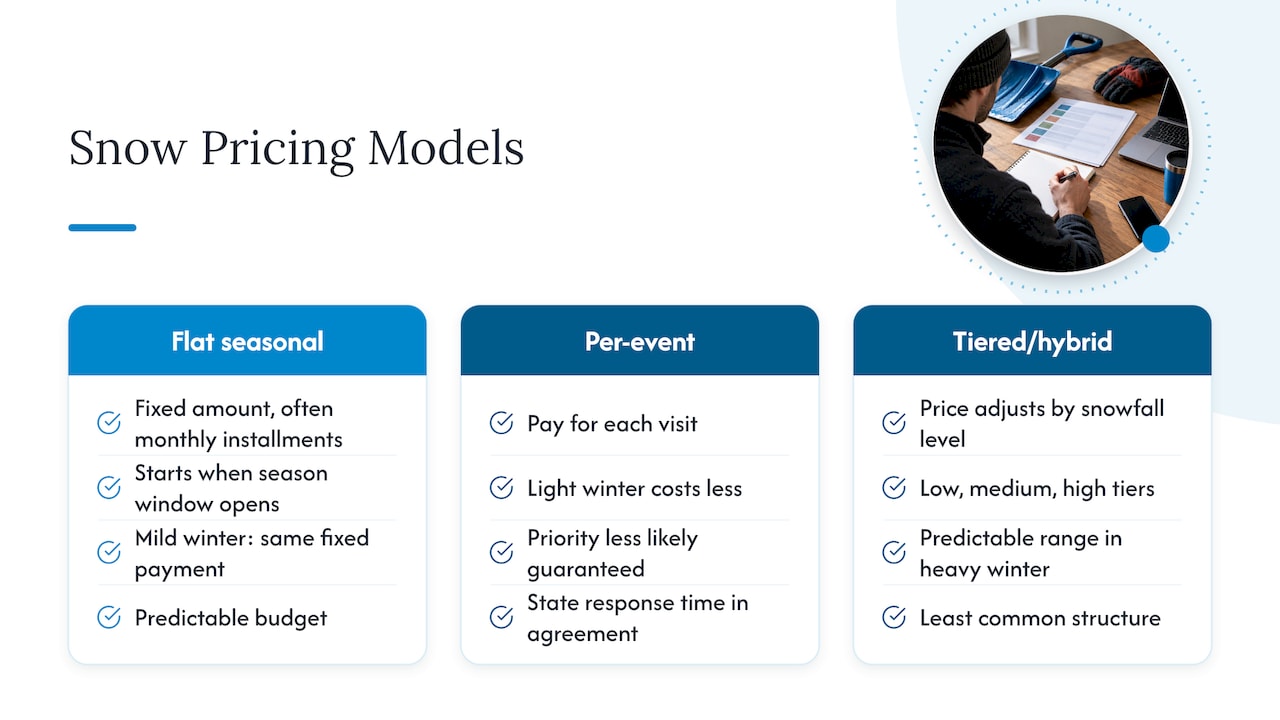
Flat seasonal rate. You pay a fixed amount, often in monthly installments, no matter how much snow falls. The contract usually starts when the season window opens, and you are covered from that date. The risk to you is paying for a mild winter. The benefit is a predictable budget.
Per-event pricing. You pay for each visit. Many owners like this because a light winter costs less, but the contractor has less reason to guarantee priority. Make sure the agreement still states a response time, or you may find yourself waiting behind seasonal clients.
Tiered or hybrid pricing. Industry leaders, including SIMA’s Rick Kier, describe a tiered seasonal model that adjusts price by snowfall level: low, medium and high. The contractor covers fixed costs in a mild winter, and the property manager gets a predictable range in a heavy one. It is the least common structure, but it is worth asking about if your budget needs a ceiling.
A billing guide for snow contracts also recommends that the agreement spell out whether the rate is flat or based on storm size, along with when invoices are issued and when payment is due. Decide that at signing, not after the first storm.
What Denver law adds to the timing picture
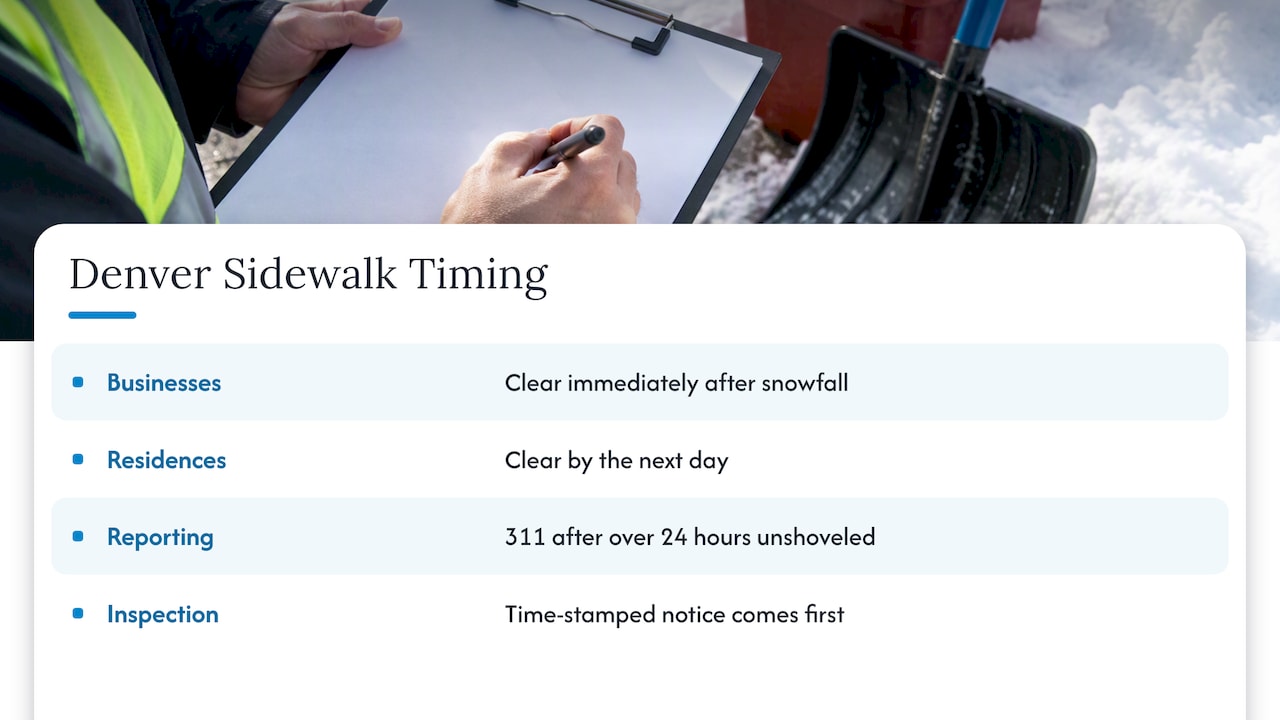
Your contract exists to help you meet a legal duty. In Denver, the city’s snow and ice fact sheet says that after snow stops falling, businesses must begin clearing sidewalks immediately, while residences need to clear by the next day. If a sidewalk is still unshoveled more than 24 hours after the event, anyone can report it through 311.
Enforcement starts with inspection. According to local news coverage, inspectors first leave time-stamped notices at properties with unshoveled sidewalks. Rules differ across metro cities, so a property in Aurora or Lakewood may face different timing than one in Denver. Check your city before you set your response time.
The practical conclusion: if you own a commercial property in Denver, a response time measured in “within 24 hours” does not fit your obligation. Your contract should call for sidewalk service that starts as soon as the snow stops. Our guides on who clears what for Denver property owners and sidewalk shoveling rules for downtown property owners go through the details by property type.
Why insurance and liability language belong next to the date
A start date means nothing if the provider cannot stand behind the work. Industry commentary frames snow removal as risk management: one expert quoted by a rental-industry blog says a single slip-and-fall lawsuit can cost more than five years of contracts. That is one reason owners should ask for proof of insurance before the season starts, and ask what the contractor’s policy covers.
Insurance questions are not limited to slip-and-fall. Snow load and melt can also affect a building’s roof and gutters, and owners should know what their own policy says about ice dam insurance coverage. That is a separate question from your plowing contract, but it is worth settling in the same month.
We also recommend asking for documented service visits. A log with date, time and work performed gives you a record if a fall is ever claimed. Our guide to five contract essentials for property managers covers this in more depth, and for associations, six nonnegotiable HOA snow contract terms lists what boards should require.
A checklist to review before you sign
- Effective date and end date. Written as calendar dates.
- Trigger depth. A number in inches, and how it is measured.
- Response time. Hours after trigger, or a deadline such as before opening.
- Sidewalks and entrances. Whether they are included and when they are cleared.
- Ice management. Whether anti-icing before a storm and de-icing after are included or billed separately.
- Snow hauling. What happens when piles outgrow the space.
- Payment schedule. Flat, per-event or tiered, with due dates.
- Insurance and documentation. Certificate of insurance and service logs.
- Renewal and termination. How the contract renews and how either side exits.
- Who to call. A dispatch number that is answered during a storm.
Our perspective on start dates
We have plowed Denver for over 44 years, and the pattern is consistent: the contracts that go wrong are rarely the ones with a bad price. They are the ones with vague timing. An owner signs in November, assumes service starts at the first flake, and learns during the first heavy storm that the agreement only says “as needed.”
Our approach is to start with the property. We walk or review the lot, note the entrances, loading areas, sidewalks and places where snow will pile, and then write the trigger depth and response time to match how the property is used. A retail lot that opens at 8 a.m. needs a different clock from a warehouse that runs overnight.
We run seasonal contracts from September through May, and we offer 24/7 emergency dispatch, because Denver storms do not care about the calendar. We also take same-day service for new and existing clients, which matters if you read this after the first storm has already hit. Estimates are free and pricing is given up front, so you know the number before you commit.
If you can only do one thing this month, do this: get the trigger depth and the response time in writing.
— Jesse
If you are signing late: what to do in late October
It is now late October, so many Denver owners are in exactly this position. You have not missed the season. You have, however, lost the early-booking advantage, so act with clear priorities.
- Ask about capacity first. Ask a provider whether they can add your property to an existing route. Routes that are dense serve you faster than a one-off stop.
- Request an effective date of signing. Do not wait for a November 1 start. Early storms in the Denver area are common enough to justify coverage now.
- Use per-visit service as a bridge. If you need time to compare seasonal bids, a per-visit agreement can cover you meanwhile. Our residential driveway and walkway clearing starts from $41.25 per visit.
- Pre-treat. Anti-icing before a storm cuts down on bonded ice, which is harder to remove later. Our commercial anti-icing and ice prevention guide explains when it pays off.
Start service with us
We plow and clear commercial, industrial, HOA and residential properties across the Denver metro, including parking lots, sidewalks, de-icing and snow hauling. If you want a contract with the dates, trigger and response time written down, request a free estimate through our Denver snow removal page, or see how we handle commercial parking lot plowing and residential driveway clearing. For storms already in progress, read what to expect from emergency plowing in a Denver snowstorm.
FAQ
When should a snow service contract start?
For a seasonal contract, the start date should come before the first likely snowfall. In the Denver area that means September or early October. Signing in late summer also gives you a better chance of getting a place on an efficient route.
Does the contract start on the day I sign or on a set calendar date?
It can be either, and the contract should say which. A signed contract with an effective date of signing starts coverage immediately, which is the better choice if you sign close to a storm. A fixed season start, such as September 1, works well when you sign early.
What is a trigger depth, and why does it matter?
A trigger depth is the amount of snow that obligates the contractor to come, for example 1 inch. Without it, you cannot tell whether a missed visit was a breach. Industry guidance lists it, along with response time, as a term owners often overlook.
Can I sign a snow contract in the middle of winter?
Yes, though your options narrow. Some providers will add you to existing routes or serve you on a per-visit basis first. We offer same-day service for new clients, so ask about onboarding even after the season has begun.
Sources
- Snow & Ice Build-Up Fact Sheet, City and County of Denver
- Denver snow removal: Sidewalk rules, fines and where to get help in the metro, Denver7
- Quality RFP Creation and Best Practices, SIMA
- Step by step, SIMA Snow and Ice Resource Center
- Model Contract for snow and ice management, Minnesota Pollution Control Agency
- Snow Removal Contract guide, VSBIT
- Snow Removal Contracts, VerticalRent
- Are Ice Dams Covered by Insurance?, AM Exteriors