
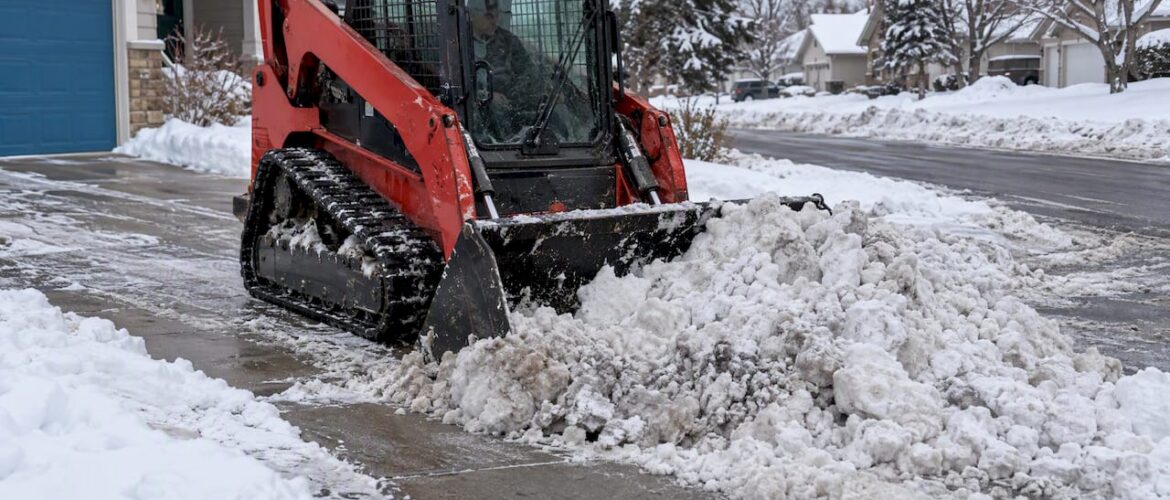
A windrow is the ridge of heavy, packed snow a plow leaves across the mouth of your driveway. In Denver, clearing it is almost always your job, not the city’s. You can shovel or blow it yourself, or hire a plow crew to cut through it. Either way, the snow has to go onto your own property, not back into the street.
This guide covers why the berm appears, who is responsible, how to remove it without hurting your back or your driveway, what hiring help costs, and how to keep it from stranding you before work.
TL;DR
- The plow berm at the end of your driveway is a by-product of clearing the street. Plow drivers generally cannot lift the blade at every driveway, so the cleanup falls to the property owner.
- Do not push the snow back into the street. Public guidance in Colorado treats that as a hazard and, in some places, a violation.
- Windrow snow is dense and heavy. Work in layers, fill the shovel only partway, and take breaks, because overexertion is the biggest risk in residential snow removal.
- Professional driveway clearing in the Mountain West typically runs about $45 to $90 per visit. Our own residential clearing starts from $41.25 per visit.
- Clear the berm after the plow passes, not before. Clearing early just means you do it twice.
Table of Contents
- Why the plow leaves a berm at your driveway
- Who is responsible for clearing the windrow
- When to clear it: timing the cleanup
- How to remove a driveway windrow yourself
- What if the berm is too big to move by hand
- What it costs to have a windrow removed in Denver
- Our perspective: how we handle berms
- Preventing a bad berm before the storm
- Hiring a pro: what to ask
- Get your driveway cleared in Denver
- FAQ
- Sources
Why the plow leaves a berm at your driveway
A plow blade moves snow off the traffic lanes and sideways. The curb side of the street is where that snow lands, and your driveway apron sits in that path. The result is a wall of snow that is often denser than what fell on your lawn, because it has been scraped, compressed and sometimes mixed with slush and ice.
Cities do not ignore the problem out of indifference. Municipal crews work on a road-first basis: open the routes emergency and transit vehicles need, then move down the priority list. Highwood, Illinois, explains that plowing often leaves a berm across driveway entrances, and that crews try to keep it to a minimum but cannot eliminate it. Asking a driver to lift the blade at every driveway would slow the whole operation and create traffic risks.
Scale matters in Denver too. The city’s transportation department says it plows roughly 2,050 lane miles of main streets with a fleet of 70 large plows. With that much road and that few trucks, the crews are moving fast, and driveway cleanup is not part of the job.
Why Denver windrows can be especially stubborn
Colorado snow swings between light powder and wet, heavy spring storms. A windrow built from wet snow, then frozen overnight, can be close to solid. Sun on a Front Range afternoon softens the surface, and the freeze that follows glazes it. If you have waited two days, expect to break up a crust before you can lift anything.
Who is responsible for clearing the windrow
In most Colorado jurisdictions the answer is the property owner. Grand County’s snow removal guidance describes how plowing is done in two stages, quick passes during the storm to keep roads open and cleanup afterward, and places the driveway entrance on the homeowner’s side of the line. The same guidance and other Colorado local rules also make clear that pushing snow back into the roadway is not allowed, because it creates hazards for commuters.
A few practical points follow:
- Your own pile goes on your own property. Lawn, planting beds away from trees and shrubs you care about, or the sides of the driveway are all fair game.
- Do not shovel into the travel lane. Even a small pile of snow in a street can freeze into a rut that catches tires.
- Check your local rules. Denver, Aurora, Lakewood, Littleton and HOA communities each have their own wording. Our page on who clears what at a Denver property is a good starting point for sidewalks and frontage.
Some communities elsewhere run assistance programs for residents who cannot do this work. Huntington, New York, for example, removes driveway berms for residents with a disability who meet income criteria. If you are older or have a medical limitation, ask your city or county whether a similar program exists before the next storm, and ask a neighbor or a contractor in the meantime.
When to clear it: timing the cleanup
The most common mistake is clearing the driveway, then watching the plow come by and bury it again. The better sequence:
- Clear the main driveway first, or let your plow service do it, while the storm is still moving through.
- Wait for the street plow to pass. In a long storm, that may be more than once.
- Remove the windrow last, in one session, so you are not repeating the heaviest work.
- Clear it before dark when you can. A berm that sits through a freeze is much harder the next morning.
If you have to leave for work before the plow arrives, plan to clear a narrow exit lane right after the pass anyway. A single lane the width of your tires is far easier than the full apron.
How to remove a driveway windrow yourself
The work is not complicated, but it is hard on the body. Utah State University Extension says the main risk in residential snow removal is overexertion and injury from poor technique. Its advice is to walk slowly and fill the shovel partway rather than heaping it.
With a shovel
- Cut the berm into layers. Slice the top 6 to 8 inches off, toss it to the side, then take the next layer. Do not try to lift the full depth in one go.
- Use the right blade. Lightweight aluminum shovels work best for general use, and a long-handled, square-ended shovel is good for breaking ice on concrete, according to the USU Extension guide.
- Push where you can, lift where you must. Pushing the loosened snow to the sides of the apron is less strain than throwing it.
- Break up ice first. If the windrow is frozen, chop it into blocks with the edge of the shovel before lifting. Do not pry against the concrete edge.
- Take breaks. If you have heart problems or other medical concerns, ask your doctor before doing heavy shoveling, and stop right away if you feel chest pain or unusual shortness of breath.
With a snowblower
A snowblower can handle the top of a windrow, but dense, icy berms can overload a single-stage machine. Take thin passes and let the machine work.
USU Extension’s safety guidance is specific on the points that cause injuries:
- Clear the driveway of rocks, hoses and toys before you start, so the machine cannot throw them.
- On gravel, set the intake height at least 1 inch above the surface. Thrown stones can travel more than 60 feet.
- If the chute clogs, never use your hands, even with the engine off, because the impeller can still turn from stored energy. Use a wooden dowel or plastic rod instead.
If you are preparing your equipment now, a fall maintenance checklist for homeowners is a handy time to add the snowblower: check the shear pins, the fuel and the skid height before the first storm, not during it.
Protecting pavers, gravel and decorative concrete
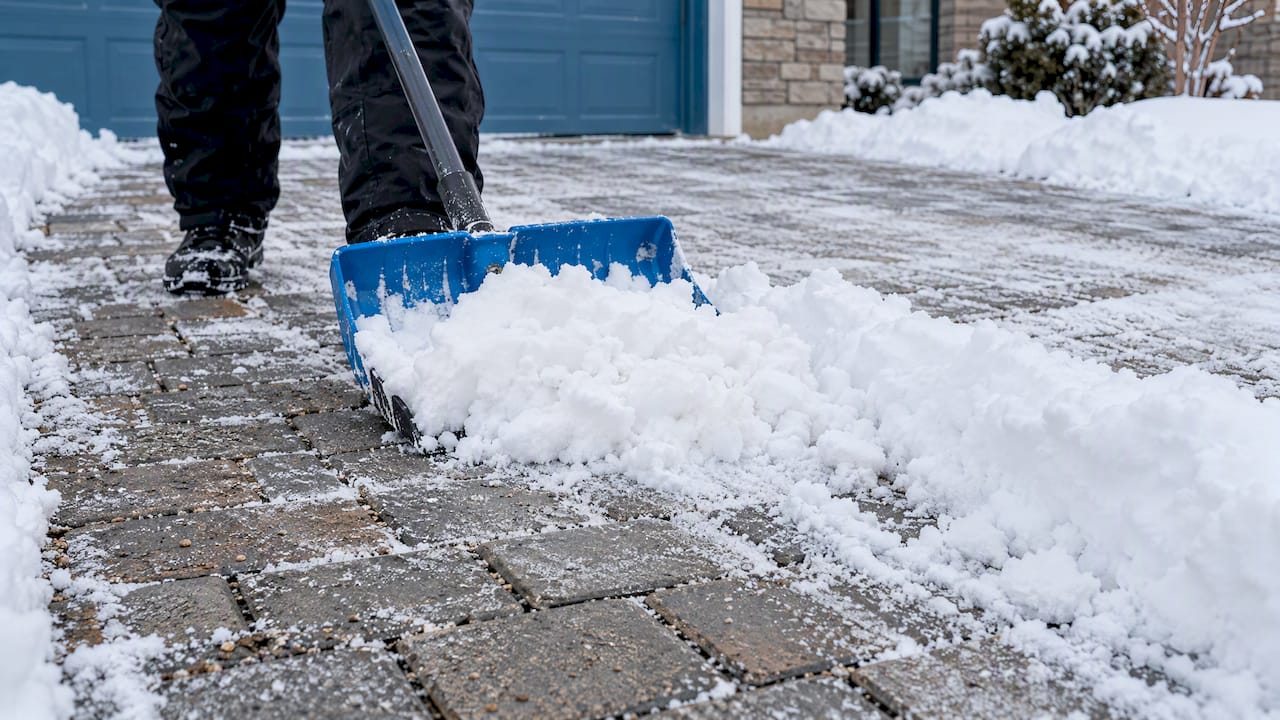
Metal blades and rock salt can scar decorative surfaces. On pavers, use a plastic-edged shovel or a plow with a rubber or poly cutting edge, and leave a thin layer of snow rather than scraping to bare stone. On gravel, keep the blade or skid raised so you do not scoop up your driveway along with the snow.
What if the berm is too big to move by hand
Some windrows are beyond a sensible DIY job: waist-high berms on a steep driveway, ice-packed ridges after a multi-day storm, or a berm at the end of a long shared drive. Here, hiring help is a safety decision, not a luxury.
A storm cleanup service or a snow contractor can move far more snow in minutes than you can in an hour, and they carry the equipment to do it without damaging the pavement.
What the equipment difference looks like
| Method | Best for | Watch out for |
|---|---|---|
| Hand shovel | Small, fresh berms, short aprons | Strain, ice that has frozen solid |
| Single-stage snowblower | Light to moderate berms | Overload on dense, icy snow, gravel stones |
| Pickup with a plow blade | Standard driveways, repeated clearing | Needs room to stack, can scrape pavers |
| Skid steer with bucket or pusher | Large, deep or icy windrows, long drives | Typically a surcharge, needs space to maneuver |
What it costs to have a windrow removed in Denver
Prices depend on snow depth, driveway size, and whether the crew needs heavier equipment. Lawnity’s 2026 cost guide puts residential driveway plowing in the Mountain West, Denver included, at about $45 to $90 per visit for a two-car driveway, with seasonal contracts of roughly $500 to $900 per winter. The same guide says a skid steer usually adds a surcharge of $50 to $150 for faster, cleaner work on large driveways. A separate national cost roundup gives a wider range of $60 to $400 per event, depending on driveway size, snow depth and equipment.
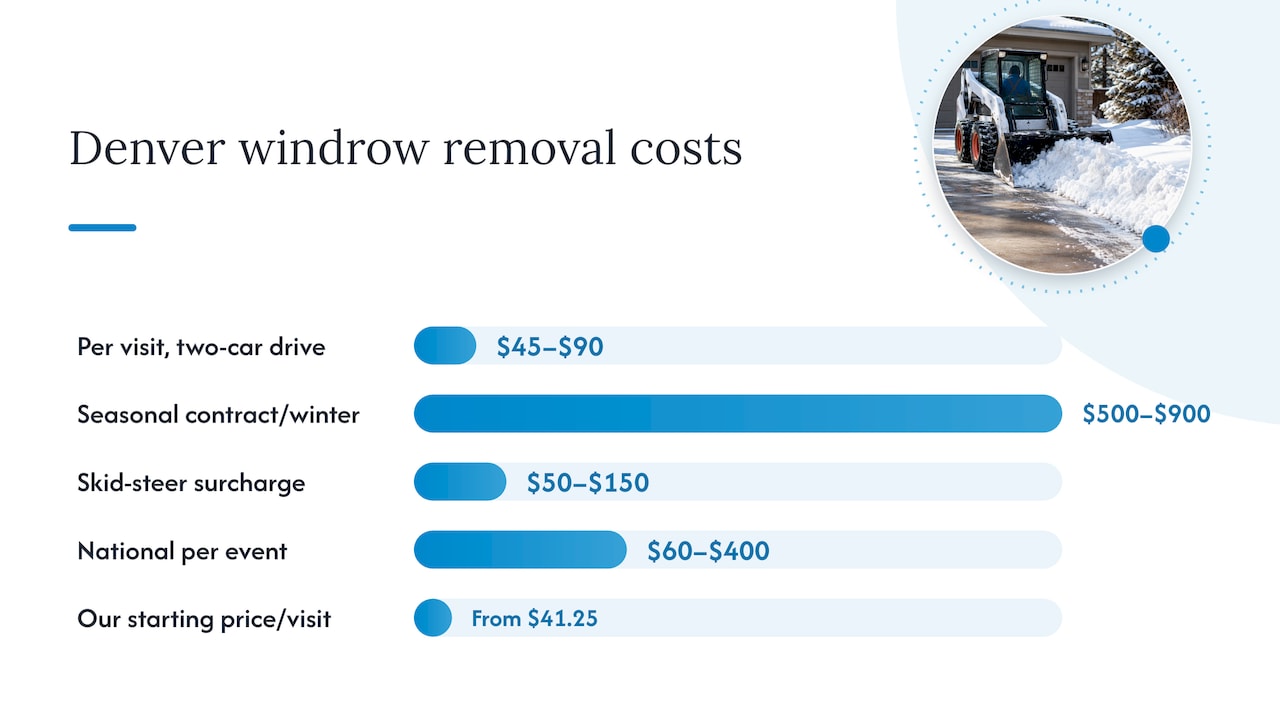
Those are market ranges, not our quotes. For our own pricing, residential driveway and walkway clearing starts from $41.25 per visit. Other jobs are quoted after a free estimate, because a heavy berm on a steep, long driveway is a different job from a flat two-car pad.
A few things push the number up:
- Waiting too long. An ice-hard berm takes longer than a fresh one.
- Limited stacking space. If there is nowhere to put the snow, it may need to be hauled.
- Gravel or paver surfaces. These need lighter equipment and slower work.
- Storm timing. Calls in the middle of a storm, or the morning after a big one, are in demand.
For a deeper breakdown, see our driveway plowing cost guide for Denver.
Our perspective: how we handle berms
We have been plowing Denver driveways, lots and sidewalks for more than 44 years, and the windrow question comes up every winter. Here is how we think about it.
First, the berm is not an afterthought to us. When we plow a driveway, we plan where the snow will go before the truck moves, and we try to leave the apron clear so you can get out, rather than clear the driveway and leave the windrow behind. If the street plow comes through after us, we can return, and that is something to settle in your service plan up front.
Second, we think a seasonal plan is usually the calmer choice for a homeowner who has a long or sloped drive, or who has to be on the road early. Our seasonal contracts run September through May, and our team is available around the clock when heavy snow hits. The point is that you wake up to a driveway you can use, not a to-do list.
Third, we say what we are going to charge before we start. Free estimates and up-front pricing are how we work, because the worst moment to discover the price is when you are standing in the cold with a shovel.
Finally, we would rather you stay healthy than save a few dollars. If a berm is heavy, icy or deep, let us move it.
— Jesse
Preventing a bad berm before the storm
You cannot stop the plow, but you can make the cleanup easier.
- Mark the edges. Stakes along the driveway edge help any crew, yours or mine, avoid the lawn and the sprinkler heads.
- Keep cars off the street. Plows clear more cleanly when the curb is empty, and many Colorado towns restrict overnight parking in winter. Frisco, for example, announced winter enforcement of its overnight storage rules starting November 1, 2025. Check your own city’s dates.
- Pre-treat the apron. An anti-icing treatment before a storm keeps snow from bonding to the pavement, so a windrow lifts off more cleanly.
- Think about drift. Wind can build deep drifts at driveway entrances. Research on blowing snow shows that drifting can add significantly to winter maintenance costs and safety hazards, and that snow fences and site design reduce it.
- Leave room to stack. Decide where the plowed snow will go before it falls. A pile on the sunny side melts faster.
Hiring a pro: what to ask
Whether you call us or someone else, ask these questions before you sign anything.
- Do you return after the street plow passes, and is that included?
- What is the trigger depth for a visit, and how is the price set?
- Do you carry liability insurance, and do you document your visits?
- What equipment will you use on my surface: concrete, pavers, gravel?
- Where will the snow go, and is hauling extra?
- Is there a seasonal option, and what does it cover?
If you manage an HOA or apartment community, the questions get longer, and our guide to HOA snow contract terms covers what boards should insist on.
Get your driveway cleared in Denver
We clear residential driveways and walkways across the Denver metro area, with free estimates and flexible service plans, including seasonal contracts for September through May and 24/7 emergency response. Residential driveway and walkway clearing starts from $41.25 per visit. See our driveway and walkway clearing services or request a free estimate before the first storm.
FAQ
Is the city responsible for removing the berm at the end of my driveway?
Usually not. Plow crews work road-first and generally cannot lift the blade at every driveway, so the property owner clears the windrow. Some places, such as Oakville, Ontario, run paid windrow programs, but that is a local exception, so check with your own city or county.
Can I push the berm back into the street?
No. Colorado local guidance treats pushing snow into the roadway as a hazard for drivers, and in some municipalities it is a violation. Pile the snow on your own property, on the lawn or beside the driveway.
How much does it cost to have a driveway plowed in Denver?
Market ranges for the Mountain West run about $45 to $90 per visit for a two-car driveway, according to Lawnity. Our residential driveway and walkway clearing starts from $41.25 per visit, and we give free estimates for larger or more complex jobs.
Is it safe to use a snowblower on a windrow?
It can be, with care. Clear debris first, take thin passes, raise the intake at least 1 inch on gravel, and never clear a clogged chute with your hands. If the berm is icy and dense, a plow or skid steer is a better tool.
Sources
- Practice Safe Snow Removal, Utah State University Extension
- Snow Removal, Grand County, CO
- Snow Removal, Highwood, IL
- Snow Removal, City and County of Denver
- Snow Berm Removal, Town of Huntington, NY
- Snow Removal Cost 2026, Lawnity
- Driveway Snow Removal Cost, Well Built Florida
- Town of Frisco snow removal cooperation notice
- Controlling Blowing and Drifting Snow with Snow Fences and Road Design
- Driveway Windrow Snow Clearing, Oakville