
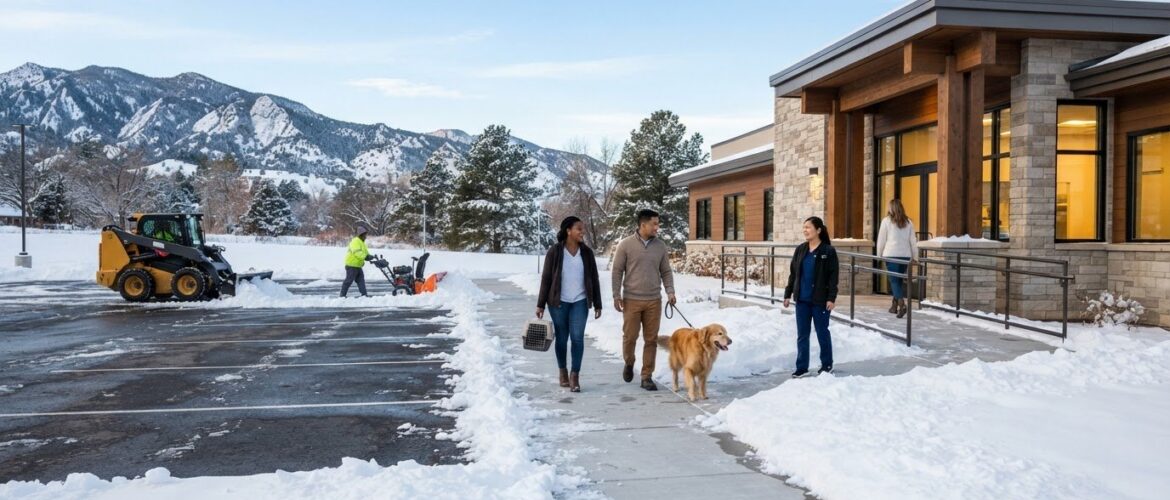
What good is a cleared parking lot if snow still blocks the clinic entrance? Choosing commercial snow removal for veterinary clinics means planning for more than plowing. Staff, clients carrying pets, and animals arriving for care all need clearly defined access routes, even when winter weather disrupts normal operations.
You likely already know that snow and ice can make entrances, accessible paths, parking, and service areas harder to reach. The challenge is finding a provider whose scope and equipment fit your property, while setting clear expectations before a storm. This guide explains how to identify priority routes, discuss snow placement so plowing doesn’t interfere with vehicle movement, and clarify communication, clearing, and ice management procedures.
Snow Removal Denver is a family-owned commercial snow removal provider serving the Denver Metro area, with over 44 years of experience. Its fleet includes trucks, front-end loaders, and snow blowers, which may suit different areas of a property. The guide also outlines questions to ask about service triggers and site-specific needs, so you can compare providers and build a practical winter plan for your clinic.
Key Takeaways
- Map the routes your clinic relies on, from client parking and entrances to deliveries and animal transport, before comparing providers.
- For commercial snow removal for veterinary clinics, request written details on included areas, priority zones, equipment, and exclusions.
- Walk the property to identify where shade, slopes, exposure, and foot traffic may create different snow and ice concerns.
- Clarify how the provider communicates, what service expectations apply, and how changed instructions or snow placement decisions will be handled.
- Compare the provider’s capabilities with your site constraints, then confirm the agreed scope in writing before winter weather arrives.
Why Veterinary Clinics Need a Snow Removal Plan That Prioritizes Access
A clinic manager’s first winter concern is practical: can staff, clients, deliveries, and animals reach the areas they need to use? Snow may narrow a parking aisle, cover a walkway, or build up beside an entrance. A general request to plow the lot doesn’t necessarily explain which routes matter most or where snow should be placed. A site-specific plan gives the clinic and provider a shared picture of priority access.
Snow removal can involve different methods and equipment, as outlined in this overview of commercial snow removal methods. The useful question for a clinic is how the agreed work fits its property and daily operations. Commercial snow removal for veterinary clinics should start with clear access priorities, not assumptions about what a standard plowing visit includes.
Which clinic areas should a snow plan prioritize?
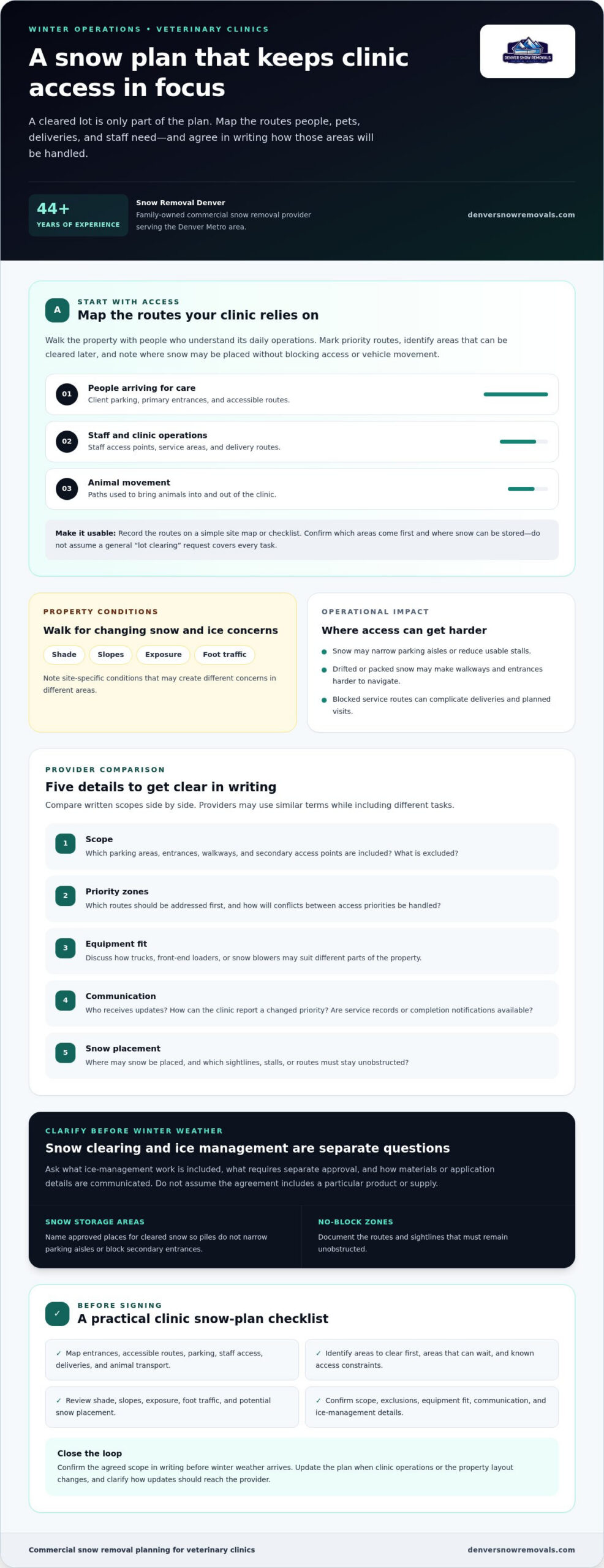
Walk the property with the people who understand how it operates. Mark primary entrances, accessible routes, parking areas, and staff access points. Then identify delivery and service routes, along with the paths used to bring animals in and out. Priorities will vary with the clinic’s layout, parking configuration, entrances, and operating routines.
Record these locations on a simple site map or written checklist. Distinguish the routes that should remain usable from areas that can be cleared later, and note where snow can be placed without blocking access or vehicle movement. Confirm the details with the provider rather than assuming every task is included in a general plowing request.
How can snow affect daily clinic operations?
Snow-covered stalls can reduce usable parking, while drifted or packed snow may make walkways and entrances harder to navigate. Staff may have trouble reaching the building, and clients may need more time to get from their vehicles to the entrance. A blocked service route can also complicate deliveries or other planned visits. These are operational risks to plan for, not reasons to assume every clinic handles emergencies.
Before the first storm, document the priority routes, known access constraints, and agreed snow-placement areas. Review the plan when clinic operations or the property layout changes, and clarify how updates should reach the provider. A clear, current plan helps both sides understand which areas matter most and reduces reliance on rushed decisions during winter weather.
What to Compare When Hiring Commercial Snow Removal for a Veterinary Clinic
Providers may use similar terms while including different tasks. Compare their written scopes side by side, and make sure the agreement reflects the clinic’s actual access priorities. This matters for commercial snow removal for veterinary clinics because a cleared parking lot alone may not address walkways, secondary entrances, or areas where ice creates a separate concern.
| Compare | What to clarify |
|---|---|
| Scope | Which parking areas, entrances, walkways, and secondary access points are included? What is excluded? |
| Priority zones | Which routes should be addressed first, and how should the provider handle conflicts between access priorities? |
| Equipment | How might trucks, front-end loaders, or snow blowers suit different parts of the property? |
| Communication | Who receives updates, how can the clinic report a changed priority, and are service records or completion notifications available? |
| Snow placement | Where may cleared snow be placed, and which sightlines, stalls, or routes must remain unobstructed? |
Which service-scope questions should a clinic ask?
Ask the provider to name each included area rather than relying on a broad phrase such as “lot clearing.” Confirm how snow clearing and ice management are handled separately at the property. Ask what ice-management work is included, what requires separate approval, and how any materials or application details are communicated. Don’t assume an ice-management scope includes a specific product or supply.
Snow placement deserves equal attention. A pile that seems convenient during plowing could narrow a parking aisle or block a secondary entrance. Put approved storage areas and no-block zones in writing. For broader planning context, see this commercial snow removal guide.
How should equipment and communication factor into the choice?
Match equipment discussion to the site, not just the provider’s fleet list. Trucks may be suitable for larger paved areas, while loaders or snow blowers may suit other spaces depending on layout and access. Ask the provider which equipment may fit your property and confirm the expected scope in writing. The Occupational Safety and Health Administration’s guidance on preventing slips on snow and ice reinforces why access and surface conditions deserve attention.
Before signing, identify the clinic contact and ask how updates, revised priorities, and completion information will be handled. Verify which communication methods and service records the provider can offer. To explore a Denver-area provider’s commercial snow removal and ice management, review Denver commercial snow removal services.
How to Assess a Snow Contractor’s Plan for Clinic Access and Ice
A useful plan should reflect what happens on your property, not just describe a standard service. Walk the site with the contractor, rank the routes the clinic depends on, define the agreed snow and ice management scope, then confirm how updates and decisions will be handled. This sequence gives both sides a practical reference before conditions change.
Look closely at how surfaces vary. A shaded walkway may stay icy after a sunny parking area has cleared. Sloped pavement, exposed entrances, and high-traffic paths can also present different conditions across the same property. Ask how the contractor assesses these areas and discusses changing conditions. Don’t assume a particular service trigger, inspection schedule, or response arrangement unless it’s confirmed in writing.
What should the clinic document during a site walk?
Use a property map or annotated site plan to mark entrances, pedestrian paths, parking, loading areas, and locations where snow must not be piled. Note narrow turning areas, gates, and spots that may be blocked by parked vehicles. Identify priority routes and name the clinic contact authorized to approve changes, so instructions have a clear path when operations or conditions shift.
Then review the map with the contractor. Ask whether the proposed approach accounts for each marked constraint, and record any limits or areas that aren’t included in the work. A site review is more useful when it leads to clear written scope, rather than informal assumptions about what “clear the property” means.
How can a clinic evaluate ice-management communication?
Ask how the contractor assesses icy areas and communicates recommended actions. Clarify who at the clinic can authorize work, which contact method will be used, and how operational updates or changed priorities should be shared. Discuss what information the clinic can expect about work performed, but verify whether records or completion notices are available instead of assuming they are part of the service.
Clear communication supports informed decisions, but no plan can promise that a surface will remain free of ice or eliminate the risk of a fall. Focus on practical steps: identify concern areas, agree on how they’ll be reviewed, and define how recommendations and approvals will be handled. For related planning considerations, see Denver ice management services.
For commercial snow removal for veterinary clinics, the assessment should end with a written plan that reflects the property’s layout, access constraints, and communication preferences. Review it when clinic operations or site conditions change, and make sure the designated contacts know how updates are approved.
Questions to Ask Before Signing a Veterinary Clinic Snow Removal Agreement
A contract should make the service understandable before winter weather puts the plan to the test. For commercial snow removal for veterinary clinics, don’t rely on broad phrases such as “snow service” without checking which areas and tasks they cover. Terms vary by provider, so read the actual agreement and ask for written clarification wherever the scope, process, or exclusions are unclear.
Which contract details should the clinic clarify?
Use these questions to guide the review:
- Included areas: Which parking areas, walkways, entrances, and secondary access points are covered?
- Snow and ice work: Which tasks are included, and what requires separate approval?
- Service expectations: How is service requested or initiated, and what expectations or conditions are stated in the agreement?
- Communication and records: Who will communicate with the clinic, how are updates shared, and what documentation, if any, is available?
- Exclusions and access: What is not covered, and must gates, parking areas, or work zones meet specific access conditions?
- Snow placement: Where may snow be piled, and which clinic routes or areas must remain clear?
- Plan changes: Who can approve revised priorities, and how should those instructions be submitted and confirmed?
Request that agreed priorities and snow-storage restrictions appear in the written scope or an attached site plan. If a term could be interpreted in more than one way, ask the provider to explain it before signing. A broader Denver snow removal company selection guide can help you consider additional contractor questions.
How can the clinic prepare before winter weather?
Assign a primary contact and a backup who can relay site changes and follow the agreement’s approval process. Share a current property map that identifies priority routes, access constraints, and restricted snow-storage zones. Review it with the provider so the written scope and the clinic’s expectations match.
Make the plan usable for staff, too. Let relevant team members know whom to contact, who can authorize a change, and how updates should be passed along. Revisit the map and agreement if entrances, parking arrangements, gates, or other site conditions change. For a Denver Metro clinic comparing commercial snow plowing and ice management options, review Snow Removal Denver’s commercial services and confirm the proposed scope and communication details directly with the provider.
Choose a Denver Snow Removal Partner That Fits Your Clinic’s Property
Make the decision in this order: prioritize the routes your clinic relies on, confirm the exact work included, and check whether the provider’s equipment and approach fit the property’s constraints. A clear agreement helps keep expectations aligned, but the plan should also make sense on the ground, from parking and walkways to narrow access points and approved snow-storage areas.
Snow Removal Denver is a family-owned commercial snow removal provider serving the Denver Metro area, with over 44 years of snow removal experience. Its commercial service covers parking lots, carports, and walkways, and its fleet includes trucks, front-end loaders, and snow blowers. Those are options to discuss for different site areas, not a promise that particular equipment will be assigned to a clinic. Confirm whether the clinic’s location is within the provider’s service area.
When might Snow Removal Denver suit a clinic property?
A clinic with commercial parking, carports, and walkways may have areas that align with the provider’s listed commercial scope. A property discussion can help determine whether the work being considered fits the clinic’s access routes and site layout. Be specific about what must remain usable and ask which tasks the provider can include. The discussion should establish fit based on the actual property, not an assumption of veterinary-clinic specialization or prior clinic projects.
Equipment suitability also depends on site constraints. A truck, loader, or snow blower may be relevant to different areas, but turning space, parked vehicles, and tight routes can affect what is practical. Ask the provider to review those details and clarify the proposed equipment and scope in writing.
What information should a clinic provide when requesting an estimate?
Give the provider enough detail to assess the property and prepare a relevant estimate. Share:
- Location and layout: The property address and a site map or clear description of its layout.
- Priority areas: Main and secondary entrances, parking areas, walkways, and staff or service access routes.
- Site constraints: Restricted snow-storage locations, narrow access routes, gates, and areas that may be blocked by parked vehicles.
- Planning questions: Which areas and snow or ice management work can be included, how the provider communicates updates, and how changed instructions are handled.
Review the proposed scope against your clinic’s priorities before agreeing to service. To discuss your property and request an estimate, contact Snow Removal Denver about commercial snow removal.
Set Your Clinic Up for a More Prepared Winter
A dependable snow plan starts with usable access. Identify the routes that matter to your clinic, confirm exactly which areas and ice-management tasks are included, and put snow placement and communication expectations in writing. These steps help you compare commercial snow removal for veterinary clinics based on your property’s real needs, not assumptions about what a general plowing request covers.
Snow Removal Denver is a family-owned provider serving the Denver Metro area, with over 44 years of experience. Its commercial service covers parking lots, carports, and walkways, with trucks, front-end loaders, and snow blowers available as equipment options to discuss for different site areas. Confirm the proposed scope and equipment fit your property before making a decision.
Ready to talk through your clinic’s layout, priority entrances, parking, and access constraints? Request a commercial snow removal estimate for your Denver clinic. A clear plan can help your team approach winter weather with greater confidence.
Frequently Asked Questions
Can commercial snow removal be tailored to a veterinary clinic?
Yes, a contractor can discuss a site-specific scope, but the written agreement should name the included areas and service terms. For commercial snow removal for veterinary clinics, share entrance, parking, walkway, delivery, and animal-transport priorities during the property review. Snow Removal Denver serves commercial properties across the Denver Metro area and lists parking lots, carports, and walkways within its commercial service. Confirm the proposed scope directly, and don’t assume veterinary-clinic-specific experience.
What areas should a veterinary clinic prioritize for snow removal?
Start with routes people need to reach and enter the building, including primary entrances, accessible paths, and relevant parking areas. Depending on the property and clinic operations, staff access, delivery areas, and animal-transport routes may also need attention. Mark these locations on a site map and review them with the contractor before winter weather. Priorities should reflect the actual layout, not a generic assumption about every clinic’s needs.
How should a clinic compare snow removal contractors?
Compare each proposal’s written scope, priority areas, equipment fit, snow-placement plan, ice-management details, and communication process. Ask how the provider will account for site constraints and who can approve changes. Don’t treat another company’s published service trigger as an industry standard or assume it applies to your property. Review the actual agreement, then confirm any service expectations that matter to your clinic before signing.
What happens if snow blocks a clinic entrance or parking area?
Follow the clinic’s access and communication plan, then contact the provider using the process agreed in the contract. Clearly identify the blocked entrance or parking area and explain whether priorities have changed. The provider’s response timing and available work depend on the agreement, current conditions, and capacity. Confirm those expectations in advance, and avoid relying on an assumed response time or a promise that isn’t written into the contract.
Does commercial snow removal include ice management?
Not necessarily. Snow clearing and ice management may be listed as separate tasks or covered under different terms. Ask how icy areas are assessed, what work is included, who authorizes it, and how updates are communicated. Confirm approved materials and any site restrictions directly with the provider. Don’t assume ice management includes supplying a particular de-icing product, since product supply and treatment details should be explicitly verified.
How much does commercial snow removal for a veterinary clinic cost?
Costs vary with the property’s size and layout, the requested scope, access requirements, and the agreement’s terms, so a general figure may not reflect your clinic’s needs. Request an estimate based on the actual property and compare proposals using the same list of areas and tasks. Check what is included, what may require separate approval, and whether the ice-management scope is addressed separately.
When should a veterinary clinic arrange snow removal service?
Begin planning before winter weather arrives. This gives the clinic time to map priority routes, discuss access constraints, and review the proposed agreement without relying on rushed decisions during a storm. Ask the provider how service is initiated and which conditions or requests are covered. Dispatch practices and timing vary, so confirm them directly. Review the plan again if the property, access needs, or clinic operations change.