
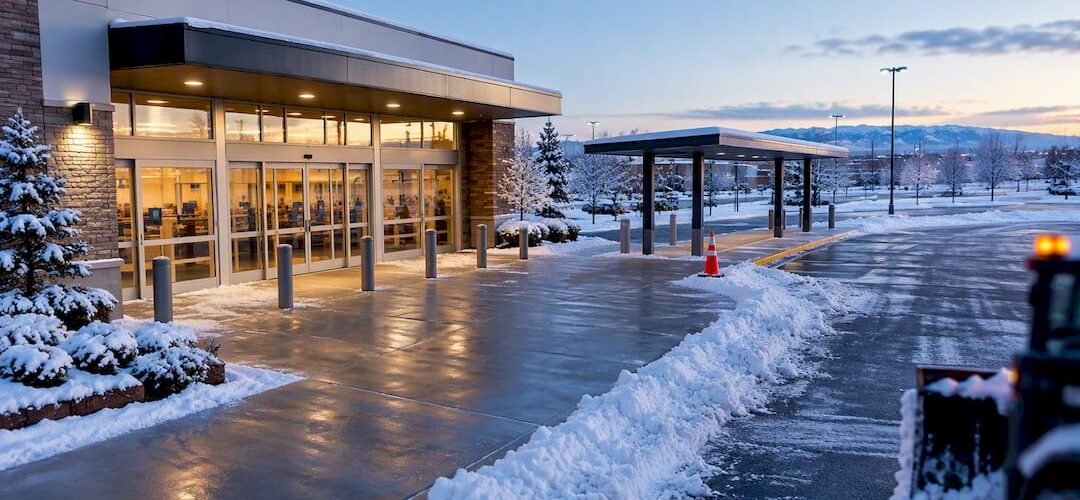
A retail store snow removal plan works when it keeps entrances, parking, and curbside pickup clear enough that customers can safely reach the register, while shielding the business from slip-and-fall claims. That means a site survey, written SOPs with insurance and service-level terms, preseason readiness, a storm-day sequence, and photo documentation of every visit. If you have not already done a preseason site walk and locked in your SOPs with a vendor, that is the first call you should make.
TL;DR:
- A retail snow removal plan must include a site survey identifying hazard zones, clear SOPs with response triggers, and documentation procedures to ensure liability protection.
- Preseason planning should begin six to eight weeks before the first frost, focusing on vendor selection, site marking, and equipment readiness before storms arrive.
- Snow storage zones should be marked in advance using stakes or spray paint to prevent improper dumping and protect sightlines, drains, and signage.
- During storms, a three-pass approach prioritizes safety by clearing entrances first, then parking areas, and finally addressing ice risk around walkways, with de-icing tailored to temperature conditions.
- Maintaining detailed, timestamped service records and photos proves crucial in defending against slip-and-fall claims and supports future contract negotiations.
Table of Contents
- What a Retail Snow Removal Strategy Actually Protects
- How Do You Survey a Retail Site for Snow Risk?
- Building Your Preseason Timeline and Supply Checklist
- Writing SOPs and Vetting a Snow Removal Vendor
- Running the Storm-Day Playbook
- Keeping Records That Hold Up After a Storm
- What Denver Snow Removal Sees on Retail Properties
- Why Snow Planning Belongs in Your Operations Budget
- Getting Your Retail Snow Plan Built With Denver Snow Removal
- Templates and Guides Worth Bookmarking
- Sources
- FAQ
What a Retail Snow Removal Strategy Actually Protects
A retail snow removal strategy for stores is not really about snow. It is about protecting three things at once: the customer who could slip on your sidewalk, the sales you lose when a lot sits unplowed during your first hour of business, and the reputation that takes a hit when your storefront looks abandoned after a storm. Retailers who skip formal planning tend to discover the cost the hard way, usually in the form of a lawsuit, a missed Saturday, or both.
The liability side is real and well documented. Facilities practitioners who build winter checklists point out that unaddressed hazards, from cracked walkways to pooling meltwater near entrances, are among the most common triggers for injury claims on commercial property. A documented plan does not eliminate risk, but it gives you a paper trail showing you acted reasonably.
A snow-blocked lot costs more than a plow bill. Every hour your parking lot stays impassable during a storm is an hour of lost foot traffic you cannot get back, and Colorado’s storm season often overlaps with your busiest retail weeks.
A working plan for retail snow control usually includes:
- A written site survey identifying hazard zones and snow storage areas
- Standard operating procedures with clear triggers and response times
- Vendor contracts specifying insurance, indemnity, and documentation requirements
- A storm-day sequence prioritizing entrances, accessible parking, and curbside pickup
- Post-storm photo and log records tied to timestamps and weather data
How Do You Survey a Retail Site for Snow Risk?
Start by walking the property in daylight, ideally before the first frost, and mapping what your business calls “revenue zones.” These are the spots where a blocked path directly costs you a sale: main entrances, curbside pickup spaces, accessible parking stalls, and the primary walking path from the lot to the door. Retail-focused planning guides recommend mapping these zones during summer so nobody is guessing about priorities once snow is already falling.
While you are out there, photograph and mark every physical hazard: cracked pavement, low spots where water pools, uneven curb transitions, and any drain grate that could get buried and cause runoff to refreeze. Note where downspouts empty onto walkways, since that water becomes ice the moment temperatures drop.
Your checklist should cover:
- ADA-compliant access routes from parking to entrance, marked and measured
- Cart corral locations and whether they interfere with plow paths
- Loading dock and delivery access, which needs clearing on a different schedule than customer areas
- Staff parking, often deprioritized but still a liability if employees are slipping in the back lot
- Storm drains and grates that must stay visible and unobstructed
Choosing snow storage areas matters more than most managers expect. Piled snow blocks sightlines for drivers backing out, buries drains and causes flooding on thaw days, and can bury signage that customers rely on to find your entrance. Pick storage zones on the site survey, not during the storm.
Pro Tip: Mark your snow storage zones with stakes or spray paint before winter. Crews working at 3 a.m. in a whiteout will not know your lot the way you do, and a marked pile zone keeps them from dumping snow against your loading dock doors.
Building Your Preseason Timeline and Supply Checklist
Winter readiness for a retail property should start in summer, not October. Industry guidance on snow and ice facility readiness recommends beginning preparation 6 to 8 weeks before your area’s average first frost, which for most Denver retailers means starting the process by late summer.
A realistic preseason sequence includes starting in summer to issue requests for proposals to vendors, completing your site survey, and marking revenue zones and hazards; then in early fall selecting and signing your vendor contract, confirming insurance documentation, and scheduling an on-site kickoff walkthrough; inspecting and servicing equipment, checking generators and backup lighting, and confirming your de-icer inventory in early fall; and finally stocking signage, entry mats, and spare materials before the first snowfall arrives, without specific month references.
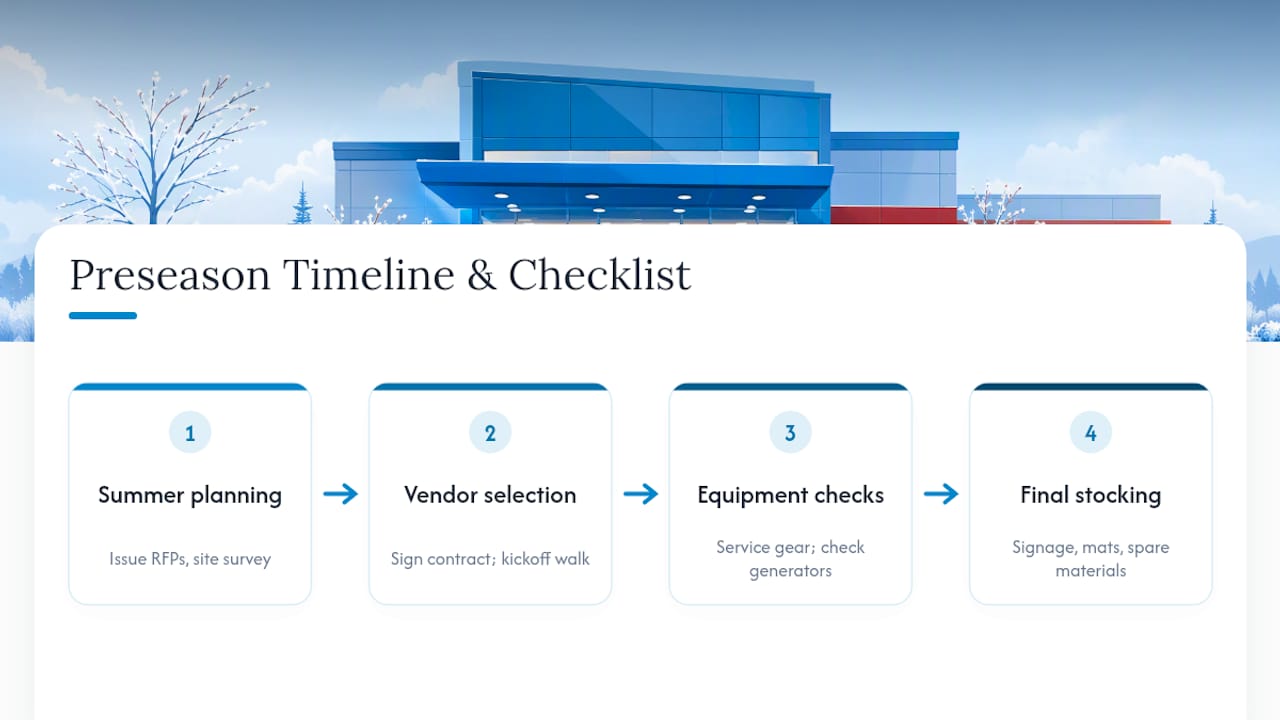
Your supply inventory should include salt and calcium chloride de-icers sized to your square footage, spare plow blades if you own equipment, backup generators for lighting during outages, wet-floor signage for entryways, and high-traffic entry mats that cut slip risk indoors.
Define your service triggers now, while you have time to think clearly. Most commercial contracts specify a snowfall depth, often 1 to 2 inches, that automatically activates plowing, plus separate triggers for ice accumulation regardless of snow depth. Put those numbers in writing, along with response-time language, before the contract is signed.
Writing SOPs and Vetting a Snow Removal Vendor
Your standard operating procedures should read like instructions, not suggestions. Facilities managers who have dealt with vendor disputes recommend using explicit, contractual language such as “the vendor will” or “the vendor must,” rather than vaguer phrasing that leaves sequencing or material choice open to interpretation.
An SOP built for a retail property should specify:
- The exact clearing sequence (entrances first, then accessible stalls, then general parking)
- Which de-icing material to use in which conditions
- Minimum pass frequency during an active storm
- Photo or GPS timestamp requirements for every visit
Your contract needs to go further than the SOP. Require a certificate of insurance naming your business as an additional insured, not just a general liability policy the vendor happens to carry. Ask for indemnity language that protects you if the vendor’s work, or lack of it, contributes to an injury. Specify response-time windows tied to your service triggers, and require documented proof of service, ideally photos with timestamps, for every visit.
Vetting the vendor itself matters as much as the paperwork. Ask for client references from other retail properties, confirm the equipment fleet can handle your lot size, and check whether crew leads hold recognized snow management credentials. Retail facility guidance suggests asking directly about Certified Snow Professional status when comparing providers, since that credential signals real training rather than a plow truck and a hope.
Pro Tip: Do the kickoff walkthrough with your vendor in person, not over the phone. Walk the exact route their crew will drive, point at the drain grates, and take photos together. Disputes almost always trace back to something nobody discussed before the first snowfall.
Running the Storm-Day Playbook
Once snow starts falling, sequencing decides whether your store stays open or turns into a hazard. A three-pass approach, widely used in retail parking lot planning, keeps priorities clear even when conditions change fast.
- First pass: Clear drive lanes, accessible parking stalls, main entrances, curbside pickup zones, and fire lanes. This pass exists to keep the property legally usable and safe, not to make the lot look tidy.
- Second pass: Restore full parking capacity, clear around cart corrals, and check that signage and drain grates remain visible.
- Third pass: Address overnight melt-refreeze risk, particularly around entrances and walkways where foot traffic compacts snow into ice.
De-icing choices need to match the temperature. Rock salt loses effectiveness below roughly 15 degrees Fahrenheit, while calcium chloride keeps working in much colder conditions, making it the better call during Denver’s harder cold snaps even though it typically costs more per bag.
Retail storms often demand faster response than residential ones. A store that opens at 9 a.m. cannot wait for a routine morning pass if overnight accumulation has buried the lot; that is when emergency dispatch matters more than a scheduled push.
Once snow volume builds up over multiple storms, hauling it off-site becomes necessary. Piles that keep growing eventually block sightlines, bury drains, and slow every future pass, so plan for hauling before your storage zones run out of room.

Keeping Records That Hold Up After a Storm
Documentation is what separates a defensible snow removal program from a vulnerable one. At minimum, keep timestamped service records, photos from each visit, material application volumes, weather data for the storm date, and signed work orders from your vendor.
Digital logs with GPS stamps carry more weight than a handwritten log book if a slip-and-fall claim ever reaches a courtroom. Readiness guidance for facility teams recommends storing service records digitally with photo and GPS proof precisely because paper logs are easy to dispute and easy to lose.
At season’s end, walk the property again. Catalog any pavement damage from plowing, salt-related concrete wear, or landscaping harmed by snow piles, and use that list to plan spring repairs before it becomes next year’s hazard.
| Metric to Track | Why It Matters |
|---|---|
| Average vendor response time after trigger | Confirms SLA compliance |
| Number of documented service visits per storm | Supports liability defense |
| Material volume used per storm | Flags overuse or underuse |
| Slip-and-fall incidents (if any) | Measures plan effectiveness |
Use those numbers when you renegotiate next season’s contract. A vendor who consistently missed response windows should not get the same terms twice.
What Denver Snow Removal Sees on Retail Properties
Retail lots fail in predictable ways: piled snow blocking sightlines at exits, ice forming where downspouts drain onto walkways, and entrances that get plowed last because nobody wrote down that they should be first. A basic site-walk checklist flags cart corral placement, ADA route width, and drain locations before the first storm. An SOP snippet might read: “Vendor will clear main entrance and curbside pickup within 2 hours of a 1-inch accumulation trigger.” These are illustrative starting points, not contract language for your specific property.
Why Snow Planning Belongs in Your Operations Budget
I think most retail managers still treat snow removal as a reactive expense instead of continuity planning. That is backwards. A single lost Saturday from an unplowed lot often costs more than a season’s contract, yet the contract gets debated every fall like it is optional. Build it into your annual operations budget alongside payroll and inventory, not as an afterthought once the forecast turns ugly.
— Jesse
Getting Your Retail Snow Plan Built With Denver Snow Removal
A provider experienced in commercial lot snow removal can assist in drafting your SOP, helping with trigger depths and insurance language from the start. The company runs commercial parking lot plowing and sidewalk de-icing for retail properties across the Denver Metro area, backed by 24/7 emergency dispatch for the overnight storms that hit before your doors open.
A typical first engagement often involves a site walk to identify key areas and hazards, then providing an estimate and a service plan tailored to the lot size and traffic patterns. From there, you can move into a full seasonal snow contract covering September through May, or request one-time service if you just need a lot cleared before your next big sales weekend. If your store still lacks a written plan for this winter, request a free estimate and get a site walk scheduled before the first real storm hits.
Templates and Guides Worth Bookmarking
Beyond building your plan with a vendor, a few outside resources are worth keeping on file:
- Winter checklist for facilities managers: a fall readiness checklist covering equipment, gutters, and snow storage zones.
- Snow and Ice Facility Maintenance Readiness Plan: a timeline template for starting readiness activities 6 to 8 weeks ahead of first frost.
- Snow strategy starts in summer: vendor credentialing questions to ask before you sign.
Sources
- Winter checklist for facilities managers
- Snow and Ice Facility Maintenance Readiness Plan
- From sunshine to snowstorms: how summer planning protects your winter profits
- Parking-lot snow planning for retail properties: the rapid-weather checklist that keeps stores open
FAQ
What Should Be Included in a Retail Snow Removal Plan?
A complete plan includes a site survey marking hazards and revenue zones, written SOPs with service triggers, a signed vendor contract with insurance documentation, a storm-day clearing sequence, and post-storm photo and log records. Each piece supports the others; skipping the documentation step is what usually turns a minor incident into a liability dispute.
When Should Retail Stores Start Preseason Snow Planning?
Readiness activities should begin roughly 6 to 8 weeks before your area’s average first frost, which typically means starting by late summer for most retailers. This gives time to complete a site survey, select a vendor, and service equipment before the first storm arrives.
How Much Does Commercial Snow Removal Cost for a Retail Lot?
Pricing depends on lot size, service frequency, and contract type, and Denver Snow Removal does not publish a flat rate for commercial lots since each property differs. Current pricing is available through a free estimate after a site walk.
What Is the Difference Between Rock Salt and Calcium Chloride?
Rock salt works well in moderate cold but loses effectiveness below roughly 15 degrees Fahrenheit, while calcium chloride continues melting ice in much colder temperatures. Retail lots that need reliable clearing through Denver’s coldest snaps often benefit from keeping both on hand.
Who Is Liable if a Customer Slips in an Unplowed Parking Lot?
Liability typically falls on the property owner or manager unless a vendor contract clearly assigns responsibility and includes proof of timely service. Documented service logs, photos, and a signed SOP are what most insurers and courts look for when determining fault.