

No ice melt is 100% risk-free for pets. That said, urea-based, CMA-based, and specialty non-chloride formulations carry meaningfully lower risk of paw irritation and acute toxicity than standard rock salt. For Denver property managers, the practical answer isn’t finding a magic product — it’s specifying the right process and requiring documentation from whoever you hire.
Require these from any vendor before signing a contract:
- Mechanical removal (plowing, shoveling) before any chemical is applied
- Targeted, low-rate deicer application — avoiding broadcast spreading
- Use of non-chloride or low-chloride formulations with full ingredient disclosure and SDS provided
- Post-service sweeping or rinsing of treated surfaces
- Dated service logs and product receipts maintained for every visit
Two warnings belong in every spec. First, ingestion is the primary hazard. According to PetMD, signs of significant exposure include drooling, vomiting, diarrhea, and in severe cases neurologic symptoms — contact Pet Poison Helpline or a veterinarian immediately if a pet ingests a large amount. Second, “pet-safe” on a label is a marketing claim, not a regulated standard. Require the actual ingredient list and SDS, not just the packaging.
Pro Tip: Denversnowremovals has extensive local experience and can provide SDS documentation, service logs, and pet-aware application protocols as part of a seasonal contract.
Table of Contents
- What every property manager should know about pet safe ice melt
- Denversnowremovals handles pet-aware deicing so you don’t have to
- Key Takeaways
- FAQ
What every property manager should know about pet safe ice melt
Ice melt chemistry: what’s in the bag and what it means for pets

The common ice melt chemistries each carry different tradeoffs:
| Chemistry | Effective Temp | Pet Risk Level | Surface Risk |
|---|---|---|---|
| Sodium chloride (rock salt) | Around typical freezing threshold | High — paw burns, GI upset | High — concrete spalling, metal corrosion |
| Calcium chloride | Effective at lower temperatures | High — exothermic, skin burns | Moderate on cured concrete |
| Magnesium chloride | Moderate effective temp range | Moderate | Lower than sodium chloride |
| Potassium chloride | Moderate effective temp range | Moderate | Moderate |
| Urea | Moderate effective temp range | Lower — GI upset if ingested in volume | Low |
| CMA (calcium magnesium acetate) | Moderate effective temp range | Lower | Lowest — anti-corrosive |
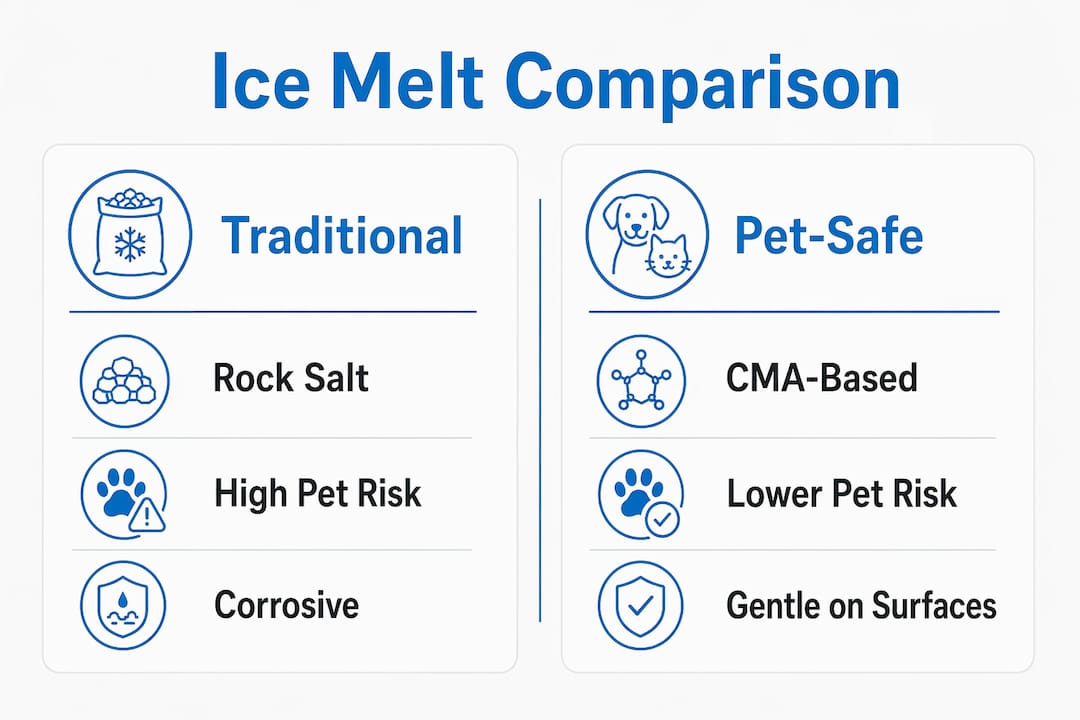
Consumer Reports and Cornell Local Roads Program experts recommend skepticism toward “pet-friendly” label claims and instead focus on technique: thin layered application, mixing with sand, and mechanical removal first. Rock salt works adequately above about 15°F, but Denver’s overnight lows routinely drop well below that, which is why calcium chloride blends remain common despite their higher pet risk.
Products like Morton Safe-T-Pet are marketed as salt and chloride-free, melting to 10°F. CMA-based blends such as Snow Joe’s MELT20PET work to -12°F and are gentler on concrete older than one year. These are useful reference points, but always require the full ingredient disclosure — manufacturer marketing copy is not a substitute for an SDS.
No product is fully safe, and here’s why that matters
PetMD confirms that every common ice-melt ingredient poses some risk. Paw irritation from topical contact and GI upset from ingestion are the two primary hazards. The AKC recommends wiping paws after every walk, using rinse trays at building entries, and considering booties for resident pets during heavy treatment periods. Post-walk rinsing reduces both hazards simultaneously.
Require rinse stations or boot-wipe mats at all main entries. Post visible signage when chemical treatment has occurred. Include in your resident communications the specific symptoms that warrant a vet call.
How professionals reduce total chemical exposure
The most effective risk reduction is process, not product selection. Professionals layer treatments: light pre-treatment before a storm, mechanical clearing during, and minimal post-treatment only where ice bonds to pavement. Mixing deicer with sand reduces total salt volume while providing immediate traction — a practical approach for high-pedestrian areas like building entries and shared driveways.
Material impacts: concrete, plants, and metal
Salt and chloride formulations cause concrete spalling and metal corrosion over time. Most products, including non-chloride options, specify that concrete must be at least one year old before application. Landscape salt stress is cumulative — runoff from treated walkways damages turf and plantings across multiple seasons. Contract language should require landscape protection measures and cleanup of excess material after each service.
Contract language and vendor checklist
Include these items in any snow removal contract or RFP:
- Approved product families by ingredient type (not brand name), with SDS attached
- Maximum application rate per 1,000 sq. ft.
- Temperature thresholds below which a specific product may not be used
- Required mechanical removal before chemical application
- Post-service sweep or rinse within a specified timeframe
- Photographic before/after documentation for each visit
- Incident reporting procedure for any pet exposure event
Red flags during vendor interviews: no SDS available, refusal to document application rates, no pre-treatment or mechanical-first protocol, and inability to name the active ingredient in their standard deicer.
Verification steps: request product receipts from the prior season, ask for sample service logs, and confirm whether the vendor carries liability coverage for property damage from chemical application.
Cost drivers for pet-aware deicing include property square footage, service frequency, material selection (specialty non-chloride melts cost more per pound than rock salt), emergency call-out fees, and documentation requirements. Equipment type also affects pricing — a vendor using calibrated spreaders applies product more precisely than hand-broadcast methods, which reduces both waste and pet exposure.
Denversnowremovals handles pet-aware deicing so you don’t have to
Denversnowremovals brings 44 years of Denver-specific experience to every contract, which means the team already knows what overnight lows demand from a deicer and where mechanical clearing alone gets the job done. For property managers who need documented, pet-aware service, Denversnowremovals commits to mechanical-first clearing, approved low-risk deicer options, calibrated application rates, post-service cleanup, and full SDS and service-log documentation on every visit. That paper trail matters for liability, resident safety, and HOA compliance.
Specialty materials and documentation add a modest cost premium over basic rock-salt service, but the reduction in liability exposure and resident complaints typically justifies it quickly. Request a free estimate or ask about a seasonal pet-aware service plan today.
Key Takeaways
No ice melt is 100% safe for pets, but specifying process over product — mechanical removal first, low-rate non-chloride application, and documented cleanup — reduces risk more reliably than any label claim.
| Point | Details |
|---|---|
| No product is risk-free | Common deicers can cause paw irritation or GI upset; urea and CMA formulations present comparatively lower acute risk. |
| Label claims aren’t enough | Require a full ingredient list and SDS from vendors, not just “pet-safe” packaging. |
| Process beats product | Mechanical removal first, sand mixed with deicer, and post-service cleanup reduce total chemical exposure. |
| Contract language matters | Specify approved ingredient types, max application rates, temperature limits, and photographic documentation. |
| Denversnowremovals delivers | Decades of local experience, pet-aware protocols, and full service documentation on every visit. |
FAQ
Is any ice melt truly 100% safe for dogs?
No. PetMD confirms every common ice-melt ingredient poses some risk; urea and CMA-based products carry lower acute risk but can still cause GI upset if ingested in volume.
What should I do if a pet ingests ice melt?
Contact Pet Poison Helpline or a veterinarian immediately if the pet shows drooling, vomiting, diarrhea, or neurologic symptoms. Small exposures typically cause mild GI upset.
Which ice melt chemistry is safest for concrete and pets?
CMA (calcium magnesium acetate) is the least corrosive to metal and concrete older than one year, and poses lower pet risk than sodium or calcium chloride formulations.
What contract terms protect against pet exposure liability?
Require SDS documentation, maximum application rates, mechanical-first clearing, post-service sweep or rinse, photographic logs, and an incident reporting procedure for any pet exposure event.
Does Denversnowremovals offer pet-aware deicing service?
Yes. Denversnowremovals provides mechanical-first clearing, approved low-risk deicer options, calibrated application, and full service documentation as part of its seasonal contracts in the Denver Metro area.
Recommended
- Types of Properties Needing Snow Services: A Manager’s Guide – Snow Removal Denver 303-591-2089
- What Is Pre-Treatment Snow Service? A Property Owner’s Guide – Snow Removal Denver 303-591-2089
- Common Area Snow Removal: What Property Managers Must Know – Snow Removal Denver 303-591-2089
- How to Set Snow Clearing Expectations for Residents – Snow Removal Denver 303-591-2089