
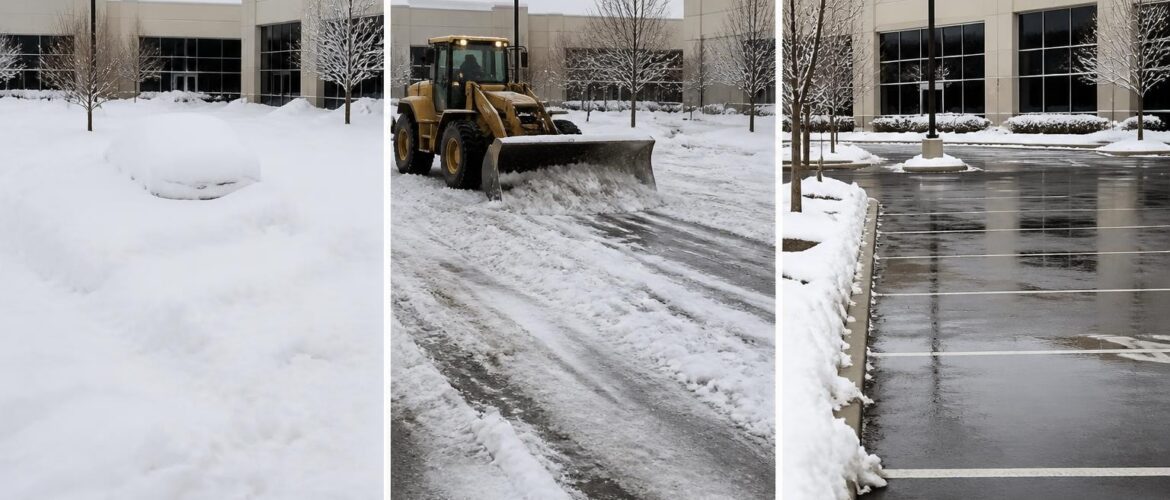
When winter storms blanket the Denver Metro area, commercial property managers face a critical challenge: maintaining safe, accessible facilities for employees, customers, and tenants. The ability to clear the snow quickly and effectively directly impacts business continuity, liability exposure, and customer satisfaction. Understanding proper snow removal strategies, timing considerations, and professional techniques can make the difference between a minor weather inconvenience and a major operational disruption.
Understanding Snow Removal Timing and Frequency
Property managers often underestimate the importance of timing when planning to clear the snow from commercial spaces. Waiting until a storm ends may seem logical, but this approach creates unnecessary risks and increases the physical effort required.
The Four-Inch Rule for Active Storms
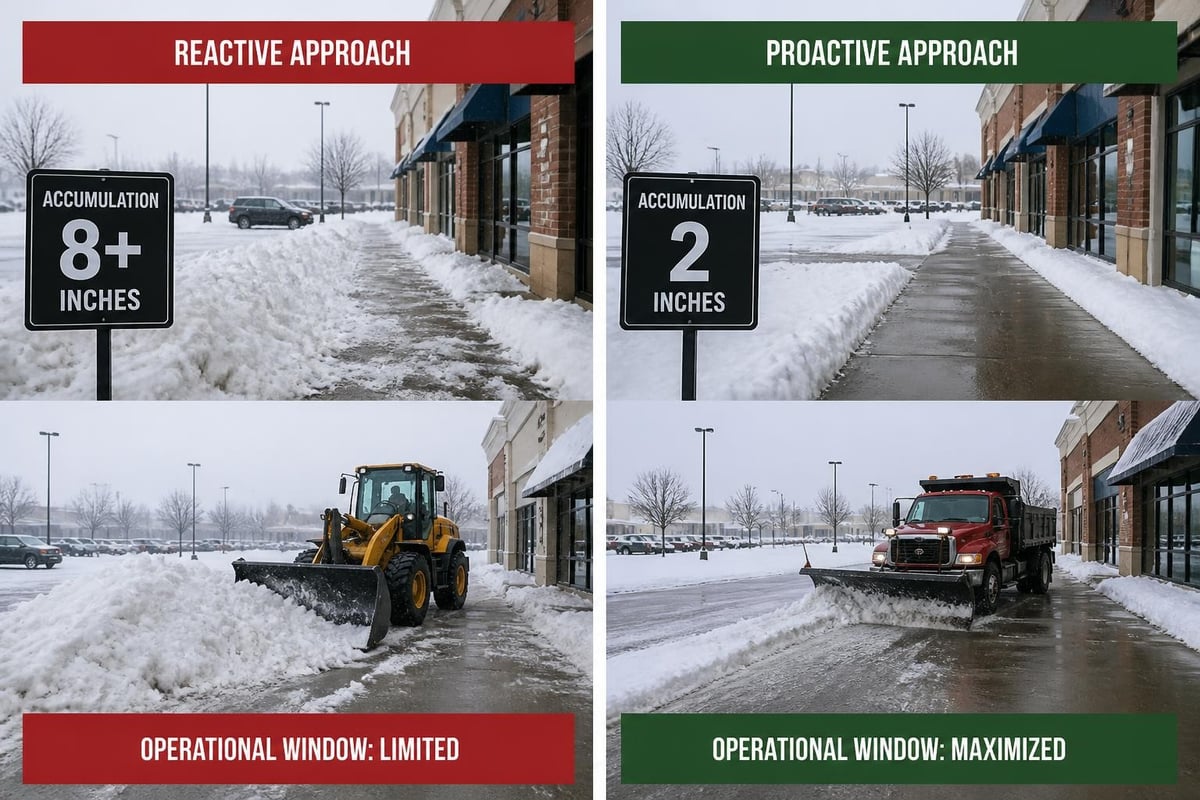
Most snow removal professionals recommend clearing accumulation every four to six inches during active snowfall. This strategy prevents the bottom layers from compacting into ice, which becomes exponentially more difficult to remove. Research on optimal shoveling frequency during storms demonstrates that proactive clearing reduces both physical strain and equipment wear.
For commercial properties, this translates to initiating operations when forecasts predict significant accumulation. Large parking lots and high-traffic walkways require continuous attention throughout major weather events.
Benefits of frequent clearing during storms:
- Prevents ice formation beneath snow layers
- Reduces total removal time by up to 40%
- Maintains continuous access for emergency vehicles
- Minimizes slip-and-fall liability exposure
- Decreases chemical de-icer requirements
24/7 Monitoring and Response Protocols
Commercial operations cannot afford to clear the snow on standard business hours alone. Storms frequently intensify overnight or during weekends, requiring round-the-clock monitoring capabilities. Professional emergency snow removal services maintain weather tracking systems that trigger automatic deployment based on precipitation thresholds.
Setting clear activation triggers ensures consistent response. Many organizations establish protocols that automatically dispatch crews when accumulation reaches two inches, regardless of the time or day.
Legal Compliance and Liability Considerations
The obligation to clear the snow extends beyond customer convenience into legal territory. Colorado municipalities enforce specific regulations regarding snow removal timelines and disposal methods, with violations carrying substantial penalties.
Municipal Requirements and Deadlines
Denver property owners typically have 24 hours after snowfall ends to clear sidewalks adjacent to their properties. Commercial facilities face stricter scrutiny than residential properties due to higher foot traffic volumes. Failure to maintain safe walkways exposes property owners to premises liability claims when injuries occur.
Understanding proper disposal methods is equally critical. Common mistakes in snow disposal can result in fines up to five hundred dollars. Many property managers unknowingly violate ordinances by pushing snow into streets, blocking fire hydrants, or creating visibility hazards at intersections.
| Violation Type | Typical Fine Range | Additional Consequences |
|---|---|---|
| Uncleared sidewalks (24hr+) | $150 – $500 | City crew clearing + fees |
| Snow pushed onto streets | $300 – $500 | Traffic hazard liability |
| Blocked fire hydrants | $500 – $1,000 | Emergency access violations |
| ADA non-compliance | $500+ | Federal accessibility violations |
OSHA Safety Standards for Commercial Operations
Organizations that employ staff to clear the snow must comply with OSHA winter weather safety guidelines. These regulations address proper equipment use, cold exposure limits, and ergonomic practices. Property managers who assign snow removal duties to maintenance teams assume responsibility for providing adequate training, appropriate tools, and safety monitoring.
Cold stress, slips and falls, and overexertion represent the most common winter workplace injuries. Implementing formal safety protocols reduces workers' compensation claims while ensuring consistent service quality.
Strategic Approaches for Different Property Types
The techniques required to clear the snow vary dramatically based on property configuration, traffic patterns, and operational priorities. A retail center demands different strategies than an office park or industrial facility.
Large Parking Lot Management
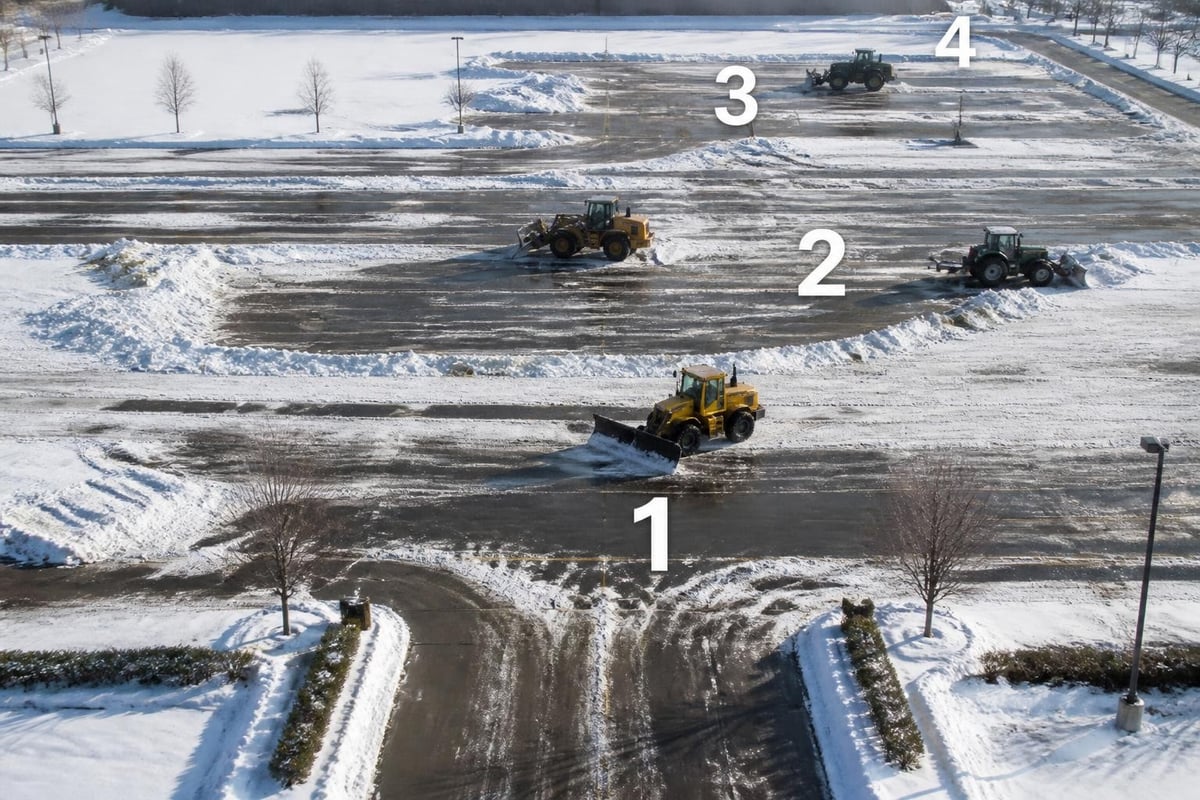
Parking lots present unique challenges due to their size and the need for continuous vehicle access. Professional operations divide lots into clearing zones, establishing priorities based on traffic flow and safety considerations.
Parking lot clearing priorities:
- Fire lanes and emergency vehicle access routes
- Main entrance and exit lanes
- Handicapped parking spaces and access aisles
- Primary parking zones nearest building entrances
- Overflow and peripheral parking areas
- Designated snow storage zones
Equipment selection significantly impacts efficiency when working to clear the snow from expansive paved areas. Commercial-grade plow trucks handle the bulk removal, while skid steers with pusher boxes address corners and loading zones. Sidewalk crews follow behind with smaller equipment to complete pedestrian pathways.
Multi-Tenant Office Campus Considerations
Office campuses require coordinated approaches that minimize disruption to multiple tenants. Unlike single-tenant facilities, these properties must balance diverse operational schedules and access requirements. The strategy to clear the snow must account for staggered business hours, delivery schedules, and varying tenant priorities.
Establishing clear communication protocols ensures tenant satisfaction. Professional commercial snow removal services typically provide progress updates and completion notifications to property management teams, who relay information to individual tenants.
HOA Community Infrastructure
Homeowners associations managing common areas face distinct challenges when planning to clear the snow. Community roadways, guest parking, clubhouses, and amenity areas all require attention. Budget constraints often limit response capabilities, making strategic planning essential.
| Property Feature | Clearing Priority | Recommended Equipment | Typical Timeline |
|---|---|---|---|
| Main access roads | Critical (1st) | Plow trucks | During/immediately after |
| Guest parking | High (2nd) | Skid steer, pushers | Within 6 hours |
| Mailbox clusters | High (2nd) | Hand crews | Within 12 hours |
| Sidewalks/paths | Medium (3rd) | Walk-behind equipment | Within 24 hours |
| Amenity areas | Low (4th) | As resources permit | Within 48 hours |
Equipment and Technique Selection
Choosing the right tools and methods to clear the snow determines both efficiency and quality outcomes. Commercial operations require industrial-grade equipment capable of handling high-volume, continuous use during extended storm events.
Mechanical Removal Technologies
Modern snow removal relies on specialized equipment designed for specific applications. Plow trucks remain the workhorses for large open areas, but technology advances have introduced hydraulic pushers, automated salt spreaders, and GPS tracking systems that optimize operations.
Professional operators understand that equipment alone doesn't guarantee success. Proper technique prevents pavement damage, minimizes material waste, and ensures thorough clearing. Angling plows correctly, maintaining appropriate speeds, and following systematic clearing patterns all contribute to superior results.
Chemical De-Icing Strategies
Mechanical removal alone rarely suffices in commercial settings. Chemical de-icers prevent bonding between snow and pavement, accelerating the clearing process and maintaining surfaces after mechanical work concludes. Selecting appropriate materials requires balancing effectiveness, environmental impact, and surface compatibility.
Common de-icing materials comparison:
- Sodium chloride (rock salt): Effective to 15°F, economical, corrosive to concrete and metal
- Calcium chloride: Effective to -20°F, faster acting, higher cost, less corrosive than sodium chloride
- Magnesium chloride: Effective to -10°F, less environmental impact, moderate cost
- Potassium acetate: Airport-grade, non-corrosive, premium pricing, excellent environmental profile
The most effective approach combines pre-treatment before storms, strategic application during clearing operations, and post-storm maintenance applications. This layered strategy reduces total material consumption while maintaining superior surface conditions.
Workforce Management and Operational Logistics
Successfully executing plans to clear the snow from commercial properties requires more than equipment and materials. Skilled operators, efficient logistics, and reliable workforce management systems ensure consistent service delivery regardless of storm severity.
Crew Deployment and Route Optimization
Professional snow removal companies develop detailed route plans that maximize efficiency while ensuring timely service for all clients. GPS tracking systems monitor equipment location and progress, allowing real-time adjustments based on changing conditions. These technological tools help operations managers deploy resources where they're needed most.
Route planning considers multiple factors: property priority levels, geographic clustering, equipment positioning, and estimated clearing times. Properties requiring 24/7 snow plowing services receive continuous attention throughout major events, with crews rotating to prevent operator fatigue.

Communication Systems During Winter Events
Maintaining clear communication channels between property managers, tenants, and removal crews prevents confusion and ensures accountability. Professional operations establish multiple contact methods: dedicated phone lines, mobile apps, email updates, and online portals that provide real-time service status.
Documentation systems capture before-and-after photos, completion timestamps, and material usage data. This information protects both service providers and property owners by creating verifiable service records. When slip-and-fall claims arise, thorough documentation demonstrates due diligence in maintaining safe conditions.
Budgeting and Contract Structures
Financial planning for snow removal services requires understanding industry pricing models and anticipating seasonal variability. The investment required to clear the snow from commercial properties fluctuates based on seasonal severity, service frequency, and property characteristics.
Seasonal Contract Options
Most commercial properties choose between per-occurrence pricing and seasonal contracts. Per-occurrence arrangements charge for each service visit, creating variable costs that align with actual snowfall. Seasonal contracts establish fixed fees covering unlimited service throughout winter, providing budget certainty but potentially overpaying during mild seasons.
Contract structure comparison:
| Contract Type | Best For | Advantages | Considerations |
|---|---|---|---|
| Per-occurrence | Properties with minimal clearing history | Pay only for actual service | Unpredictable annual costs |
| Seasonal unlimited | High-priority facilities needing guaranteed service | Budget certainty, priority response | Fixed cost regardless of snowfall |
| Seasonal with caps | Medium-priority properties | Balance of predictability and cost control | Complex billing when exceeding caps |
| Retainer + per-inch | Large portfolios | Secures capacity, variable costs | Requires accurate measurement systems |
Hidden Cost Factors
Beyond basic plowing and clearing services, commercial properties must budget for related expenses. Salt and de-icing materials, liability insurance adjustments, backup equipment rentals, and emergency call-out premiums all impact total winter maintenance costs. Professional snow removal services typically bundle these elements into comprehensive pricing, simplifying budget management.
Property managers should also account for indirect costs: lost revenue from inaccessible facilities, increased heating expenses from extended door openings, and potential litigation expenses from inadequate clearing. Investing in reliable snow removal services often costs less than addressing the consequences of inadequate winter maintenance.
Environmental Considerations and Sustainable Practices
The environmental impact of operations to clear the snow has gained increasing attention from municipalities, environmental groups, and property owners committed to sustainability. Modern snow removal strategies balance operational effectiveness with environmental responsibility.
Eco-Friendly De-Icing Alternatives
Traditional rock salt damages vegetation, contaminates waterways, and corrodes infrastructure. Alternative materials and application techniques reduce environmental impact while maintaining effective ice control. Liquid pre-treatments require smaller quantities than granular applications, reducing total chemical usage by up to thirty percent.
Combining mechanical removal with targeted chemical applications maximizes effectiveness while minimizing environmental impact. Removing the maximum amount of snow mechanically before applying de-icers reduces the quantity of chemicals entering storm drains and groundwater systems.
Snow Storage and Melt Management
Commercial properties must designate appropriate locations for snow storage as crews clear the snow from operational areas. Improperly located snow piles create drainage problems, damage landscaping, and violate municipal codes. Professional operators identify suitable storage areas that accommodate maximum accumulation while minimizing environmental and aesthetic impacts.
Snow storage location criteria:
- Away from building foundations and utilities
- Outside required sight triangles at intersections
- Clear of fire hydrants and emergency access routes
- Positioned to prevent drainage toward buildings
- Accessible for removal if storage capacity exceeded
Technology Integration and Future Trends
The snow removal industry continues evolving through technology adoption and operational innovation. Property managers who understand emerging trends can leverage these advances to improve service quality while controlling costs.
Weather Prediction and Automated Deployment
Advanced weather modeling provides increasingly accurate forecasts, allowing operations to clear the snow based on predicted conditions rather than reactive responses. Some commercial snow removal companies deploy artificial intelligence systems that analyze multiple weather data sources, automatically triggering crew deployment when conditions warrant.
These predictive systems reduce response times and ensure equipment positioning before storms intensify. Property managers benefit from improved service consistency and reduced liability exposure through faster clearing initiation.
GPS Tracking and Service Verification
Modern fleet management systems provide real-time visibility into clearing operations. Property managers can monitor exactly when crews arrived, which areas received attention, and how long operations required. This transparency builds trust while providing documentation for billing verification and liability protection.
Some systems integrate automatic reporting that sends completion notifications with photographic evidence, eliminating uncertainty about service delivery. These technological capabilities transform snow removal from a reactive emergency service into a managed, predictable operational component.
Effective snow and ice management requires strategic planning, appropriate resources, and reliable execution when winter weather strikes commercial properties throughout the Denver Metro area. Property managers who implement comprehensive clearing protocols, understand legal requirements, and partner with experienced professionals minimize operational disruptions while protecting tenants and visitors. Denver Snow Removals brings nearly five decades of commercial snow clearing expertise to office parks, retail centers, industrial facilities, and HOA communities, delivering 24/7 emergency response and systematic clearing protocols that keep Colorado businesses operational regardless of weather conditions.