
7 Best Snow Plow Service Near Me: 2026 Guide
When winter storms blanket the Denver Metro area, finding a dependable snow plow service near me becomes a critical priority for commercial property managers, HOA board members, and facility directors. The difference between a contractor who shows up at 3 AM during a blizzard and one who leaves your parking lot inaccessible can directly impact your business operations, liability exposure, and tenant satisfaction. Understanding what separates professional commercial snow removal from residential services helps you make informed decisions that protect your property investment and keep operations running smoothly.
Why Commercial Properties Need Specialized Snow Plow Services
Commercial snow removal demands far exceed typical residential driveway clearing. When searching for a snow plow service near me, property managers must recognize that industrial parks, office campuses, and large HOA communities require specialized equipment, trained crews, and strategic planning that most residential-focused companies cannot provide.
Professional commercial operations differ in several critical ways:
- Fleet capacity to handle 50,000+ square foot parking areas
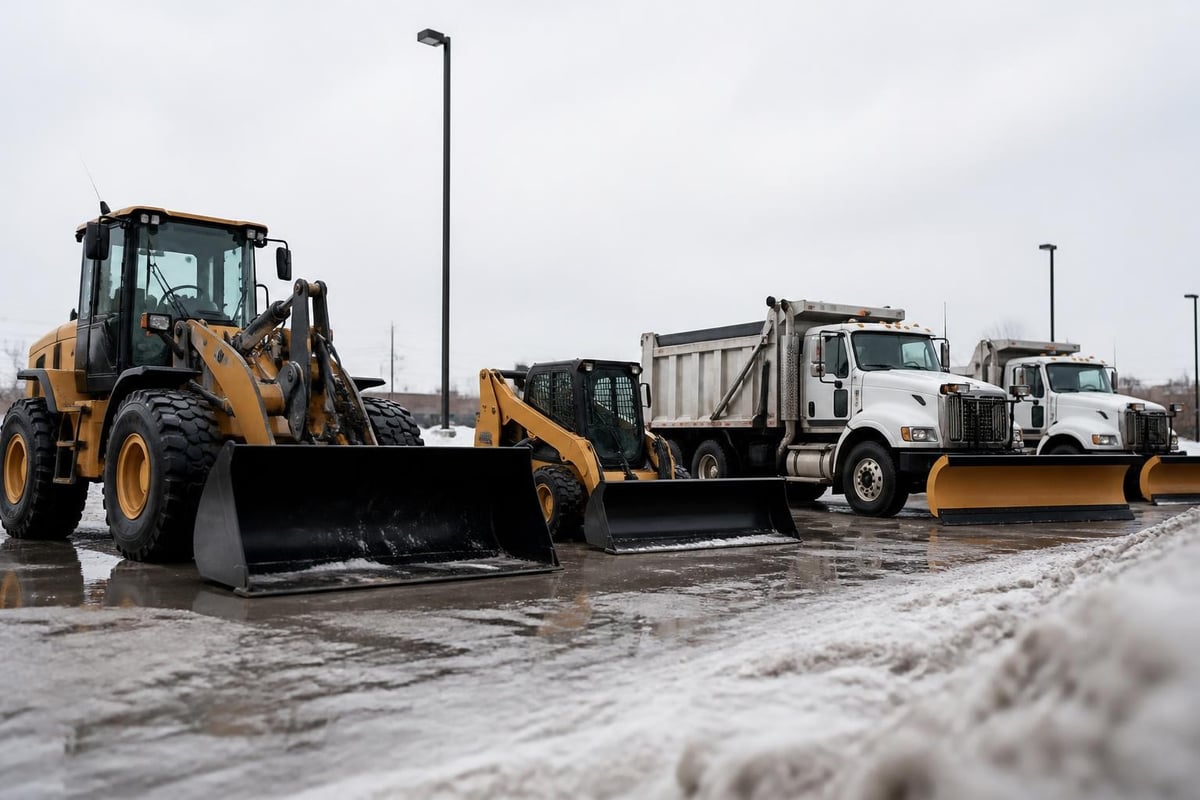
- Multiple equipment types including loader plows, skid steers, and salt spreaders
- 24/7 availability with guaranteed response times during storm events
- Liability insurance coverage appropriate for commercial contracts
- Documented safety protocols that meet industry standards for snow plow safety
Large parking lots cannot be cleared with a pickup truck and a blade attachment. The scale demands dedicated commercial-grade equipment operated by experienced professionals who understand traffic flow patterns, drainage considerations, and proper snow stacking locations. Companies with 47 years of experience, for example, have refined their approaches through thousands of storm events and understand the nuances that newer operators miss.
Equipment Requirements for Commercial Properties
The equipment needed to service a 100-unit apartment complex differs dramatically from what clears a single-family home. When evaluating a snow plow service near me, ask about their fleet composition and whether they own or subcontract their equipment.
| Equipment Type | Best Use Case | Typical Coverage Rate |
|---|---|---|
| Loader Plow | Large open lots, industrial parks | 2-3 acres per hour |
| Skid Steer | Tight corners, loading docks, sidewalks | 50,000 sq ft per hour |
| Salt/Sand Spreader | Post-plow treatment, ice prevention | 5-8 acres per load |
| Backup Trucks | Simultaneous multi-site operations | Varies by configuration |
Companies that own their equipment demonstrate long-term commitment to the industry and typically maintain higher standards than those relying entirely on subcontractors. This ownership also means faster response times since they’re not coordinating external resources during emergencies.
Trusted Resources for Commercial Snow Removal in Denver
When you hire a snow plow service near me for your commercial property, stay informed with these trusted resources:
Check the National Weather Service Denver snow forecast before hiring a snow plow service near me – Denver gets an average 57 inches of snow per year.
OSHA winter safety guidelines require commercial properties to keep walkways and parking lots clear to avoid liability.
See CDOT winter road conditions to plan commercial access and deliveries during major storms.
How to Evaluate Snow Plow Service Near Me Options
The search process for commercial snow removal requires more diligence than simply calling the first company that appears online. Your evaluation should examine operational capacity, financial stability, safety records, and client retention rates.
Key Selection Criteria
Start by requesting detailed information about their commercial client portfolio. Companies that specialize in properties similar to yours bring relevant experience and established protocols. An operator who primarily services retail shopping centers understands different challenges than one focused on office parks or manufacturing facilities.
Essential questions to ask during your evaluation:
- How many commercial accounts do you currently maintain?
- What is your average client retention rate year-over-year?
- Can you provide references from properties exceeding 100,000 square feet?
- What backup plans exist if primary equipment experiences mechanical failure?
- How do you handle multi-day storm events requiring continuous operations?
Insurance verification ranks among your most important due diligence steps. Request certificates of insurance showing general liability coverage of at least $2 million, commercial auto insurance, and workers’ compensation. Companies without adequate coverage transfer risk directly to property owners, creating potentially catastrophic exposure.
Response Time Guarantees and Service Level Agreements
Professional snow plow service near me providers offer written service level agreements specifying trigger depths, response times, and completion standards. These contracts protect both parties by establishing clear expectations and measurable performance metrics.
Typical SLA components include:
- Trigger depth: The snowfall accumulation that initiates service (commonly 2-3 inches)
- Response window: Maximum time between trigger and crew arrival (typically 2-4 hours)
- Completion timeline: Expected duration to clear specified areas
- Re-service protocols: Return visits during ongoing storms
- Communication procedures: Weather monitoring and client notification systems
The Colorado Department of Transportation provides insights into professional snow removal processes that inform commercial best practices. Understanding state-level approaches helps property managers set realistic expectations for private contractors.
Pricing Models for Commercial Snow Removal
Cost structures for commercial snow plowing vary significantly based on service frequency, property size, and contract duration. When comparing a snow plow service near me, understanding different pricing models helps you evaluate proposals accurately and avoid unexpected charges.
Per-Push vs. Seasonal Contracts
The two primary pricing structures each offer distinct advantages depending on your property type and budget predictability needs.
| Pricing Model | How It Works | Best For | Potential Drawbacks |
|---|---|---|---|
| Per-Push (Per-Event) | Fixed rate per service visit | Properties with light snowfall, budget flexibility | Unlimited cost exposure during heavy winters |
| Seasonal Contract | Single price for entire season | Budget certainty, high-traffic properties | Paying for coverage even in light snow years |
| Per-Inch | Charges based on accumulation | Medium snowfall areas | Measurement disputes, variable costs |
| Hourly Rates | Time-based billing | Small properties, irregular needs | Incentivizes slower work, unpredictable costs |
Seasonal contracts typically prove most cost-effective for commercial properties requiring guaranteed availability and rapid response. A Denver office park paying $15,000 for seasonal coverage gains budget certainty and priority status that per-push clients don’t receive. During major storms when contractors face overwhelming demand, seasonal contract holders get serviced first while per-push clients wait in queue.
Hidden Costs and Additional Services
Base snow plowing represents only one component of comprehensive winter property management. When requesting quotes from a snow plow service near me, clarify what services the base price includes versus what generates additional charges.
Common additional services that may carry separate fees:
- De-icing and salt/sand application
- Sidewalk clearing and hand shoveling
- Snow hauling and off-site removal
- Emergency call-outs outside standard hours
- Equipment repositioning between storm events
Properties with limited snow storage capacity often require hauling services mid-season as accumulated piles consume parking spaces. This specialized service involves loading snow into dump trucks and transporting to approved disposal sites, typically costing $75-150 per truck load depending on dump site distance.
Safety Considerations for Commercial Snow Removal
Property owner liability extends to winter maintenance obligations, making safety protocols a critical evaluation factor when selecting a snow plow service near me. Inadequate clearing creates slip-and-fall hazards, while improper equipment operation damages property and endangers both workers and the public.
Operator Training and Certification
Professional commercial operators complete specialized training covering equipment operation, commercial snow plow safety procedures, property protection techniques, and emergency protocols. This training differentiates experienced crews from inexperienced operators who learn through trial and error on client properties.
Companies should provide documentation of:
- Equipment-specific operator certification
- Annual safety refresher training
- OSHA compliance for commercial operations
- Drug testing and background check programs
- Ongoing performance evaluations
The most experienced operators understand how to protect landscape features, avoid underground irrigation systems, and prevent damage to curbs and pavement edges. A single inexperienced driver can cause thousands in property damage during a single storm event, far exceeding any savings from hiring a cheaper contractor.
Coordination with Property Operations
Commercial snow removal doesn’t occur in isolation. Professional snow plow service near me providers coordinate with property management teams to understand business hours, delivery schedules, special events, and high-traffic periods requiring priority attention.
Effective coordination includes:
- Pre-season site walks identifying obstacles, priority areas, and snow storage locations
- Weather monitoring with advance notice to property managers
- Real-time communication during active operations
- Post-storm documentation with timestamps and completion photos
- Damage reporting protocols when incidents occur
This collaboration proves especially critical for 24/7 facilities like healthcare centers or emergency services buildings where operations cannot pause for weather. Detailed planning ensures snow crews work around critical operations rather than disrupting them.
The Role of Technology in Modern Snow Removal
Leading commercial snow removal companies leverage technology to improve service delivery, enhance communication, and document performance. When evaluating a snow plow service near me, inquire about their technology adoption as it often indicates operational sophistication.
GPS Tracking and Route Optimization
Fleet management systems with GPS tracking provide real-time visibility into crew locations, service progress, and completion verification. Property managers can monitor when their lot received service, how long crews spent on-site, and whether agreed-upon protocols were followed.
Technology benefits for commercial clients include:
- Automated service notifications when crews arrive and depart
- Digital time-stamping proving service completion
- Route optimization reducing response times
- Historical data tracking for contract verification
- Photo documentation of pre- and post-service conditions
These systems eliminate disputes about whether service occurred and provide concrete evidence of contractor performance. The transparency protects both parties while elevating service quality through accountability.
Weather Monitoring and Predictive Planning
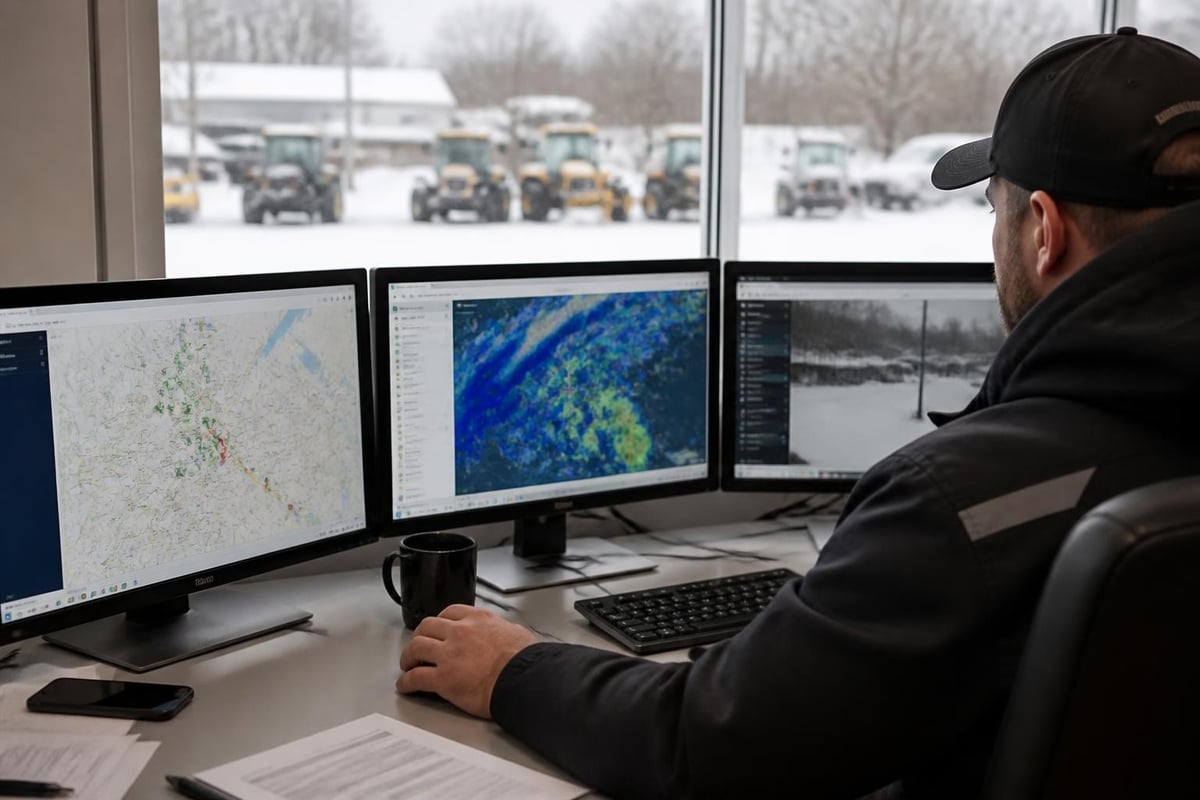
Professional operators utilize advanced weather forecasting services that provide hyperlocal predictions and storm tracking. This intelligence allows proactive crew scheduling, equipment positioning, and client communication hours before precipitation begins.
Companies monitoring weather patterns can pre-treat parking lots with anti-icing agents that prevent snow bonding to pavement, reducing required plowing time and salt usage. This proactive approach, detailed in resources about snow removal and safety protocols, demonstrates operational maturity that reactive contractors lack.
Environmental Considerations in Commercial Snow Management
Environmental stewardship has become increasingly important in commercial snow removal, particularly regarding salt and chemical de-icer usage. Responsible snow plow service near me providers balance effective ice control with environmental protection and regulatory compliance.
Salt Management Best Practices
Excessive salt application damages vegetation, contaminates water sources, and corrodes vehicles and infrastructure. Professional operators apply de-icing materials strategically rather than broadcasting indiscriminately across entire properties.
| De-Icing Material | Temperature Range | Environmental Impact | Typical Application Rate |
|---|---|---|---|
| Rock Salt (NaCl) | Above 15°F | High chloride runoff | 100-300 lbs per acre |
| Calcium Chloride | Down to -25°F | Moderate, less volume needed | 50-150 lbs per acre |
| Magnesium Chloride | Down to 5°F | Lower chloride impact | 75-200 lbs per acre |
| Beet Juice Blends | Above 20°F | Biodegradable, minimal impact | Mixed with salt, reduces quantity |
Targeted application in high-traffic walkways, building entrances, and sloped areas provides necessary traction while minimizing total chemical usage. Pre-wetting salt with liquid solutions improves adhesion and effectiveness, allowing lower application rates that reduce both cost and environmental impact.
Sustainable Snow Storage and Runoff Management
Large commercial properties require designated snow storage areas that prevent contamination of storm drains, landscaped areas, and adjacent properties. When selecting a snow plow service near me, discuss their snow stacking strategies and familiarity with local environmental regulations.
Proper snow management includes:
- Stockpiling away from building foundations and drainage systems
- Avoiding sensitive landscape areas and protected wetlands
- Ensuring melting snow doesn’t refreeze across pedestrian paths
- Coordinating with property drainage infrastructure
- Implementing hauling when storage capacity becomes exhausted
Properties in environmentally sensitive areas face stricter regulations regarding chloride discharge and runoff water quality. Contractors familiar with these requirements help clients maintain compliance while still providing effective winter maintenance services.
Long-Term Partnership Benefits with Established Providers
The relationship between property managers and their snow removal contractor ideally extends across multiple seasons, building institutional knowledge and operational efficiency. Seeking a reliable snow plow service near me should focus on partnership potential rather than simply finding the lowest bid each year.
Multi-Year Contract Advantages
Established providers who return season after season develop deep familiarity with your property’s unique characteristics, optimal service patterns, and tenant expectations. This continuity delivers measurable value through improved service quality and operational efficiency.
Benefits of maintaining consistent contractor relationships:
- Reduced annual procurement time and administrative burden
- Price stability versus annual bid fluctuations
- Crew familiarity with property layout and obstacles
- Streamlined communication requiring less oversight
- Priority status during extreme weather events
- Continuous improvement based on previous season feedback
Companies like Denver Snow Removals that have served the Denver Metro area for 47 years demonstrate the stability and expertise that comes from decades of operational refinement. This longevity indicates financial health, satisfied clients, and adaptability to changing conditions that newer companies haven’t proven.
Performance Tracking and Continuous Improvement
Professional commercial relationships include formal performance reviews analyzing response times, completion rates, communication effectiveness, and overall satisfaction. These assessments identify improvement opportunities and ensure service standards remain aligned with property needs.
Regular evaluation examines:
- Average response time from storm trigger to crew arrival
- Completion time relative to property size and storm severity
- Quality metrics including missed areas or property damage incidents
- Communication timeliness and accuracy
- Cost performance versus budget projections
This data-driven approach transforms snow removal from a transactional service into a strategic partnership that continuously evolves and improves. The insights gained inform contract adjustments, service refinements, and operational modifications that benefit both parties.
Preparing Your Property for Winter Service
Property managers share responsibility for successful winter maintenance by ensuring their facilities are properly prepared for snow removal operations. Even the best snow plow service near me cannot overcome poor site conditions or inadequate preparation.
Pre-Season Site Preparation
Before winter arrives, conduct comprehensive property assessments identifying potential obstacles, drainage issues, and areas requiring special attention. This preparation prevents mid-season problems and ensures crews can work efficiently without constant supervision.
Essential pre-winter preparation tasks:
- Mark curbs, islands, and buried obstacles with reflective stakes
- Repair pavement damage preventing proper scraper blade contact
- Clear loose debris, vehicles, and equipment from parking areas
- Verify lighting adequacy for overnight operations
- Update emergency contact lists and communication protocols
The investment in proper marking and preparation pays dividends throughout the season through faster service, reduced property damage, and improved clearing quality. Contractors appreciate well-maintained properties and often prioritize them during peak demand periods.
Communication Protocols and Expectations
Establish clear communication channels before the first snowflake falls. Both property managers and contractors need defined protocols for weather monitoring, service authorization, and issue escalation.
Effective communication frameworks specify:
- Primary and backup contacts with 24/7 availability
- Preferred notification methods for service start and completion
- Thresholds requiring management approval before proceeding
- Documentation requirements for billing and verification
- Emergency procedures when standard protocols prove inadequate
These systems prevent confusion during high-stress storm events when rapid decisions affect service delivery and cost management. Clear expectations established in advance reduce disputes and improve working relationships throughout the winter season.
Regional Considerations for Denver Commercial Properties
The Denver Metro area presents unique challenges for commercial snow removal that influence contractor selection and service expectations. When searching for a snow plow service near me in Colorado, understanding regional weather patterns and regulations helps set realistic requirements.
Denver’s Variable Winter Weather Patterns
Colorado’s Front Range experiences dramatic temperature swings, rapid-onset storms, and variable snow conditions that demand flexible operational approaches. A storm might begin as heavy wet snow, transition to sleet, and finish with light powder, each requiring different equipment settings and techniques.
Experienced Denver-area contractors understand these patterns and adjust their approaches accordingly. They know that March storms often produce heavier, wetter snow than December events, and that chinook winds can rapidly melt accumulation, creating different challenges than sustained cold periods.
Local expertise matters significantly because national companies without regional experience often misapply techniques that work elsewhere but prove ineffective in Denver’s unique climate. The comprehensive guide to commercial snow removal in Denver provides additional insights into area-specific considerations.
Municipal Regulations and Requirements
Denver and surrounding municipalities maintain specific requirements for commercial property snow removal, including sidewalk clearing timeframes, de-icing material restrictions in certain areas, and snow storage regulations. Non-compliance can result in fines and liability exposure.
Property managers must ensure their snow plow service near me contractors understand and comply with:
- Sidewalk clearing deadlines (typically 24 hours after storm end)
- Prohibited snow storage locations including street right-of-ways
- Environmental restrictions on de-icer types near water features
- Accessibility requirements under ADA regulations
- Local ordinances specific to each municipality within the metro area
Professional contractors familiar with these regulations incorporate compliance into their standard operating procedures, protecting clients from inadvertent violations. This local knowledge represents another advantage of established regional providers over national chains without Colorado-specific expertise.
Selecting the right commercial snow removal partner requires careful evaluation of equipment, experience, safety protocols, and long-term partnership potential rather than simply choosing the lowest bid. Property managers who invest time in thorough contractor assessment protect their investments, reduce liability exposure, and ensure reliable winter operations. Denver Snow Removals brings 47 years of specialized commercial experience to the Denver Metro area, offering the equipment capacity, 24/7 availability, and proven expertise that large-scale properties demand throughout winter’s most challenging conditions.