
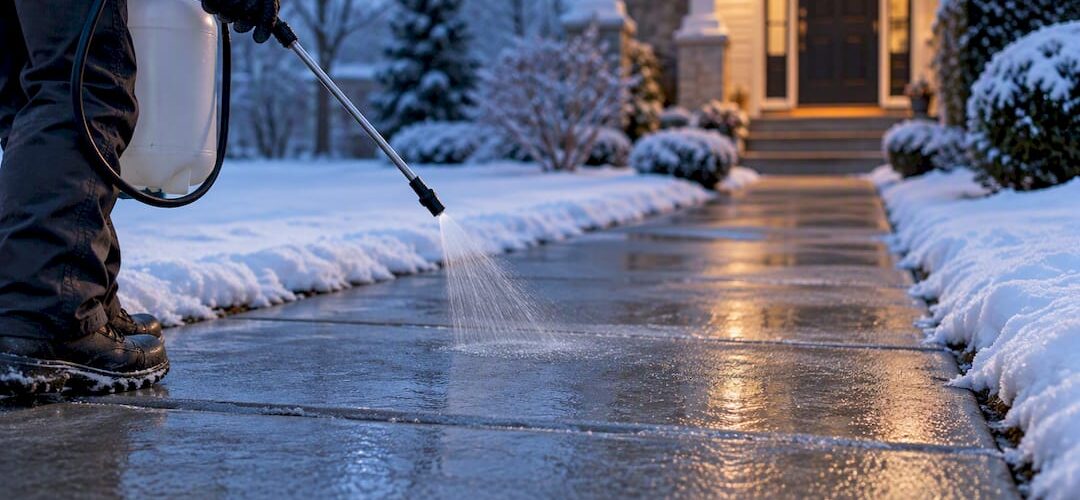
The fastest way to reduce sidewalk ice is to clear loose snow immediately, before foot traffic packs it down, then apply a temperature-appropriate anti-icing or traction agent while the surface is still workable. Waiting even a few hours lets snow compact into a bonded layer that is far harder to remove. For large commercial walkways, persistent black ice, or liability concerns, calling a professional crew is usually the safer and faster call.
TL;DR:
- Applying a prestorm liquid brine for anti-icing can prevent snow from bonding, making removal easier and reducing chemical use.
- Magnesium chloride and calcium chloride outperform rock salt at temperatures below 20°F, but over-application yields little extra melting power.
- Shoveling early and often, followed by scraping and matching deicer to current temperatures, is essential for effective sidewalk ice control.
- Professional services are recommended for large, high-traffic, or liability-prone areas, especially during severe or prolonged icy conditions.
- Proper cleanup, responsible deicer application, and adherence to local responsibility laws can minimize environmental damage, pet risks, and property wear.
Table of Contents
- Step-by-step methods: physical removal, traction, and deicing, when to use each
- Anti-icing and pretreating: stop the bond before it forms
- Match deicer to temperature and surface conditions
- Equipment and tools: from a shovel to a heated mat
- Environmental, pet, and concrete safety
- Operational checklist: before, during, and after a winter event
- Why field experience still matters for sidewalk safety
- What sidewalk ice control actually costs
- Disposing of and cleaning up leftover deicing materials
- Planning ahead for the winter season
- How weather patterns change what actually works
- Handling severe or prolonged ice conditions
- Who is actually responsible for a snowy sidewalk
- What actually works, season after season
- Denver Snow Removal: professional sidewalk ice control when you need it handled
- Sources
- FAQ
Step-by-step methods: physical removal, traction, and deicing, when to use each
Sidewalk ice control works best as a sequence, not a single product. Skipping steps, especially the removal step, is why most homeowners over-apply deicer and still end up with slick patches.
- Shovel early and often. Clearing snow every few inches, rather than waiting for the storm to end, keeps it loose and prevents the compaction that leads to bonded ice.
- Scrape to break the bond. An ice chopper or flat-blade scraper cracks the thin ice layer stuck to concrete so any deicer you apply next can actually reach the surface instead of sitting on top of packed snow.
- Use abrasives when melting will not work. Sand, poultry grit, or clay-based cat litter add traction instantly and work at any temperature, though they do not melt anything and need sweeping up later.
- Apply deicer only after clearing, matched to the temperature. Spreading chemical deicer on top of unshoveled snow wastes product and money.
As a rough decision guide: below about 15 to 20°F, magnesium chloride or calcium chloride will outperform rock salt, or switch to traction agents entirely. Between roughly 15 and 28°F, sodium chloride or a pre-made brine still works reasonably well, according to practical temperature guidance from UNL Water.
Anti-icing and pretreating: stop the bond before it forms
Anti-icing means putting down a thin layer of liquid brine or “prewetting” a granular product before snow or freezing rain arrives, rather than waiting to react after ice has already formed. The goal is to prevent snow and ice from bonding to the pavement in the first place, which makes the eventual shoveling and scraping dramatically easier.
- Anti-icing works because it stops the initial bond, so the storm’s snow stays loose instead of freezing into a sheet.
- The best window to pretreat is a few hours before forecasted snow or a hard frost, giving the brine time to dry onto the surface.
- Handheld pump sprayers work for a single walkway; vehicle-mounted sprayers or prewetting nozzles on a spreader make sense for larger commercial sites.
Field guidance from state transportation handbooks, including Minnesota DOT’s deicing products guide, recommends anti-icing and prewetting as standard practice because it reduces total material use and improves how well plowed surfaces clear afterward.
Pro Tip: Avoid pretreating right before a rain event: liquid brine can wash away or leave a slick, oily residue on dry pavement if you skip the reduced starter rate.
Match deicer to temperature and surface conditions
Not every deicer works at every temperature, and picking the wrong one wastes money without solving the ice problem.
- Sodium chloride (rock salt): works reliably down to roughly 15 to 28°F, then loses effectiveness fast.
- Magnesium chloride: stays effective to roughly negative 10 to negative 20°F, making it a better cold-weather choice.
- Calcium chloride: performs at still lower pavement temperatures, roughly negative 15 to negative 25°F, according to UNL Water’s application guidance.
- Calcium magnesium acetate (CMA): a non-chloride option worth considering near sensitive plantings or metal fixtures, within its own effective range.
These are practical, real-world working ranges rather than laboratory eutectic points, and they matter because a bag labeled “effective to negative 20°F” in a lab test can still underperform on a windy, high-traffic sidewalk.
Over-application does not buy extra melting power. University extension guidance recommends limiting application rates of deicers to a moderate amount per square yard, since over-application mostly runs off without increased melting effect, per University of Minnesota Extension. When temperatures drop below what any chloride product handles well, switch to sand or grit instead of piling on more chemical.
Equipment and tools: from a shovel to a heated mat
The right tool depends on how much sidewalk you are responsible for and how often ice is a problem.
- Basic setup: an ergonomic snow shovel, a push shovel for larger flat stretches, and an ice chopper for bonded patches covers most single homes.
- Frequent-use setup: a hand-crank or backpack spreader, paired with a small prewetting kit, pays off once you are treating the same walkway several times a season.
- Heated mats and embedded systems: these melt snow continuously without manual labor, with commercial systems reported handling roughly 2 to 4 inches of snowfall per hour, though installation cost and the need for reliable power make them a fit mainly for high-traffic commercial entrances.
- Hiring a professional: worth considering once a property has enough square footage, foot traffic, or liability exposure that missing one clearing window creates real risk.
Environmental, pet, and concrete safety
Chloride-based deicers work well, but they carry side effects worth managing rather than ignoring.
- Excess salt damages nearby grass, shrubs, and tree roots, and it corrodes metal railings and can pit or scale concrete over time, per University of Minnesota Extension.
- No deicer is entirely risk-free around pets: CMA and careful, low-rate salt use are gentler options, but paws should still be rinsed after walks on any treated surface.
- Avoid deicers on new concrete until it has fully cured to reduce risk of surface scaling, according to UNL Extension’s homeowner guide.
- Sweep up leftover granules once the ice melts instead of letting rain wash them into lawns or storm drains.
Pro Tip: Flush salt-exposed garden beds with water in early spring to help clear residual chloride from the soil before new growth starts.
Operational checklist: before, during, and after a winter event
A little planning turns sidewalk ice control from a scramble into a routine.
- Before: stock shovels, traction agents, and the right deicer for the forecast temperature; pretreat walkways ahead of expected snow or frost.
- During: clear snow in stages, scrape to break any bond, then apply traction or deicer matched to the current pavement temperature.
- After: sweep leftover granules, photograph cleared areas for your own records, and check for any new cracking or surface damage.
| Stage | Key action | Why it matters |
|---|---|---|
| Before | Pretreat and stock supplies | Prevents bonding, saves time later |
| During | Clear, scrape, then treat | Stops compaction and ice buildup |
| After | Sweep and document | Protects surfaces and limits liability |
Escalate to a professional crew when black ice keeps returning, when foot traffic is heavy enough that a missed window creates real fall risk, or after repeated near-misses on the same stretch of sidewalk.
Why field experience still matters for sidewalk safety
DIY methods handle most single-family driveways and walkways just fine. Where the stakes rise, commercial entrances, HOA common areas, properties with heavy foot traffic, professional crews bring consistency that is hard to match on a snow day.
- A local company in the Denver Metro area has operated for over four decades, offering emergency dispatch for snow removal conditions.
- A scheduled ice management program reduces the slip-and-fall exposure that property managers otherwise carry alone.
- Documented service visits give property owners a record to point to if a liability question ever comes up.
What sidewalk ice control actually costs
Costs scale with labor, material, and how often ice forms during the season. A bag of rock salt runs a modest amount for occasional homeowner use, while magnesium chloride or calcium chloride products cost more per pound but go further in extreme cold, since less product is needed to get the same result. Sand and grit are cheap upfront but add ongoing sweep-up labor that salt does not.
Heated mats and embedded systems carry the highest upfront cost, mainly installation and electrical work, but eliminate labor entirely once running. For a single walkway treated occasionally, buying your own shovel and a bag of deicer is the cheapest path. For a commercial property or HOA with multiple entrances and daily foot traffic, the labor time of staff clearing ice by hand often outweighs the cost of a seasonal contract, which bundles pretreatment, clearing, and material into one predictable fee. Denver Snow Removal’s Residential Driveway and Walkway Clearing starts at $41.25 per visit, giving homeowners a comparison point against buying and maintaining their own equipment.
Disposing of and cleaning up leftover deicing materials
Once the ice is gone, what is left on the surface still needs attention. Sweep unused granules back into a sealed container rather than leaving them to wash into a storm drain or garden bed, since concentrated chloride runoff is one of the main ways deicers damage nearby vegetation and waterways, per University of Minnesota Extension. Reusable granules can go back into storage in a dry container for the next storm.
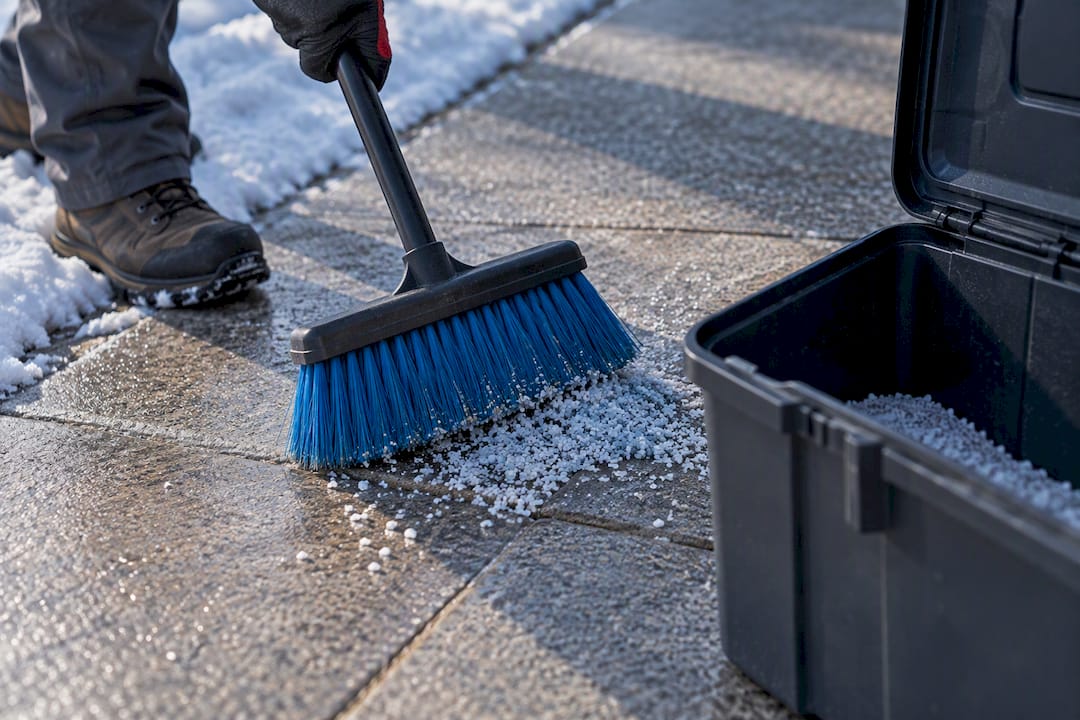
Store deicer bags off the ground and away from moisture, since clumped, wet product spreads unevenly and loses effectiveness. Rinse spreaders and sprayers at the end of the season to prevent corrosion from residual brine. If a large spill happens on a driveway or walkway, sweep up as much dry material as possible before it dissolves, rather than hosing it directly into a storm drain.
Planning ahead for the winter season
Sidewalk ice control works best when it is planned before the first snowfall, not improvised during it. Stock deicer and traction agents by early fall, and decide in advance which product fits your typical low temperatures rather than grabbing whatever is on the shelf mid-storm. Checking extended forecasts a few days out lets you pretreat before a freeze instead of reacting to ice that has already formed.
Properties with recurring ice problems, north-facing entrances, shaded walkways, spots near downspouts, benefit from marking those trouble areas early and treating them first every time. For commercial properties or HOAs, a seasonal snow contract locks in coverage for the whole season, from September through May, so pretreatment and clearing happen on a schedule instead of depending on whoever is available that morning.
How weather patterns change what actually works
Ice does not form the same way every time, and the method that works for dry, powdery snow will not necessarily handle a freeze-thaw cycle or freezing rain. A slow, steady snowfall at a consistent cold temperature is the easiest scenario: shovel as it falls and the sidewalk stays manageable. Freezing rain is harder, since it coats the surface directly with ice rather than snow, and pretreating with brine before it starts is far more effective than trying to melt a solid ice sheet afterward.
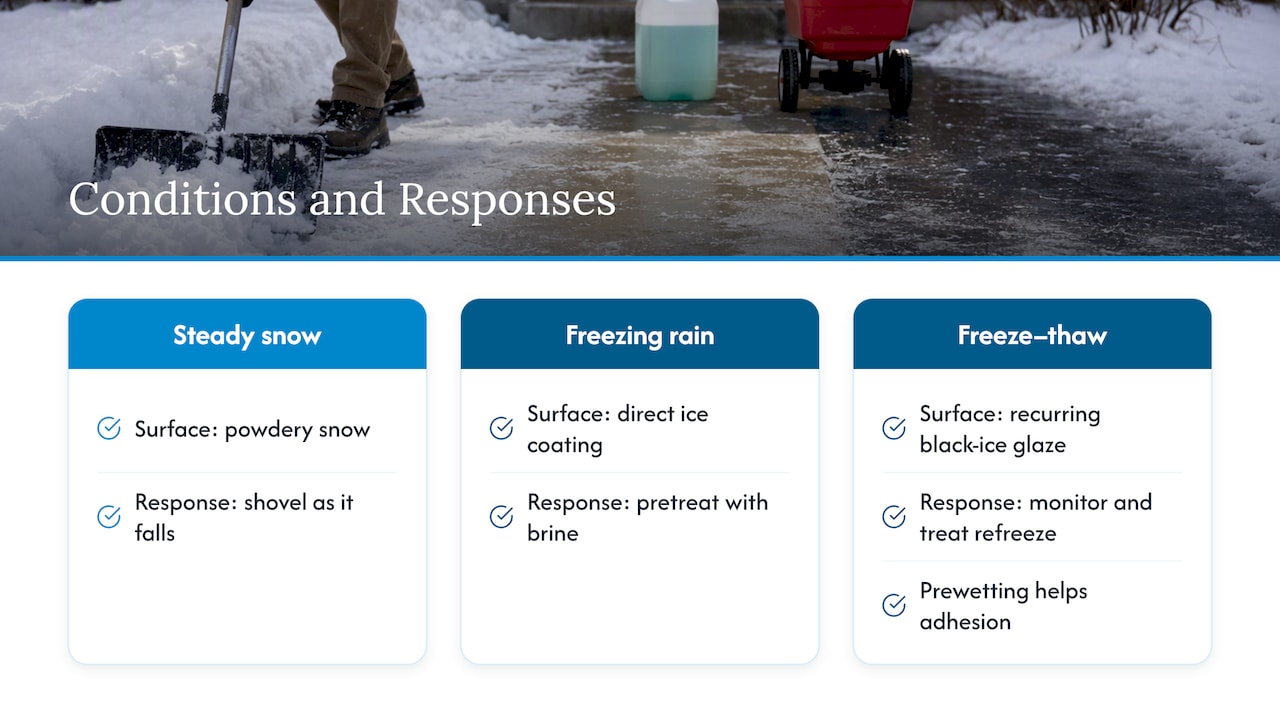
Freeze-thaw cycles, common in shoulder-season months, create the most persistent black ice, because meltwater refreezes overnight into a nearly invisible glaze. Wind matters too: prewetted product stays on the surface better than dry granules on a windy walkway, which is one reason field handbooks favor prewetting even outside anti-icing applications, per Minnesota DOT’s guidance.
Handling severe or prolonged ice conditions
When a single deicer application is not keeping up, usually during extended cold snaps or repeated freezing rain, the response needs to shift. Increase the frequency of clearing rather than the amount of product per application, since piling on more chemical past the recommended rate mostly runs off without adding melting power. Switch fully to traction agents once pavement temperatures drop below the working range of whatever chloride product is on hand.
For commercial sites, severe conditions are where a documented response plan matters most: assign specific staff or a contracted crew to check high-traffic entrances on a set schedule rather than waiting for complaints. Anti-icing with liquid brine before a major storm hits reduces how much reactive work is needed once the ice actually forms, since it prevents the initial bond rather than fighting an already-frozen surface, according to Cargill’s roadway anti-icing overview. Properties that cannot keep pace internally during a severe event are exactly the case where calling in emergency plowing and de-icing service makes more sense than pushing staff to catch up.
Who is actually responsible for a snowy sidewalk
In most U.S. cities, the property owner, not the city, is responsible for clearing the sidewalk in front of their home or business, usually within a set window after snow stops falling. Requirements vary by city: some give homeowners 24 hours, others less, and municipalities can fine owners or send a crew and bill them if the sidewalk goes uncleared, as seen in ordinances like Minneapolis’s sidewalk snow clearing rules.
Because these ordinances differ by city and change periodically, checking your own municipality’s public works page before winter starts is the only reliable way to know your exact deadline and any applicable fine. For commercial properties and HOAs, the responsibility question often shows up in a lease or association agreement rather than just city code, which is another reason many opt for a documented seasonal contract instead of leaving it to informal effort.
What actually works, season after season
Most sidewalk ice problems come from skipping the physical clearing step and reaching straight for a bag of salt. Anti-icing before a storm and shoveling promptly during it solve more of the problem than any deicer applied afterward. For a single home, that combination is usually enough. For a commercial entrance or an HOA common area, the liability math changes, and a professional program is the more defensible choice.
— Jesse
Denver Snow Removal: professional sidewalk ice control when you need it handled
If shoveling and pretreating are not realistic for your property, whether it is a busy commercial entrance or a large HOA common area, Denver Snow Removal handles sidewalk clearing and anti-icing pre-treatment as part of its Denver Metro service lineup, alongside seasonal contracts and 24/7 emergency dispatch for sudden storms.
Residential walkway clearing starts at a modest per-visit fee, and commercial properties can request a free estimate for anti-icing and full sidewalk management through the sidewalk clearing and de-icing service page. For urgent conditions, same-day and emergency dispatch is available through the main service line.
Sources
- What do they spray on roads before snow? — Cargill
- Deicing Products User Guide — Minnesota DOT
- The effects of deicing salts on landscapes — University of Minnesota Extension
- Using deicers safely in your landscape — UNL Water
FAQ
How to keep ice off a sidewalk?
Clear snow before it gets packed down, then apply a temperature-appropriate deicer or traction agent to the bare surface. Pretreating with liquid brine before a storm, a practice called anti-icing, prevents ice from bonding to the pavement in the first place, per Minnesota DOT’s field guidance.
Is the city responsible for snow removal on sidewalks?
In most cases, no: the property owner is responsible for clearing the sidewalk in front of their home or business within a set time after snowfall. Rules and deadlines vary by city, and some municipalities can fine owners or bill them for city-performed clearing, as outlined in Minneapolis’s sidewalk snow rules.
What temperature is too cold for rock salt to work?
Sodium chloride loses much of its melting power once pavement temperatures drop to around 15 to 20°F. Below that range, magnesium chloride or calcium chloride perform better, and switching to sand or traction grit is the safer option once temperatures fall further, according to UNL Water’s guidance.
Can deicer damage my concrete or plants?
Yes, over-applying chloride-based deicers can corrode concrete and harm nearby grass and shrubs, especially at rates above roughly 2 to 4 ounces per square yard. Sweeping up leftover granules after the ice melts and avoiding deicer on concrete less than 30 days old limits most of that damage, per University of Minnesota Extension and UNL Extension’s homeowner guide.
Is it cheaper to shovel or hire a snow removal service?
For a single driveway or walkway treated occasionally, a shovel and a bag of deicer are the cheaper option. For commercial properties or HOAs with frequent ice and heavy foot traffic, a seasonal contract, like Denver Snow Removal’s Seasonal Snow Contracts, often costs less overall than the staff time and liability risk of handling it in-house.