
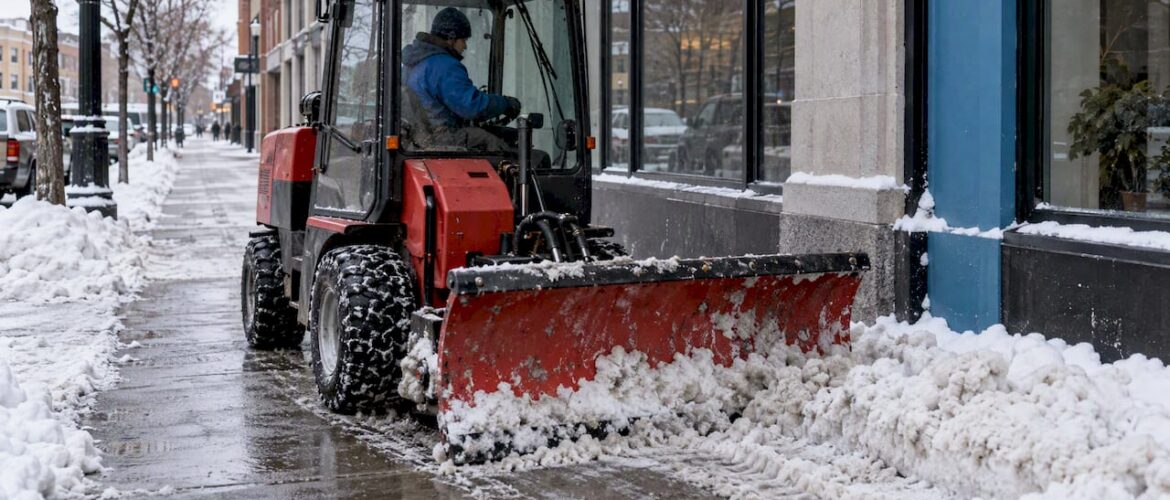
If you manage or own a downtown Denver site, the city will not clear it for you. Denver plows public streets. Your lot, sidewalks, ramps, loading docks and entrances are yours to keep safe, and the clock starts ticking the moment snow stops falling. This guide explains what the law expects, why downtown sites are harder than suburban ones, and how to set up service so a storm never becomes a liability claim.
TL;DR
- Denver requires property owners to clear adjacent sidewalks: businesses must start right after snow stops, residences have until the next day.
- After a time-stamped notice, a business has 4 hours before a re-check and a possible $150 fine. A residence has 24 hours.
- Downtown sites have tight lots, heavy foot traffic and little room for piles, so hauling and pre-treatment matter more than they do in the suburbs.
- Sign a seasonal contract before the first storm, and ask for documented visits and proof of liability coverage.
- Our seasonal contracts run September to May, with free estimates and 24/7 emergency dispatch.
Table of Contents
- Why downtown sites are a different snow problem
- What Denver law requires of property owners
- Liability: the risk is bigger than the fine
- Ice management in Denver’s freeze-thaw climate
- Equipment and methods that fit tight downtown lots
- Perspective: what we see on downtown jobs
- How to choose a downtown snow removal provider
- What downtown snow removal costs
- Residential and condo owners: know when to hire out
- Prepare your site before the first storm
- Get your downtown site covered
- FAQ
- Sources
Why downtown sites are a different snow problem
A suburban parking lot has space. You push snow to the edges, it melts in April, and nobody notices. A downtown site has none of that. Think of a small office building with a surface lot, a retail storefront with a single entrance, a mixed-use building with a rear loading area, or an apartment community squeezed between streets.
Three things make these sites hard:
- Nowhere to put the snow. Every foot you plow has to go somewhere. Piles block sight lines, take parking stalls and eventually melt across walkways.
- Pedestrians everywhere. Public sidewalks run along your frontage, and people use them whether or not your building is open.
- Tight timing. Employees arrive early, deliveries come before dawn, and the sidewalk deadline runs from the end of the snowfall, not from when your staff gets in.
That is why a downtown site needs a plan before the storm, not a phone call during it.
What Denver law requires of property owners
The City and County of Denver says property owners are responsible for clearing snow and ice from the sidewalks next to their property, including ADA ramps and bus stops. Businesses must begin clearing immediately after snow stops falling, while residences have until the next day.
Enforcement follows a sequence:
| Step | Business property | Residential property |
|---|---|---|
| Snow stops falling | Clearing should begin immediately | Clear by the next day |
| Inspector leaves a time-stamped notice | Yes | Yes |
| Time to clear after notice | 4 hours | 24 hours |
| Re-check and possible fine | $150 | $150 |
The figures above come from the City of Denver snow page. The city also publishes a Snow & Ice Build-Up Fact Sheet that explains the policy and why accessible sidewalks matter for seniors, people with disabilities and anyone with a stroller.
If you want a plain checklist for the compliance side of walkways, including ADA surfaces, this sidewalk compliance checklist for owners is a good companion. Check Denver’s own page for current rules, because deadlines and fines can change.
What “immediately” means in practice
For a downtown business, you cannot wait for a convenient morning. If snow ends at 9 p.m., your crew needs to be on site that night or at first light at the latest, with the walks and ramps cleared before foot traffic builds. A provider with true overnight dispatch is the practical answer. Staff shoveling before opening is rarely fast enough on a large frontage.
Liability: the risk is bigger than the fine
A $150 fine is the smallest cost of a bad winter. A slip-and-fall claim is the large one.
Colorado case law shows how this plays out. In Anderson v. Dunton Management Co., a shopping center visitor slipped in a parking lot owned by one company and managed by another, which had contracted out the snow work. The case is a useful reminder that responsibility does not vanish when you hire a contractor, and that runoff and refreezing from piled snow are foreseeable hazards. Courts have looked at whether management knew, or should have known, that melting water from piles would cross walkways and freeze.
What that means for you:
- Pile snow where meltwater cannot reach walkways, ramps or entrances. If the only spot drains across a path, haul it away.
- Keep records. Dated, time-stamped service logs show you acted promptly.
- Verify your contractor’s insurance. Ask for a certificate and read the scope.
- Know your contract. Learn exactly who is responsible for sidewalks, ice treatment and re-visits.
This is general information, not legal advice. If you have an active claim or a lease that shifts snow duties between landlord and tenant, talk to a Colorado attorney or your insurer.
Ice management in Denver’s freeze-thaw climate
Denver often sees sun-melt by day and refreezing at night. Snow that melts at noon becomes a sheet of ice by 6 p.m., right when workers leave the building.
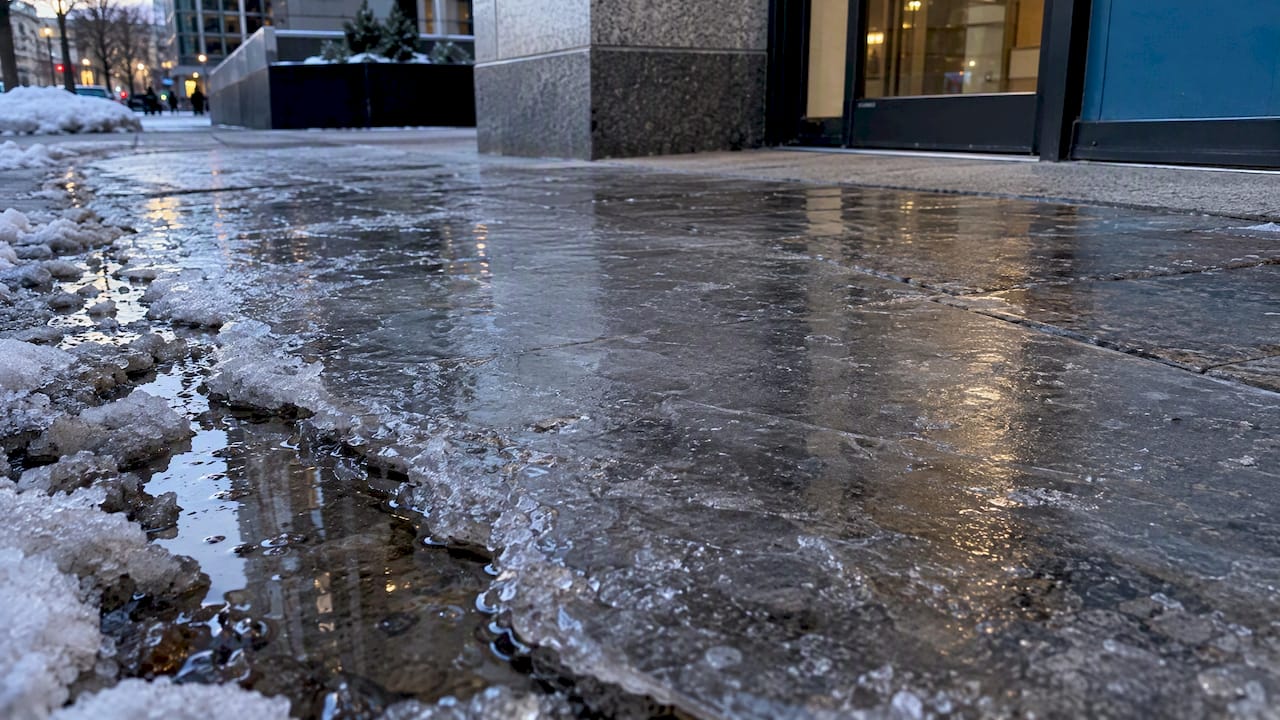
The city’s fact sheet advises owners to apply de-icing materials before forecast storms, because that prevents the bond between ice and pavement. Clearing ice after it forms is harder and slower.
A sound downtown ice plan has four parts:
- Anti-icing pre-treatment before the storm on high-traffic walks, ramps and drive lanes.
- Plowing and clearing as soon as accumulation justifies it.
- Ice melt on walkways after clearing, and again when refreeze is likely.
- Drainage checks. Look at where meltwater runs from your piles and downspouts. A guide to exterior drainage systems explains how water management protects a building, and the same thinking applies to keeping runoff off your walkways.
Equipment and methods that fit tight downtown lots
Big trucks and wide blades are not always the right tool. Downtown work often combines several methods:
- Truck plowing for open lanes and larger lots.
- Skid steer push and pile work for corners, loading docks and tight stalls. Attachments such as skid steer snow pushers move large volumes in confined spaces.
- Hand crews for entrances, stairs and ramps where machines cannot go.
- Snow hauling when the pile has nowhere to sit.
Hauling deserves a closer look. Once accumulated snow takes up parking stalls or blocks sight lines, you are paying for stalls you cannot use. Removing the pile off site restores capacity and removes the runoff risk described earlier.
Perspective: what we see on downtown jobs
We have served the Denver metro for more than 44 years, and the same mistakes appear every winter. Owners hire a plow for the lot and forget the sidewalk. They save a pile in the one corner that drains across the main entrance. They wait to sign until the first big storm, when everyone is calling at once.
Our advice is simple. Decide who is responsible for each surface: lot, sidewalks, ramps, loading area. Put it in writing. Ask for documented visits so you can show what was done and when. And treat before storms, not after. We run a dedicated team 24/7 because snow does not follow business hours, and our commercial-grade equipment is built to clear lots in one pass so your tenants and customers are not stepping around half-finished work.
We also give free estimates and price up front, because a property manager should know the cost before the storm, not after.
— Jesse
How to choose a downtown snow removal provider
Use these criteria to compare any provider, whatever its size:
| Question | What a good answer looks like |
|---|---|
| Do you dispatch overnight? | Yes, with a real person and a defined response process |
| Do you cover sidewalks, ramps and ice? | Written into the scope, not an add-on discovered later |
| Can you haul snow? | Yes, with a stated process and pricing basis |
| Do you document visits? | Time-stamped records you can request after any storm |
| What insurance do you carry? | A current certificate you can see and review |
| How is pricing set? | Clear per-visit, per-event or seasonal terms in writing |
| What is the trigger depth? | A stated accumulation that starts service |
Be cautious with providers who give a quote by text with no site visit. A downtown site has details: where the grates are, where pedestrians cut through, where the delivery truck parks. Those details belong in the contract.
Seasonal contract or per-storm service?
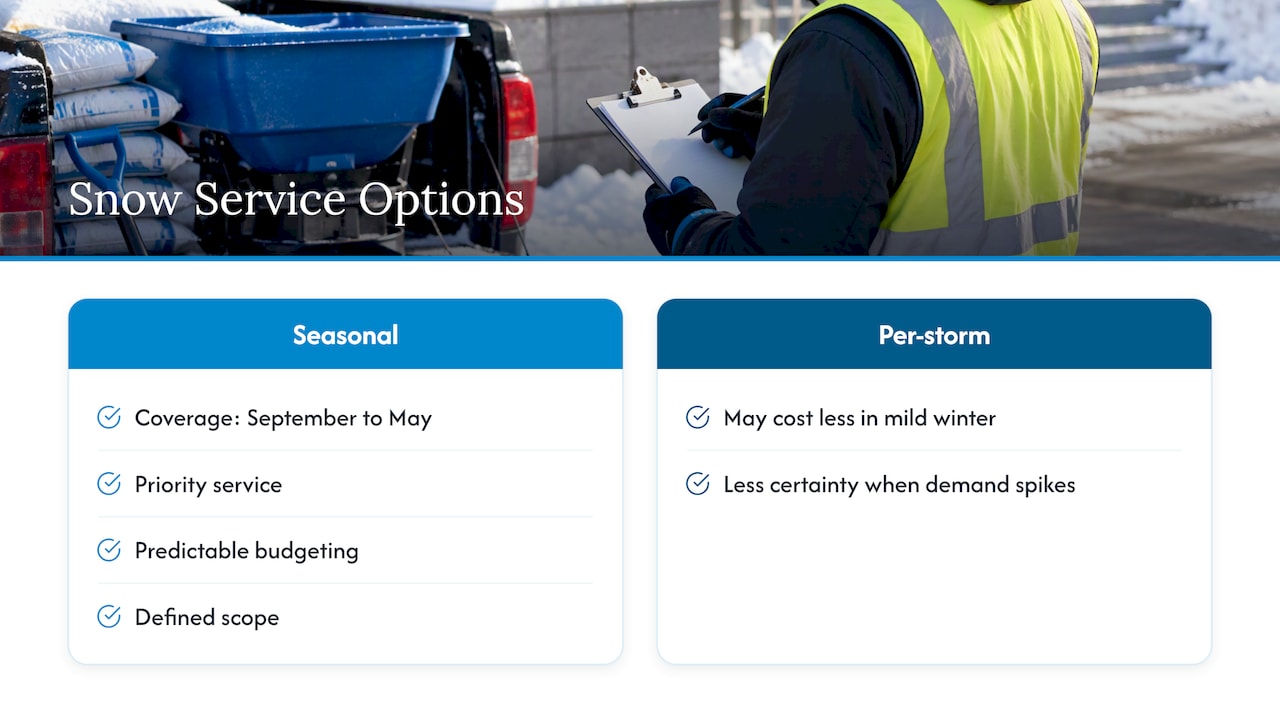
A seasonal contract suits most downtown commercial sites. You get priority service, predictable budgeting and a defined scope. Per-storm billing can look cheaper in a mild winter, but it gives you less certainty when demand spikes. Our seasonal contracts cover September to May, which matches the full Denver snow window. Contracts are usually arranged before the season, so the early fall is the time to ask.
What downtown snow removal costs
Commercial pricing depends on square footage, number of surfaces, trigger depth, hauling needs and whether you want pre-treatment. That is why we do not publish a flat commercial rate. We provide free estimates after we understand your site.
For residential service, driveway and walkway clearing starts from $41.25 per visit. If you own a downtown townhome, condo unit or small residence, that is the starting point, and the final price depends on the property.
Residential and condo owners: know when to hire out
Not every downtown site is a tower. Many are homes, lofts and small HOA communities. If you are deciding whether to shovel yourself, the medical guidance is clear. The American Heart Association warns that clearing snow can be hazardous to your heart, and Johns Hopkins public health experts advise that older adults, inactive people and those with conditions such as heart disease or high blood pressure should have someone else handle it. Cold air constricts arteries, which is a particular concern after age 40. The National Safety Council reports that shoveling causes thousands of injuries nationwide each year. If you have a heart condition or any doubt, ask your doctor before you pick up a shovel.
For condo boards and HOAs, the same logic applies at the community level: one contract, one scope, one set of records.
Prepare your site before the first storm
A short checklist for late October:
- Walk the property and mark curbs, drains, bollards, hydrants and low landscaping that a plow can hit.
- Decide where snow will be piled and where it will be hauled.
- Identify every sidewalk, ADA ramp and bus stop you are responsible for.
- Confirm who authorizes service calls and who gets the visit records.
- Ask your provider about pre-treatment before the first forecast.
- Keep delivery and tenant parking plans flexible on plow nights.
If your building also needs seasonal readiness inside, a commercial winterization guide covers the building-systems side, and snow service handles the exterior.
Get your downtown site covered
We handle commercial parking lot plowing, sidewalk de-icing, anti-icing pre-treatment, snow hauling and 24/7 emergency dispatch. See our commercial snow removal and plowing services or the page for parking lot plowing and anti-icing in Denver, then request a free estimate. We offer same-day service for new and existing clients.
FAQ
How fast do I have to clear sidewalks downtown?
In Denver, businesses must begin clearing immediately after snow stops falling. If an inspector leaves a notice, a business has 4 hours before a re-check and a possible $150 fine. Residences have until the next day, then 24 hours after a notice.
Does Denver plow my private lot or sidewalk?
No. The city handles public streets, and property owners are responsible for the sidewalks beside their property. Private lots, loading areas and entrances need your own provider.
Am I still liable if I hire a snow contractor?
Possibly. Colorado courts have examined owner and manager responsibility when a contractor handles snow, as in the Anderson case discussed above. Review your contract, confirm insurance, and ask an attorney or insurer about your specific lease and coverage.
What is the difference between plowing and snow hauling?
Plowing pushes snow aside so you can use the surface. Hauling removes it from the site. Downtown, hauling is often the better choice when piles would block stalls or send meltwater across walkways.
How much does residential snow removal cost?
Our residential driveway and walkway clearing starts from $41.25 per visit. Commercial pricing is quoted by site, so we provide a free estimate.
Sources
- Snow Removal, City and County of Denver
- Snow & Ice Build-Up Fact Sheet, City of Denver
- Anderson v. Dunton Management Co., 865 P.2d 887 (Colo. App. 1993)
- Winter Safety and Injury Prevention, Johns Hopkins Bloomberg School of Public Health
- Snow shoveling can be hazardous to your heart, American Heart Association
- Snow Shovel Safety, National Safety Council