
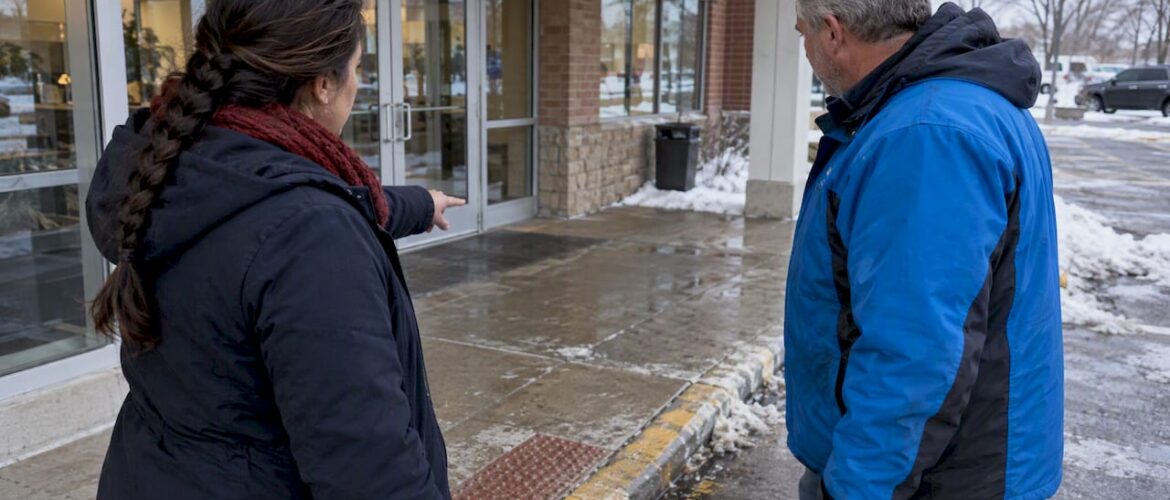
If your clinic needs reliable winter access, the fastest path is a preseason snow management agreement with a site-specific scope of work, clear service triggers, ADA-aligned priorities, anti-icing authorization and GPS-verified documentation. Ask any provider for proof of 24/7 dispatch, equipment sized for curb ramps and entrances, and written service logs. We offer free estimates and plans designed to suit clinic hours and risk factors.
TL;DR:
- Precise trigger depths, priority zones, and anti-icing authorization are essential elements to include in a snow management contract for reliable clinic access.
- Documentation such as GPS logs, time-stamped photos, and site maps are critical for defending liability claims and ensuring service accountability.
- Use equipment specifically suited for ADA ramps and accessible routes, with crew training on ADA priorities to prevent packed snow and improve safety.
- Contracts should be awarded before September 1 and span at least one year to guarantee capacity, consistent pricing, and thorough site planning.
- Keep a comprehensive file of service logs, photos, insurance, and safety training records, tying payments to documentation submission to enforce compliance.
Table of Contents
- Why Clear Clinic Access Matters Now: Safety, Liability and Operations
- Core Contract Elements: What to Put in the SOW and LOS
- Accessibility and ADA-Aligned Practices for Entrances, Sidewalks and Curb Ramps
- Dispatch Logic, Scheduling and Proof: Making Sure Crews Arrive
- Preventive Measures: Anti-Icing, Site Prep and Haul Triggers
- Procurement Timing and Term Recommendations
- Document Checklist and Verification Items to Keep on File
- Provider Perspective: Building a Clinic Snow Access Plan
- How to Request a Clinic Snow Access Estimate
- FAQ
- Sources
Why Clear Clinic Access Matters Now: Safety, Liability and Operations
A missed entrance or an icy ramp outside a clinic is not just an inconvenience. It is a liability exposure, a patient safety issue and, often, an operational failure that ripples through the day.
Documentation changes how slip-and-fall claims get resolved. When a provider can produce time-stamped photos and arrival records, a property owner has a defensible account of what happened and when. Without that record, outcomes often hinge on memory and assumption.
Clinics also carry obligations that retail or office properties do not: ambulance bays, deliveries of medical supplies and patients with mobility limitations all depend on predictable access. Public agencies have a duty to keep pedestrian routes usable with only isolated or temporary interruptions, and federal guidance on maintaining pedestrian facilities places reasonable snow removal squarely inside that obligation, even though day-to-day clearing duties typically fall to the adjacent property owner.
- Slip-and-fall incidents are harder to defend without time-stamped records.
- Blocked entrances disrupt deliveries, staff arrival and ambulance access.
- Accessible routes carry a maintenance expectation that snow removal must support.
Core Contract Elements: What to Put in the SOW and LOS
A snow contract works best as an operational document, not a vague promise. The service level agreement (LOS) and scope of work (SOW) should spell out exactly when crews mobilize and what “done” looks like.
Guidance on building precise snow contracts notes that vague “as needed” language is a leading cause of billing and operational disputes. Contracts work only when dispatch rules, field crews and documentation all point to the same definitions.
- Define trigger depths precisely. Spell out whether service begins at a specific accumulation, such as a 2-inch trigger, or runs on forecast-based automatic dispatch regardless of will-call requests.
- Set priority areas and completion windows. Entrances, ADA ramps, ambulance bays and primary walkways should have shorter completion targets than overflow parking.
- Authorize anti-icing and refreeze treatment. Specify whether pre-treatment is included and how post-storm refreeze gets handled without a separate approval each time.
- Set stacking versus hauling criteria. Define pile height or location limits that trigger hauling instead of on-site stacking.
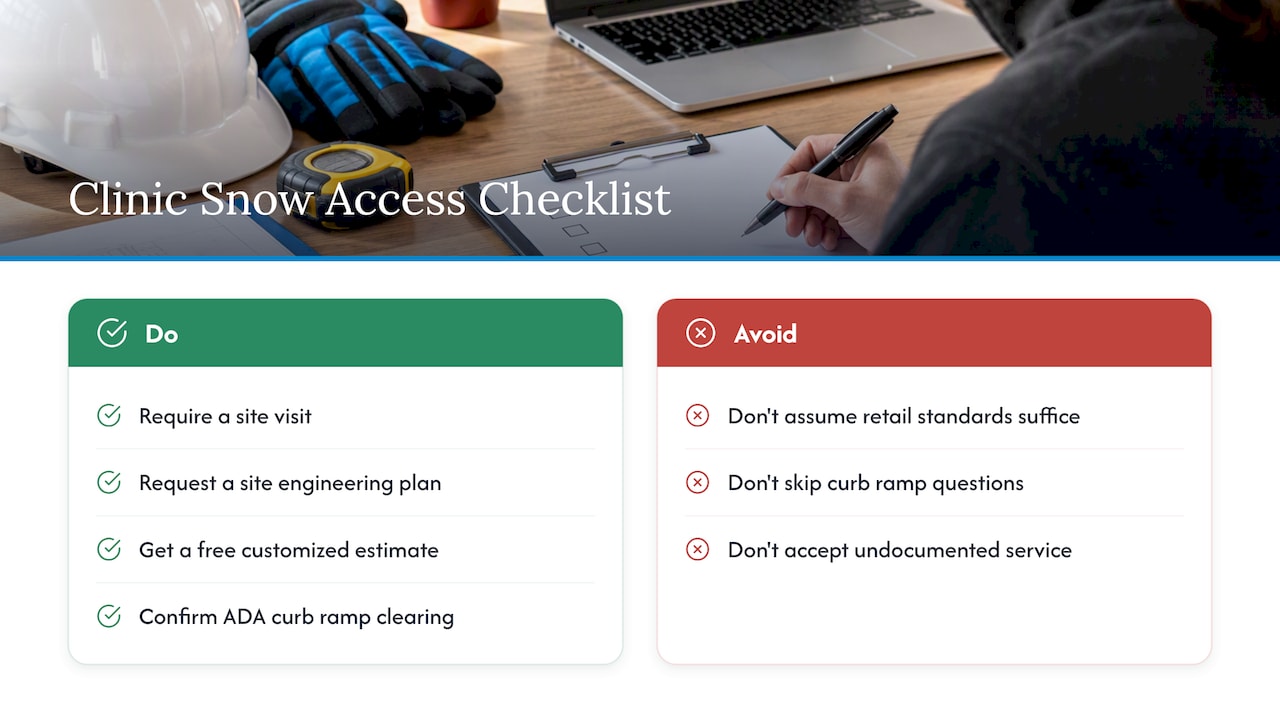
- Require a site engineering plan. This confirms the vendor has mapped your property, including equipment that fits tight clinic entrances and curb cuts.
Our own snow removal questions worth asking medical facilities walks through how these elements apply specifically to clinics, where the margin for error is smaller than at a typical retail lot.
Pro Tip: Ask any prospective vendor to walk your site in person before signing, not just review a satellite image, since curb ramps and entrance geometry rarely show up clearly from above.
Accessibility and ADA-Aligned Practices for Entrances, Sidewalks and Curb Ramps
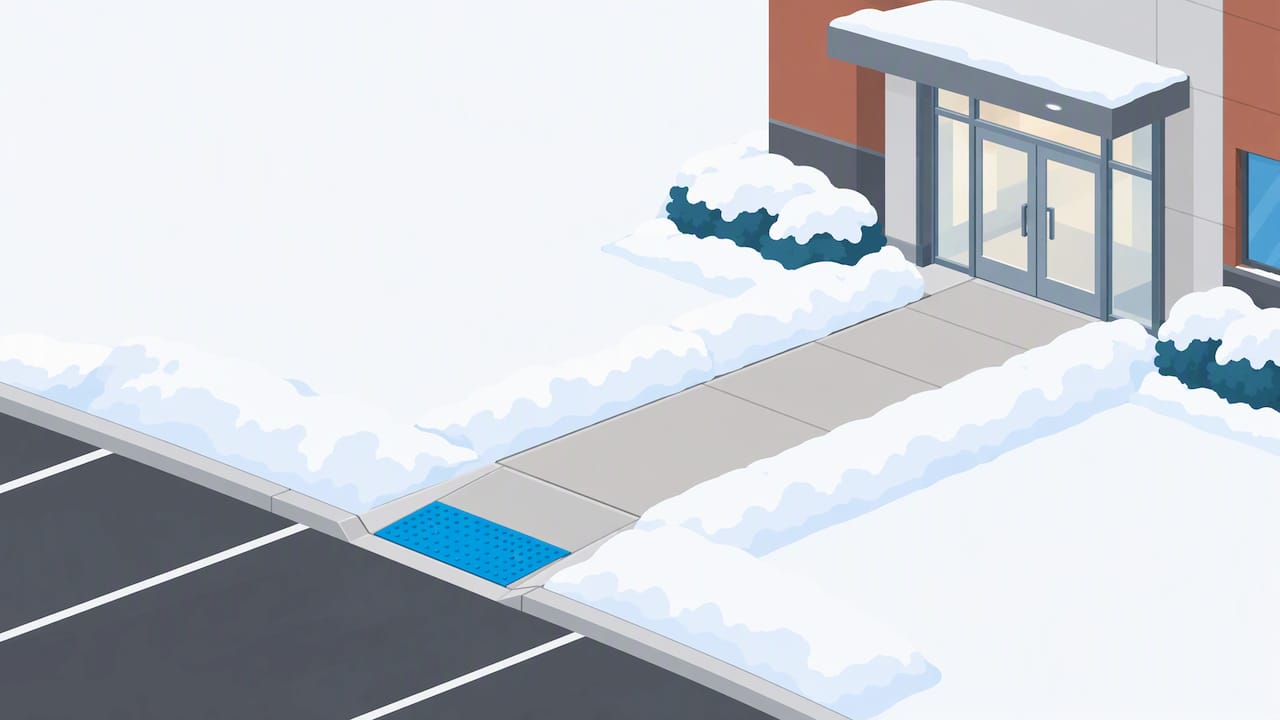
Accessible routes carry a maintenance duty that goes beyond general tidiness. Under federal pedestrian facility guidance, interruptions to an accessible path should be isolated and temporary rather than a seasonal condition patients simply learn to work around.
For a clinic, that means curb ramps, entrance pads and the primary accessible route need attention before general parking lot cleanup, not after. Compact snow blowers suited to narrow ramps avoid the ridge of packed snow a full-size plow often leaves behind, and full-width sidewalk clearance matters where a single shoveled path forces wheelchair users or patients with walkers into the street.
- Clear curb ramps and entrance pads before general lot plowing begins.
- Use equipment sized for narrow accessible routes, not just large-lot plows.
- Confirm crew training on ADA priority areas is written into the SOW.
A vendor who cannot describe how their equipment handles a curb ramp without leaving a packed edge has not thought through the accessibility piece of the job.
Dispatch Logic, Scheduling and Proof: Making Sure Crews Arrive
Dispatch confusion is where most service failures start. A contract should state plainly whether service is automatic, triggered by a forecast or snowfall threshold without a phone call, or will-call, where someone at the clinic has to authorize each visit. Contract language that defines dispatch logic in advance, rather than leaving it to interpretation during a storm, is what keeps field crews and contract terms aligned.
Verification matters just as much as arrival. GPS-verified service logs and time-stamped photos give facility managers a documented account they can produce if a claim arises, and SIMA’s guidance on quality RFPs and procurement treats this kind of documentation as more persuasive in a dispute than recollection alone.
- Specify automatic dispatch for priority areas, will-call only for secondary zones if at all.
- Require GPS logs, before and after photos, and crew identification on every visit.
- Confirm de-icing material inventory and a backup supply source in writing.
- Cap refreeze response obligations so expectations are explicit, not assumed.
Preventive Measures: Anti-Icing, Site Prep and Haul Triggers
Reactive de-icing after a storm is more expensive and less reliable than preventing the bond between ice and pavement in the first place. A summary of current snow and ice control guidance describes anti-icing pre-treatment as more efficient at maintaining safe access through a storm than waiting to treat ice after it forms, since it reduces the repeated de-icing passes a multi-day event often requires. Our parking lot de-icing guide covers timing and material choices in more detail.
Site preparation reduces surprises once snow starts falling.
- Mark curb edges, fire hydrants and landscape features with stakes before the first storm.
- Define snow storage zones that will not block sightlines, drainage or accessible routes.
- Set a pile height or size threshold that triggers hauling rather than continued on-site stacking.
Procurement Timing and Term Recommendations
Winter capacity gets booked early, and clinics that wait until the first storm often find the best routes already committed elsewhere.
Procurement standards from the snow and ice management industry recommend awarding contracts before September 1 to secure route capacity and material inventory, with contract terms of at least one year and preferably three to stabilize pricing and service consistency.
- Award contracts before September 1 whenever possible.
- Favor 1 to 3 year terms over single-season agreements.
- Require a signed site engineering plan and preseason inspection as deliverables.
- Confirm mobilization timelines and inventory commitments in writing before the season starts.
Document Checklist and Verification Items to Keep on File
Once service begins, the paperwork matters as much as the plowing. Keep a file that any facility manager, insurer or legal counsel could review without having to reconstruct events from memory.
- Service logs with GPS verification for every visit, including arrival and completion times.
- Time-stamped before and after photos covering entrances, ramps and priority walkways.
- A current site map or site engineering plan showing priority zones and designated snow storage locations.
- Insurance certificates, including any snow-specific riders, on file and current.
- Proof of worker safety training, particularly around elevated surfaces, since OSHA’s winter weather hazard guidance calls for employers to evaluate fall and other hazards and avoid rooftop snow work when safer alternatives exist.
Pro Tip: Tie a portion of payment to submission of that month’s documentation rather than treating records as optional paperwork, since that single contract clause does more than anything else to keep logs current.
Provider Perspective: Building a Clinic Snow Access Plan
We have been clearing Denver Metro properties for over 44 years, and clinics get treated with a different standard than a strip mall parking lot. A missed curb ramp at a retail property is an annoyance. At a clinic, it can keep a patient from reaching an appointment.
Our team and equipment are tailored to meet these needs, including compact snow blowers for ADA-compliant curb ramp clearing. Every clinic contract begins with a site visit, a site engineering plan, and a free estimate customized to your hours and priority zones. When you meet with a prospective vendor, ask directly how they handle curb ramps, what their dispatch trigger is, and whether documentation comes standard or costs extra.
— Jesse
How to Request a Clinic Snow Access Estimate
Getting an accurate, tailored estimate starts with giving us a clear picture of your site. We offer free estimates based on your clinic’s operating hours and risk areas, rather than a generic lot-size calculation.
- Share a basic site map noting entrances, ambulance bays and accessible routes.
- List your hours of operation, including any 24-hour or urgent care components.
- Note ADA priority zones and any areas with a history of drainage or refreeze problems.
- Tell us your preferred trigger depth, whether that is a 2-inch threshold or a forecast-based start.
If you are comparing multiple bids, ask each vendor for the same documentation commitments: GPS logs, photos and a signed site engineering plan. Visit our parking lot and commercial snow removal services page to start a conversation about a seasonal contract or a one-time service agreement for your property.
FAQ
What should a clinic’s snow removal contract include at minimum?
A clinic contract should define trigger depths, priority completion windows for entrances and ADA ramps, anti-icing authorization and documentation requirements such as GPS logs and photos. Vague “as needed” language, without those specifics, is a common source of disputes according to guidance on building precise snow contracts.
Is a clinic responsible for clearing snow from sidewalks and curb ramps?
Day-to-day clearing responsibility typically falls to the adjacent property owner, while public agencies are expected to keep accessible routes usable with only isolated interruptions under federal pedestrian facility guidance. Check your local ordinance for the specific timeframe and standard that applies to your property.
What is the difference between anti-icing and de-icing?
Anti-icing is a preventive pre-treatment applied before a storm to stop ice from bonding to pavement, while de-icing treats ice that has already formed. Anti-icing is generally considered more efficient at maintaining safe access during a storm, based on a summary of current snow and ice control guidance.
When should a clinic sign a seasonal snow removal contract?
Contracts are best awarded before September 1 to secure route capacity and material availability ahead of peak demand, per industry procurement standards. Seasonal Snow Contracts are available for properties seeking predictable service throughout the typical snow season.
What records should we keep in case of a slip-and-fall claim?
Keep GPS-verified service logs, time-stamped before and after photos, crew sign-off records and current insurance certificates with any snow-specific riders. Procurement best practice guidance notes this kind of documentation holds up better than relying on memory after an incident.
Sources
- SIMA – ANSI procurement standard (Best practices)
- Build snow contracts with precision – SIMA
- FHWA – Guide for maintaining pedestrian facilities
- OSHA – Winter weather hazards (roof snow removal guidance)