
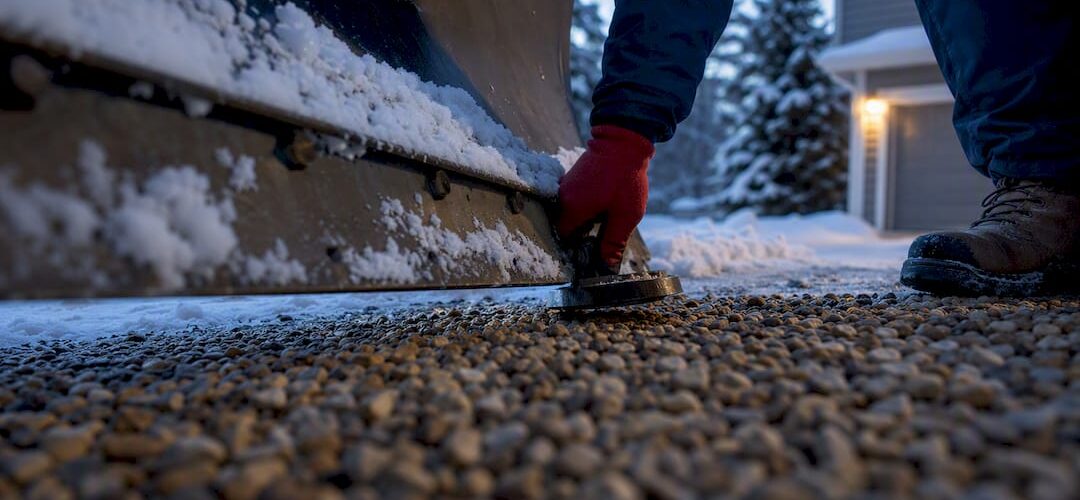
The safest way to clear a gravel driveway is to leave a thin packed base rather than scraping to bare stone, then use floating equipment settings: a two-stage snowblower with skid shoes raised to about 1/2 inch, or a plow blade with shoes set to hover roughly 0.5 inches above the surface. Hand tools work best for small areas. Speed and aggressive scraping are what actually wreck gravel, not the snow itself.
TL;DR:
- Raising snowblower skid shoes to about half an inch prevents gravel pickup while clearing moderate to heavy snow efficiently.
- Plows should be set to hover roughly 0.5 inches above the surface and wait until snow reaches around 2 inches before plowing to avoid gouging gravel.
- Sand provides traction without degrading the driveway surface, while salt can create muddy slurry and environmental runoff issues.
- Proper driveway grading, edge marking, and early-season packing significantly reduce winter damage and facilitate spring repairs.
- Professional operators adapt techniques by listening to feedback, making them more effective on long or steep drives, heavy storms, or after repeated freeze-thaw cycles.
Table of Contents
- Why Gravel Driveway Snow Removal Requires Different Techniques
- Which Snow Removal Method Fits Your Gravel Driveway?
- How Do You Set Up a Snowblower for Gravel Without Throwing Rocks?
- What Plow Shoe Settings Prevent Gravel Displacement?
- How Do You Clear Snow From Gravel by Hand?
- Should You Use Salt or Sand on a Gravel Driveway?
- What Preseason Prep Reduces Winter Driveway Damage?
- How Do You Repair Gravel After Winter?
- What Separates Pro Operators From DIY Snow Clearing?
- Get Professional Help With Gravel Driveway Snow Removal
- Sources
- FAQ
Why Gravel Driveway Snow Removal Requires Different Techniques
Pavement forgives mistakes. Gravel does not. Scrape a plow blade or a single-stage blower across loose stone the way you would across asphalt, and you will pull up rock, gouge ruts into the surface, and send gravel into the yard, storm drains, or your neighbor’s lawn. That process is called scalping, and it is the single most common cause of gravel driveway damage during winter.
The physics work against you too. Freeze-thaw cycles loosen the top layer of stone throughout winter, and meltwater needs somewhere to go. A driveway that has lost its crown, the slight center high point that sheds water to the sides, will pool, refreeze, and rut faster with every storm.
The goal is not a bare, black-top-clean surface. It is a driveway that stays intact, drains properly, and stays safe to walk and drive on.
- Loose stone shifts and displaces under scraping pressure in ways pavement never does
- A packed snow layer over gravel actually protects it, functioning like a temporary buffer
- Lost crown and drainage problems compound with each freeze-thaw cycle
Which Snow Removal Method Fits Your Gravel Driveway?
Matching the tool to the job matters more on gravel than on any other surface. Here is how to think through the options based on snow depth, driveway length, and how much risk you are willing to accept.
- Leaf blower for light, dry, powdery snow under an inch or two. Zero contact with the surface means zero risk of gravel pickup.
- Two-stage or three-stage snowblower for moderate to heavy snowfall on a driveway you clear yourself. This is the best all-around DIY choice once skid shoes are set correctly.
- Plowing with a raised blade and rubber or poly edge for long driveways where a blower would take too long. Works well when the operator goes slow and uses plow shoes.
- Hand tools and a garden rake for small areas, steps, and tight spots near landscaping where precision beats speed.
- Professional plowing for steep or long drives, back-to-back heavy storms, or repeated freeze-thaw damage that keeps reopening the same ruts.
The pattern across all four DIY methods is the same: float above the surface, never dig into it.
How Do You Set Up a Snowblower for Gravel Without Throwing Rocks?
Skip single-stage blowers entirely. Their augers make direct contact with the ground, which means direct contact with your gravel, and that is a fast way to launch stones across the yard and chip your siding. Two-stage and three-stage machines are built differently. Their impeller design lets the intake float above the surface once the skid shoes are adjusted properly, so the auger never has to touch stone to move snow.
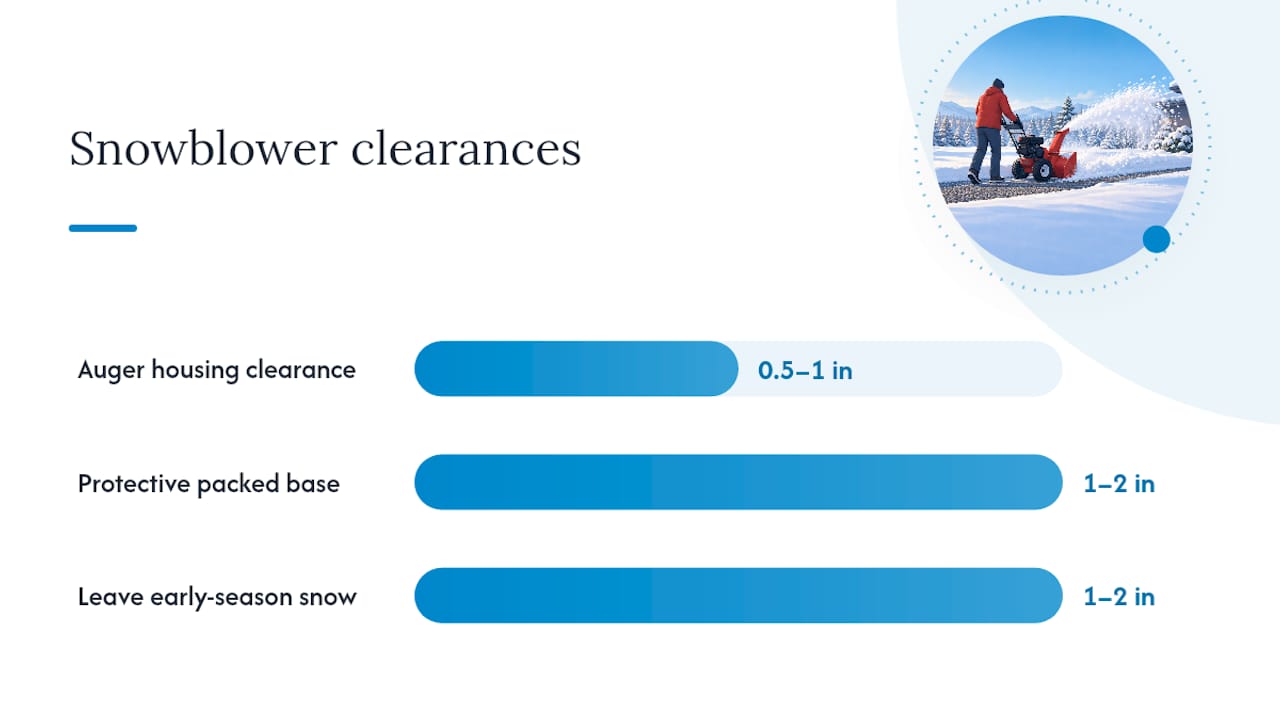
Clearance is the number that matters most. Raise the skid shoes so the auger housing sits about 1/2 to 1 inch above the gravel, then run a short test pass before committing to the whole driveway. Watch and listen. If you hear stone rattling through the chute or see gravel flying, raise the shoes a bit more and try again.
Pro Tip: Do this test pass in daylight on a low-stakes section near the street, not right next to your garage door or parked car. A few flying stones during setup are a minor annoyance there. Near glass or paint, they are a repair bill.
Once you are dialed in, technique matters as much as the setup:
- Move at a slower forward speed than you would on pavement
- Keep the auger engaged steadily rather than starting and stopping
- Take partial-width passes in heavy snow instead of trying to clear full width in one pass
- Leave the first 1 to 2 inches of an early-season snowfall to pack down and freeze, building a protective base that reduces gravel pickup for the rest of winter
Before the season starts, inspect the scraper bar, keep a spare shear pin or two on hand in case you hit a buried rock, mark your driveway edges so you know where the gravel ends, and point the discharge chute away from windows and vehicles every time.
What Plow Shoe Settings Prevent Gravel Displacement?
Plowing gravel is where amateur mistakes get expensive fast. The fix is mostly about clearance and patience rather than horsepower.
Set your plow shoes so the blade hovers roughly 0.5 inches above the gravel instead of riding directly on the surface. That half inch of buffer is the difference between pushing snow and gouging stone. Industry guidance also recommends waiting until you have about 2 inches of accumulation before the first pass, since plowing a dusting offers no benefit and just increases the chance of scraping into gravel that has no snow cushion protecting it yet.
Technique matters just as much as the hardware:
- Start plowing from the center of the driveway and angle the blade to push snow outward
- Take multiple light passes rather than one deep pass
- Tilt the blade to roughly 40 to 45 degrees to reduce direct scraping contact
- Go slow enough to hear and feel what the blade is doing, and back off the moment you hear scraping
Pro Tip: If you can hear the blade at all, you are probably too close to the gravel. A properly set plow on gravel should sound almost like it is gliding.
A rubber or poly edge on the blade absorbs minor surface irregularities better than steel, which further cuts down on gouging. For very long driveways or storms that dump more snow than a single pass can handle, back-drag on the return trip rather than pushing forward twice, and consider scheduling snow hauling or loader work once piles get too large to push efficiently.
How Do You Clear Snow From Gravel by Hand?
Small driveways, front steps, and areas tight against landscaping or a fence line call for hand methods more than machines. A garden hose reel or a snow blower can overshoot these spaces; a shovel and a rake give you control.
Shovel in layers. Remove the top few inches first, then stop well before you would need to scrape to reach bare stone. Use angled, pushing motions rather than digging straight down, which keeps the shovel blade above the gravel line.
For wet, heavy snow, a garden rake works better than a shovel in some spots. Drag it across the surface and let the gravel fall back through the tines while the snow comes with you. For light, dry powder, a leaf blower held slightly above the surface and run in multiple light passes clears the area with zero contact at all.
- Layered shoveling: top-down passes, stop short of the stone
- Garden rake: pulls wet snow while gravel falls through
- Leaf blower: best for dry powder, held above the surface
If your driveway is narrow and bordered by a fence, positioning stakes and clearing equipment near gate posts takes extra care. A well-placed gate for a narrow driveway can also make winter access easier by widening the usable clearing path near the entrance.
Should You Use Salt or Sand on a Gravel Driveway?
Skip broad salt application on gravel. Salt dissolves into the stone bed rather than staying on the surface, and the result is a muddy, unstable slurry instead of a melted, traction-friendly driveway. It also carries environmental runoff concerns that the EPA addresses directly in its best-practice guidance for deicing materials, which recommends minimizing application and storing deicing materials covered to reduce runoff into soil and waterways.
Sand is the better everyday choice for gravel. It will not melt ice, but it restores traction immediately and does not degrade the surface the way salt does. Save salt for genuine spot treatment, an icy patch on a slope or near steps, rather than a driveway-wide application.
- Use sand or a sand-salt mix for general traction, applied sparingly
- Reserve salt for small, targeted icy spots only
- Store abrasive and deicing materials covered to limit runoff
- Plan a spring cleanup to sweep up leftover sand before it gets ground into the driveway surface
One useful reference point: the EPA’s runoff guidance notes that minimizing application quantity is one of the most effective ways property owners reduce environmental impact, right alongside covered storage.
What Preseason Prep Reduces Winter Driveway Damage?
Most gravel damage gets baked in before the first snowfall even hits, through poor grading and missing edge markers. Fixing both in fall saves you from guessing where the driveway ends once everything is covered in white.
- Grade and crown the driveway so water sheds to the sides instead of pooling in the center, and fill any low spots you notice before the ground freezes.
- Install reflective stakes along both edges, spaced every few feet on curves and at hazards, tall enough to stay visible above expected snow depth.
- Service your snowblower or plow now: sharpen or replace the scraper bar, stock spare shear pins, and check skid shoe hardware for wear.
- Decide in advance where you will pile snow all season so runoff does not erode a specific section of lawn or driveway edge.
Marking edges properly is worth the extra half hour. A detailed guide to marking a driveway for plowing covers stake height and spacing in more depth if you want to get it exactly right.
How Do You Repair Gravel After Winter?
Spring is when you find out how the season actually went. Displaced stone, shallow ruts, and a flattened crown all show up clearly once the frost is out of the ground, and repairing them early prevents small problems from becoming expensive ones.
Start by collecting displaced gravel with a landscape rake and redistributing it back across the driving surface, rather than assuming you need new material right away. Only add fresh stone where gravel has genuinely been lost to erosion or repeated scraping.
- Fill potholes and low spots, then re-establish the driveway’s crown for proper drainage
- Compact new material in thin layers rather than dumping it loose
- Time repairs for early spring after frost-out, since working frozen or waterlogged ground just creates more rework
A step-by-step post-storm clearing guide walks through the repair sequence in more detail if your driveway took heavier damage than usual this winter.
What Separates Pro Operators From DIY Snow Clearing?
Experienced plow operators do not follow a fixed script. They listen and feel for feedback from the blade, taking multiple light passes instead of one aggressive scrape, and adjusting shoe height on the fly when conditions change mid-storm.
That adaptive approach is hard to replicate with a rented plow and one storm’s worth of experience. Long or steep driveways, back-to-back heavy accumulations, repeated freeze-thaw ruts, or snow piles too large to push efficiently are the situations where calling a professional makes more sense than pushing through it yourself. Detailed operator technique guidance covers what that adaptive process looks like in practice.
— Jesse
Get Professional Help With Gravel Driveway Snow Removal
Denversnowremovals is the alternative to trial-and-error DIY equipment settings for gravel driveways across the Denver Metro area: instead of guessing at skid shoe height or plow clearance yourself, a crew that already knows how local gravel drives behave clears it correctly the first time. That matters most on long or steep gravel drives, after heavy storms, or whenever a rutted, icy surface becomes a liability concern for anyone walking up to your door.
The company offers Residential Driveway and Walkway Clearing, anti-icing pre-treatment to reduce ice buildup before a storm hits, snow hauling for driveways buried under repeated storms, and Seasonal Snow Contracts running September through May for homeowners who would rather not track weather forecasts all winter. Every service starts with a free estimate. If your gravel driveway is fighting you every storm, check residential snow removal options and get a quote before the next system rolls in.
Sources
The technical clearance and timing figures in this guide come from equipment manufacturer guidance at Fisher Plows and machine setup instructions from Power Equipment CT. Environmental application guidance comes from the EPA’s best management practices document, and operator technique insight comes from Meyer Products and Ware Landscaping.
- How To Effectively Plow a Gravel Driveway or Parking Lot | FISHER
- EPA: Best management practices for deicing materials application and storage
- Best snow blowers for gravel driveways in 2026: Six picks that won’t throw rocks – HomeNestor
- How to use your Snowblower on a Gravel Driveway | Snowblow Gravel
FAQ
Can a Gravel Driveway Be Plowed?
Yes, a gravel driveway can be plowed safely as long as the blade is set correctly. Raise the plow shoes so the blade hovers about 0.5 inches above the surface and wait for roughly 2 inches of accumulation before the first pass to avoid scraping bare stone.
What Is the Best Tool for Removing Snow From a Gravel Driveway?
A two-stage or three-stage snowblower with properly adjusted skid shoes is generally the best DIY tool for moderate to heavy snow on gravel. Single-stage blowers make direct ground contact and are not recommended, since they pick up and throw stones instead of just moving snow.
What Should You Put on a Gravel Driveway to Melt Snow?
Sand is generally the better everyday choice for gravel because it adds traction without dissolving into the stone. Broad salt application is discouraged since it can create a muddy, unstable slurry and carries environmental runoff concerns, so save salt for spot-treating isolated icy patches only.
How Much Does It Cost to Plow a 100 Foot Driveway?
Pricing depends on driveway width, snow depth, and whether you need a one-time visit or a full-season plan. Denversnowremovals lists Residential Driveway and Walkway Clearing starting from $41.25 per visit, with exact quotes available through a free estimate based on your specific driveway.
How Often Should You Clear Snow From a Gravel Driveway?
Clear snow after each storm reaches a few inches rather than waiting for it to compact into ice, but let the very first inch or two of the season pack down as a protective base. That early base reduces gravel displacement for every clearing that follows for the rest of winter.