
Before you sign a snow removal contract, require your contractor to carry commercial general liability (CGL) with a snow/ice endorsement (CG 2292 or equivalent), commercial auto on every plow truck, workers’ compensation for all employees, and an umbrella policy that brings total coverage to an amount sufficient for commercial sites. Then verify every item on the Certificate of Insurance before work begins.
What to require and check on every COI:
- CGL with a named snow/ice endorsement — a standard CGL often excludes snow operations entirely
- Commercial auto, combined single limit of $500,000–$1,000,000 for plow trucks and mounted equipment
- Workers’ compensation covering all employees and any on-site crew
- Umbrella/excess policy to reach $3M–$5M total where your contract requires it
- Additional insured status naming you (the property owner/manager) on the policy
- Primary and noncontributory wording so the contractor’s policy pays first
- Waiver of subrogation preventing the contractor’s insurer from suing you after a claim
- Explicit subcontractor insurance requirements listed in the contract
Pro Tip: Call the insurer directly when a COI shows “refer to policy” for any endorsement. A phone call to the carrier confirms whether the policy will actually respond the way the COI implies.
Commercial contracts commonly require $1,000,000–$2,000,000 per occurrence general liability; municipal work in Denver often demands $2,000,000 or more per occurrence plus a performance bond.
Table of Contents
- Why snow removal insurance matters for your property
- What Denver law requires from snow removal contractors
- How to negotiate contract terms that actually transfer risk
- How to handle a snow removal injury claim
- How to select a contractor with the right coverage
- How contractor insurance limits affect your exposure
- What higher insurance limits cost and who pays
- Recordkeeping and COI renewal tracking
- Denversnowremovals: insured, documented, and ready for Denver winters
- FAQ
- Key Takeaways
Why snow removal insurance matters for your property
Slip-and-fall accidents on icy walkways and parking lots are among the most common winter liability claims in Colorado. When a visitor falls on an uncleared sidewalk, the clock starts ticking on who pays: the property owner, the contractor, or both. Risk transfer is the mechanism that shifts legal and financial responsibility to the contractor through indemnity, defense, and additional insured clauses. Without those clauses aligned to the policy language, liability can snap back to you even when you hired a professional.

What Denver law requires from snow removal contractors
Denver’s sidewalk snow ordinance requires property owners to clear snow within 24 hours after snowfall ends. That obligation does not automatically transfer to your contractor unless your contract says so explicitly. Colorado does not mandate a specific insurance minimum for private snow removal contracts, but property managers and HOA boards routinely set their own minimums in contract language. Municipal and government contracts in Denver typically require higher limits and may require a performance bond on top of standard coverage.
How to negotiate contract terms that actually transfer risk
Defense and indemnity language must mirror the policy language; a mismatch leaves gaps that neither party expects. Three clauses do the most work:
- Indemnity and defense: The contractor agrees to defend and indemnify you for claims arising from their work. Confirm the contract language matches what the policy covers.
- Additional insured + primary/noncontributory: Your name appears on the policy, and the contractor’s coverage pays before yours. Without “primary and noncontributory” wording, your own insurer may be pulled in first.
- Subcontractor requirements: If the contractor uses subs, require each sub to carry hired and non-owned auto liability and full GL endorsements, or confirm the prime contractor’s policy explicitly covers subcontractor actions.
Pro Tip: Ask for a sample COI before you sign. A contractor who cannot produce one quickly is a red flag.
How to handle a snow removal injury claim
Document everything immediately: photograph the area, note the time and weather conditions, and pull your contractor’s current COI. Notify your own insurer even if you believe the contractor is fully liable. Then contact the contractor and their insurer in writing. Proper incident documentation from the moment of the event protects your position if the claim escalates.
How to select a contractor with the right coverage
Ask every candidate three questions before you award a contract: What endorsements are on your CGL? How are subcontractors covered? Can you provide a COI showing additional insured and primary/noncontributory language today? Contractors who treat insurance as a core business strategy — not a checkbox — work with agents who understand snow-and-ice contract nuances and can answer those questions without hesitation. Check that the carrier is admitted in Colorado; non-admitted carriers create collection risk if a claim is disputed.
How contractor insurance limits affect your exposure
A contractor carrying only $500,000 per occurrence leaves a significant gap on a $2M claim. That gap lands on your property’s general liability policy, raising your premiums and potentially exhausting your own limits. Higher contractor limits cost more upfront in bid pricing, but they protect your balance sheet. Seasonal contract pricing that includes adequate insurance is almost always cheaper than a single uninsured slip-and-fall settlement.
What higher insurance limits cost and who pays
Snow removal insurance costs vary widely: small operators typically pay $800–$3,000 annually, while larger operations with significant equipment and revenue pay $5,000–$15,000 or more. Contractors pass those costs into their bids. A contractor quoting unusually low prices may be carrying minimum or inadequate coverage. When evaluating bids, ask for proof of coverage alongside the price — a well-maintained operation with strong underwriting history will have lower claims and more stable pricing over time.
Recordkeeping and COI renewal tracking
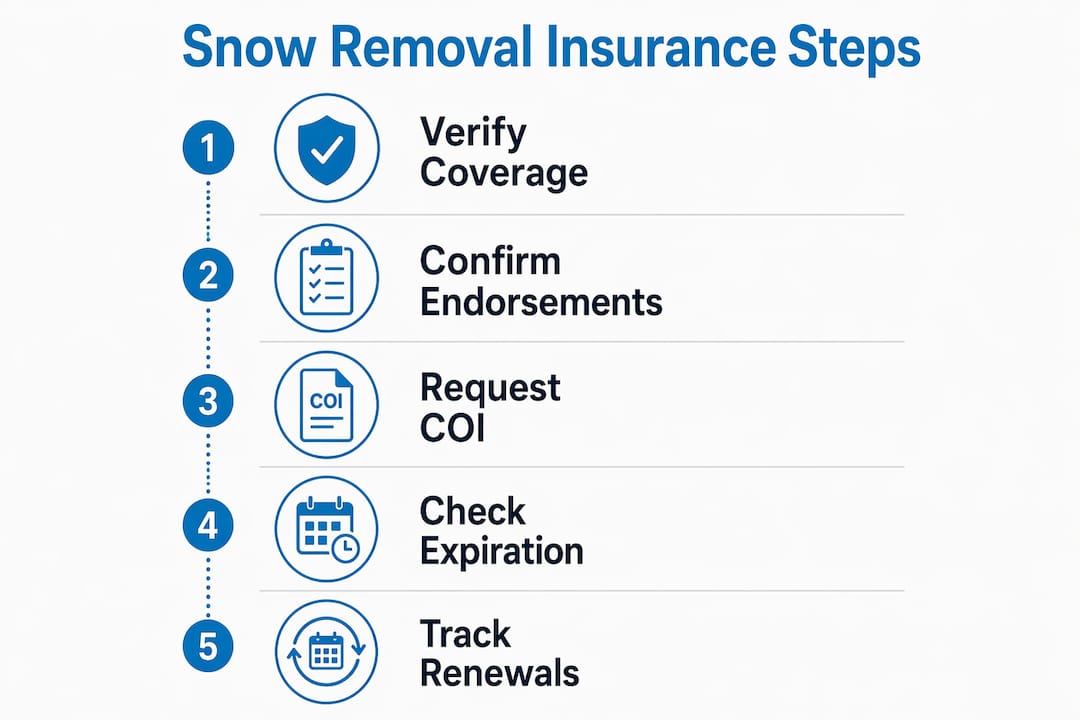
Coverage lapses are a real risk mid-season. Build a simple tracking system: store each contractor’s COI with its expiration date, set a calendar alert 30 days before renewal, and require a fresh COI before the new policy period begins. A COI renewal tracking process eliminates most administrative gaps. Keep copies of all COIs, endorsement pages, and incident reports for at least three years — Colorado’s statute of limitations for personal injury claims is generally three years.
Denversnowremovals: insured, documented, and ready for Denver winters
Property managers who need a contractor that checks every box on the list above have a direct option in Denver. Denversnowremovals has served commercial, HOA, and residential properties across the Denver Metro area for over 44 years, with 24/7 emergency response and crews equipped for parking lots, sidewalks, and multi-entrance properties.
When you call, ask for a sample COI showing the snow/ice endorsement, additional insured language, and primary/noncontributory wording. Denversnowremovals can walk you through how subcontractors are handled and confirm commercial auto coverage on every piece of equipment. Request a free estimate or a site review at denversnowremovals.com and get the documentation your contract requires before the first storm hits.
FAQ
What is the CG 2292 endorsement and why does it matter?
The CG 2292 is a named endorsement that adds snow and ice removal operations to a commercial general liability policy. Without it, a standard CGL may exclude slip-and-fall claims tied to winter services entirely.
What insurance limits should I require from a Denver snow contractor?
Require at least a million-dollar-level per occurrence general liability with a snow/ice endorsement, commercial auto coverage in the mid six figures to low seven figures combined single limit, workers’ compensation, and an umbrella policy providing additional coverage as required for commercial properties.
Is a Certificate of Insurance enough to verify coverage?
No. A COI is a summary document and can be outdated or incomplete. Confirm endorsements and additional insured status directly with the insurer, especially when the COI shows “refer to policy” for key items.
Does Denver law require snow removal contractors to carry insurance?
Denver does not set a statutory minimum for private contractor coverage, but the city’s sidewalk ordinance places clearing responsibility on property owners, making contractor insurance clauses in your contract the primary protection tool.
What happens if a contractor’s subcontractor causes an injury?
The prime contractor is commonly held responsible for underinsured subcontractors. Require that each sub carry their own GL and hired/non-owned auto coverage, or confirm the prime contractor’s policy explicitly covers subcontractor actions.
Key Takeaways
Requiring a snow/ice endorsement (CG 2292 or equivalent), additional insured status, and primary/noncontributory language in every snow removal contract is the most direct way to transfer slip-and-fall liability away from your property.
| Point | Details |
|---|---|
| Snow/ice endorsement required | Standard CGL policies often exclude snow operations; demand CG 2292 or equivalent on every COI. |
| Minimum limits for Denver | Require $1M–$2M per occurrence GL and umbrella coverage reaching $3M–$5M for commercial sites. |
| COI is not enough alone | Call the insurer to confirm endorsements and additional insured status when the COI says “refer to policy.” |
| Track renewals actively | Set 30-day expiration alerts and require a fresh COI before each new policy period to avoid mid-season gaps. |
| Denversnowremovals | Provides COIs showing snow/ice endorsements and required contract clauses, with 24/7 service across the Denver Metro area. |
Recommended
- Document Snow Removal for Liability Protection – Snow Removal Denver 303-591-2089
- Seasonal Snow Preparation Step for Homeowner Denver Colorado
- Common Area Snow Removal: What Property Managers Must Know – Snow Removal Denver 303-591-2089
- How Shared Driveways Get Cleared Safely in Winter – Snow Removal Denver 303-591-2089